Looking into the theory of non-condensing boilers i found out that its important to have a fairly high return temperature to reduce the chance of corrosive condensation.
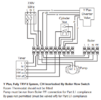
The system in the house we bought has 11 rads. Its is 22mm for about a meter then splits to 15mm. One branch goes to a single radiator in a room above and the other branch does all the other rads in the house. I thought that was mental but now I'm wondering if it was deliberate as what it does it raise the temp of the return pretty much as soon as the heating starts. If it wasn't like that it would be cool much longer. The rest of the house never gets hot but it is sufficient.
The boiler is over 20 years old and has zero corrosion inside. Could this design choice be why?
I was going to change it but now I'm thinking leave that as it is but add an always on towel rail in the bathroom we're making next to it. So its still a short loop and in effect a bypass valve. The system doesn't have a bypass valve at the moment but I expect the TRVs in the distant rads never close so it probably doesn't really need one. But having one on a short loop will allow the single rad to be closed while still having the warm return. That said even if the TRV on the single rad does close, by that time warm water will be returning from the main loop...
One thing I could improve on is making it 22mm until the main loop splits to the 2 floors. The short loop can come off that instead of it splitting to 2x 15mm. I guess that would reduce some flow through the short loop but hopefully not enough to negate the benefit
Is this sounding familiar to an installer of non-condensing boilers?
The system in the house we bought has 11 rads. Its is 22mm for about a meter then splits to 15mm. One branch goes to a single radiator in a room above and the other branch does all the other rads in the house. I thought that was mental but now I'm wondering if it was deliberate as what it does it raise the temp of the return pretty much as soon as the heating starts. If it wasn't like that it would be cool much longer. The rest of the house never gets hot but it is sufficient.
The boiler is over 20 years old and has zero corrosion inside. Could this design choice be why?
I was going to change it but now I'm thinking leave that as it is but add an always on towel rail in the bathroom we're making next to it. So its still a short loop and in effect a bypass valve. The system doesn't have a bypass valve at the moment but I expect the TRVs in the distant rads never close so it probably doesn't really need one. But having one on a short loop will allow the single rad to be closed while still having the warm return. That said even if the TRV on the single rad does close, by that time warm water will be returning from the main loop...
One thing I could improve on is making it 22mm until the main loop splits to the 2 floors. The short loop can come off that instead of it splitting to 2x 15mm. I guess that would reduce some flow through the short loop but hopefully not enough to negate the benefit
Is this sounding familiar to an installer of non-condensing boilers?