• Looking for a smarter way to manage your heating this winter? We’ve been testing the new Aqara Radiator Thermostat W600 to see how quiet, accurate and easy it is to use around the home. Click here read our review.

Can I add an EV charger for a PHEV to this CU

Joined
20 Feb 2020
Messages
384
Reaction score
12
Country
United Kingdom
Hi,

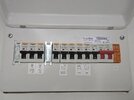
I don't plan on getting a full EV, but do have plans to get a PHEV with a 33kwh battery, which using a 7kw charger would be enough to have the battery charged overnight everyday. I won't be fitting it myself but wanted to check if it was feasible to add a dedicated circuit to power a 7kw ev charger. I would like to have the cable routed through uninsulated cavity between by ground floor ceiling and first floor boards.

Thanks in advance.
 

Attachments

  • 20250531_125345.jpg
    20250531_125345.jpg
    161.6 KB · Views: 92
Yes, will need a suitable RCBO installing into one of the empty spaces.

However if you go to the usual bandwagon box slinger types, they will probably insist on installing an entire new consumer unit just for the charging.

a PHEV with a 33kwh battery,
No one needs that.
Either go 100% petrol or 100% electric.
PHEVs are the worst of both bundled together in a package of failure which will lead to regret.
 
Yes, will need a suitable RCBO installing into one of the empty spaces.

However if you go to the usual bandwagon box slinger types, they will probably insist on installing an entire new consumer unit just for the charging.


No one needs that.
Either go 100% petrol or 100% electric.
PHEVs are the worst of both bundled together in a package of failure which will lead to regret.
Thank you for the advice. Im not sure i follow the usual bandwagon comment? Also why is a PHEV a bad idea? Most of my driving is 20-30 miles and I don't want an EV for the longer runs.
 
FWIW there are very few EVs for which this not the case.
Yes, that's very true. Given my next car is a 4 year lease, I'm happy to go down an intermediate route by having a 7kw charger running off my CU and in the future when I have my driveway done, bury a cable that can we used for a future high powered charger in case I go down the full EV route. As im renovating now, I have rhe option to run an internal cable to power a wall charger for the PHEV
 
usual bandwagon comment?
Companies that exist solely to sling in EV charging, and did not exist before EV charging weas a thing.
They will disappear just as quickly leaving others to fix the mess they made.

Also why is a PHEV a bad idea? Most of my driving is 20-30 miles
Most of the time you will be lugging around an engine, transmission and fuel tank full of fuel that you don't need.
They are also vastly more complex that either a petrol vehicle or an EV and when they go wrong, they go wrong in very expensive and unfixable ways.
PHEVs and other hybrids exist so that vehicle manufacturers can continue to sell engines for a bit longer. There are no other reasons.

and I don't want an EV for the longer runs.
To enjoy the high costs of fuel, massive pollution and thunderous noise of an engine banging away while you drive along a motorway?

I'm happy to go down an intermediate route by having a 7kw charger running off my CU and in the future when I have my driveway done, bury a cable that can we used for a future high powered charger
EV charging at home is 7kW. The very same thing that PHEVs charge with.
There are no 'high powered chargers' that can be installed at a domestic property and no one would need such a thing anyway.
7kW for an EV will add around 25 miles of charge per hour.
Charge for 8 hours overnight and it's added 200+ miles, more than most people do in a week, never mind in a day.
 
To enjoy the high costs of fuel, massive pollution and thunderous noise of an engine banging away while you drive along a motorway?

1748702955753.png


EV charging at home is 7kW. The very same thing that PHEVs charge with.
There are no 'high powered chargers' that can be installed at a domestic property
Why is that?

You can get electric showers which are considerably more powerful than 7kW, so why not chargers?

and no one would need such a thing anyway.
Families with more than 1 EV might.

A 10.8kW one would add around 38 miles per hour, and could mean it was realistic for EV A to be put on charge when the driver arrived home, and EV B just before going to bed.
 
You can get electric showers which are considerably more powerful than 7kW, so why not chargers?
Electric showers are not turned on for hours at a time. Electric showers should also be banned, but that is another discussion entirely.

If you want to go above 7kW for AC charging, 2 or 3 phase is required with most UK homes do not have and most vehicles do not support.
Charge rate is determined by the vehicle, as the AC-DC conversion and actual 'charger' is part of the car. The box on the wall just turns on 230V AC when required, or 400V for the 3 phase versions.

Families with more than 1 EV might.
They do not, because approximately no one drives the full range that an EV can do every day.
Those that claim to do so would be driving 80k+ miles every year, and in the case of those who have 2 cars, that's 80k+ miles per year in each car.
Also see 600 mile journeys without stopping and other made up stories.

Even in the desperately unlikely scenario where there are 2 cars and they need charging at the same time at home, two 3.5kW outlets could charge 2 vehicles simultaneously and still add 150+ miles to each vehicle over 12 hours, such as plug in at 7pm and finish at 7am.
Cars can be charged in the daytime as well, it's not compulsory or even desirable in some cases to charge overnight. Neither is it necessary or desirable to run vehicles down to nothing before recharging, or to charge to 100% all of the time.
 
Electric showers are not turned on for hours at a time. Electric showers should also be banned, but that is another discussion entirely.
You keep telling us this crap but I've never seen any sort of convincing explanation from you
 
Yes, that's very true. Given my next car is a 4 year lease, I'm happy to go down an intermediate route by having a 7kw charger running off my CU and in the future when I have my driveway done, bury a cable that can we used for a future high powered charger in case I go down the full EV route. As im renovating now, I have rhe option to run an internal cable to power a wall charger for the PHEV
Most of our EV charging is done at home using our Ohme Home Pro via a smart meter and a supply from Octopus. We pay 7p per kWh.

Our best price away from home is Instavolt at 50p per kWh.
 
Electric showers are not turned on for hours at a time.
So what?


If you want to go above 7kW for AC charging, 2 or 3 phase is required with most UK homes do not have
I know.

My observation was basically that 7kW is not the threshold above which you have to go to 3 phase. I used to have a 10.8kW electric shower, it wasn't 3 phase.


and most vehicles do not support.
Charge rate is determined by the vehicle, as the AC-DC conversion and actual 'charger' is part of the car. The box on the wall just turns on 230V AC when required, or 400V for the 3 phase versions.
Which came first? EV makers deciding not to make products which could take more than 7kW, or charging socket makers deciding to not make higher capacity sockets?

Do EV makers produce special versions of their cars for the UK market, as in other countries higher charging rates are supported, and generally people who make anything prefer to have one variant rather than multiple.

IEC 61851-1 Mode 3 allows 63A single phase.


They do not, because approximately no one drives the full range that an EV can do every day.
They may indeed prefer to unplug one car and plug in another according to what's most convenient for them, rather that at some inconvenient time dictated by when vehicle 1 has charged enough at 7kW.


Even in the desperately unlikely scenario where there are 2 cars and they need charging at the same time at home, two 3.5kW outlets could charge 2 vehicles simultaneously
So people have multiple chargepoints on their house? Lovely.
 
So people have multiple chargepoints on their house?
You mean like they have more than one 13A socket, or more than one lightbulb?

Seems like a not-unreasonable idea if I'm honest..

Note, they did say 3.5, which left me with the impression it's more like a portable charger with a 16A blue plug, not a "ChargePoint on the house"

some inconvenient time dictated by when vehicle 1 has charged enough at 7kW.
I think one of the problems is in taking "petrol mode" thinking(drive til empty over a number of days then completely refill in a few minutes) and levelling it as a criticism/downside of EVs that the battery can't be recharged fast enough to enable petrol mode behaviour. It's the behaviour that needs to change if the physics cant

Visiting a petrol station is a pain in the arse. Having a (relatively slow) supply of petrol to my home, and even a way to sell it back to the supplier when demand (and price) is high, and/or a system where I can buy it cheap automatically and cease purchasing it when the price rises.. That would be amazing

Oh wait.. That's me applying "electric mode" thinking to petrol. Silly me, what I should do is race the correct horse on the correct course and not expect fundamentally different physics to bend to my will

Turns out all the driving I ever need to do could be covered by a 13A granny charger, if I just get into the habit of plugging the car in whenever it's parked at home.

I accept that may not be true for others' car use pattern as it stands today, but (talking about those people now) being honest - what reasonable accommodations to their life would they need to make?
(And "no, I'm completely inflexible, I am the immovable object that the irresistible force of the universe must meet and bow down to; I only ever holiday in my caravan in the south of France, that I drive to monthly in one sitting and cannot stop off for fuel for longer than 10 minutes" isn't answer in this thought exercise, sorry. For those use cases where where they feel they have to have fossil fuels, how could they change their lives to get over the hump?)

 
Last edited:
You keep telling us this crap but I've never seen any sort of convincing explanation from you
They apply a massive peaking load to the supply
They are entirely incompatible with solar, hot water storage, battery systems and TOU tariffs,
Impossible to have more than one in a property without non-trivial supply upgrades or switching malarkey to ensure only one can be used at a time.

Combination boilers belong in the same bin.
Heating water instantaneously on demand is a failed concept.
 

If you need to find a tradesperson to get your job done, please try our local search below, or if you are doing it yourself you can find suppliers local to you.

Select the supplier or trade you require, enter your location to begin your search.


Are you a trade or supplier? You can create your listing free at DIYnot Local

 
Back
Top