
You are using an out of date browser. It may not display this or other websites correctly.
You should upgrade or use an alternative browser.
You should upgrade or use an alternative browser.
Osram 44870 downlight replacement
- Thread starter prophet
- Start date

- Joined
- 27 Jan 2008
- Messages
- 29,346
- Reaction score
- 3,608
- Location
- Llanfair Caereinion, Nr Welshpool
- Country

It is down to the transformer which supplies it, wire wound and straight swap for LED, electronic need to read what it says on the transformer, 20-100 VA for example means the lamps must exceed 20 watt, and no exceed 100 watt, but some are like this one,
 and have no minium rating. But this one
 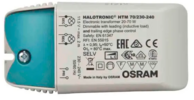 says
says
 20-70 watt, so would only work with a 70 watt load.
says 
- Joined
- 31 May 2016
- Messages
- 30
- Reaction score
- 0
- Country
Thanks for the response.
Though I'm capable with most DIY disciplines, when it comes to electrics I'ma dunce.
So, up in the loft there'll be a transformer connected to each unit so I need to check their specifcation to ensure compatibility with proposed swap-out units like this.

Though I'm capable with most DIY disciplines, when it comes to electrics I'ma dunce.
So, up in the loft there'll be a transformer connected to each unit so I need to check their specifcation to ensure compatibility with proposed swap-out units like this.
- Joined
- 27 Jan 2008
- Messages
- 29,346
- Reaction score
- 3,608
- Location
- Llanfair Caereinion, Nr Welshpool
- Country
I have moved from G5.3 to GU10 I am as an electrician confused by the bulb you show, it says bulb base MR16, we MR16 stands for multifaceted reflector 16/8th of an inch across, but G5.3 and GU10 can be MR16 so could a SES bulb, well maybe not today, as we don't have reflectors in many bulbs, so MR16 equivalent is more correct.
You normally find a G5.3 is 12 volts, but there are 120 volts versions, likely also 230 volts. And GU10 are normally 230 volts, but again they don't need to be that voltage. So the advert should state the voltage, also AC or DC, seems very poor not to state.
With 230 volts you can get smart bulbs, so I tend to move to 230 volt GU10, but it needs an earth at the bulb, which is why many stick with 12 volts.
So we need to consider the room's lighting as it is, how if any way it can be improved, what it will cost, and what to do when. LED lighting is causing many problems, as it is not a direct replacement for tungsten, typical LED lamp,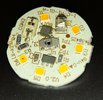 looks like this inside, and it does not matter if it looks like a spotlight or candle outside, so want to ensure the light is reflected off light coloured services to get the spread. There are exceptions, but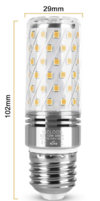
 most are rather simple, so before paying out a fortune on bulbs, you need to decide what you want. The directional lamp
 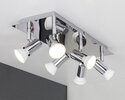 allows one to aim light to dark corners, but the down light
 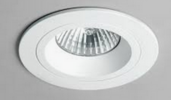 typically aims the light at a dark floor where it is absorbed, so a
 bit no more like a lot, useless for lighting, but in the days of the tungsten lamps did at least warm the room.
But down to looks, or practical, my wife's Jag looks good, my Honda Jazz is far more practical, and the same goes with lighting. So add
 to the price of the bulb, and £15.39 per bulb change is getting expensive, so now is the time to change if you want to.
You normally find a G5.3 is 12 volts, but there are 120 volts versions, likely also 230 volts. And GU10 are normally 230 volts, but again they don't need to be that voltage. So the advert should state the voltage, also AC or DC, seems very poor not to state.
With 230 volts you can get smart bulbs, so I tend to move to 230 volt GU10, but it needs an earth at the bulb, which is why many stick with 12 volts.
So we need to consider the room's lighting as it is, how if any way it can be improved, what it will cost, and what to do when. LED lighting is causing many problems, as it is not a direct replacement for tungsten, typical LED lamp,
looks like this inside, and it does not matter if it looks like a spotlight or candle outside, so want to ensure the light is reflected off light coloured services to get the spread. There are exceptions, but allows one to aim light to dark corners, but the down light typically aims the light at a dark floor where it is absorbed, so a But down to looks, or practical, my wife's Jag looks good, my Honda Jazz is far more practical, and the same goes with lighting. So add
My advice would be to replace the downlights , with customer changeable GU10 bulbs. Faffing around with transformers, LV cables and bulbs is so last century
That Osram lamp number is 12 Volt (ac or dc) 50 Watts, 680 lumen 'warm white' 2700K approx. 36 degree beam angle. Pretty sure they had a glass front to the lamp - which may or may not matter with a LED, all depending on how the lamp is retained in the fitting.
The LED you suggest is a tad dimmer (500lumen) and a tad whiter (3000K) with no mention of flood/spot beam angle (but google says they are available in 60 degree and 38 degree form. So that may need clarifying to match better?
Suck it and see with a few?
Biggest issue may be if the 5W leds on the transformer(s) presents too low a load resulting in flicker or some similar issue. Then a transformer swap to led driver will be needed.
{I had to do that with a bathroom mirror light using capsule lamps, but some 'plant uplight' capsules' transformer is perfectly happy with the low load cf halogens.}
Good luck and look forward to the saving of energy
The LED you suggest is a tad dimmer (500lumen) and a tad whiter (3000K) with no mention of flood/spot beam angle (but google says they are available in 60 degree and 38 degree form. So that may need clarifying to match better?
Suck it and see with a few?
Biggest issue may be if the 5W leds on the transformer(s) presents too low a load resulting in flicker or some similar issue. Then a transformer swap to led driver will be needed.
{I had to do that with a bathroom mirror light using capsule lamps, but some 'plant uplight' capsules' transformer is perfectly happy with the low load cf halogens.}
Good luck and look forward to the saving of energy
Problem with the above is you are putting off the inevitable
Serious question, what's inevitable?
Updating the lamps & transformers etc


Those halogen bulbs were withdrawn from sale 4 years ago. In an attempt to move people to energy efficient lamps.
To use the “MR16” led lamps you will need to change the existing transformers to compatible LED drivers. That’s expensive, compared to ditching the lot and switching to mains powered LED downlights (GU10).
If may be possible to buy a bunch of GU10 bulb bases, or replacement GU10 downlights.
To use the “MR16” led lamps you will need to change the existing transformers to compatible LED drivers. That’s expensive, compared to ditching the lot and switching to mains powered LED downlights (GU10).
If may be possible to buy a bunch of GU10 bulb bases, or replacement GU10 downlights.
- Joined
- 31 May 2016
- Messages
- 30
- Reaction score
- 0
- Country
Appreciate all the input folks. It's been very educational.
For the time being we'll take the easiest option and order the straight replacement bulbs. However, we'll look to get quotations for
Many thanks.
For the time being we'll take the easiest option and order the straight replacement bulbs. However, we'll look to get quotations for
...ditching the lot and switching to mains powered LED downlights (GU10).
Many thanks.

DIYnot Local
Staff member
If you need to find a tradesperson to get your job done, please try our local search below, or if you are doing it yourself you can find suppliers local to you.
Select the supplier or trade you require, enter your location to begin your search.
Please select a service and enter a location to continue...
Are you a trade or supplier? You can create your listing free at DIYnot Local


