
• Looking for a smarter way to manage your heating this winter? We’ve been testing the new Aqara Radiator Thermostat W600 to see how quiet, accurate and easy it is to use around the home. Click here read our review.

Do I need to change the tyres

These tyre inflator attachments rely on a good contact with the valve, courtesy of the rubber seal in the attachment. This part does degrade fairly quickly!
I prefer the push on inflator but still use a digital gauge that is replaced frequently.
John :)
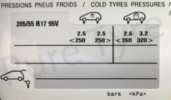
 
Tyre pressures, are dependent on load on the tyre, manufacturers list pressures in the handbook, for differing loads, and types of roads you will be driving upon.....

I am never sure how to interpret Citroen's loading pressure.
1752876207770.png

Normal loading is fine, but I find their "full load" hard to interpret.

Ford often stipulate 3+ and luggage etc.

But I'm never sure if this implies being closer to the max carrying weight of the car, rather then "3+ in the back and luggage" as that rear pressure is 46 psi, which is crazy high.
 
For setting pressures, it's worth getting a hand pressure gauge with a pressure relief button. For example, Draper do one which is currently £11 online.

Overinflate the tyre slightly, remove the inflator tube (when a bit of air will often escape) and put the gauge tube on. Then use the button to reduce pressure to your chosen setting.

------------
As others have said....

Your first consideration on tyres should not be the MOT. The tyres are the only thing in contact with the road. They are the main determinant of whether you make it around a corner or can stop when, for example, a child runs out in the road. Tyres at the MOT limit are already performing well below their best (you should target replacing when they are no less than double the legal limit of 1.6mm ideally).

A tread depth gauge is cheap and easy to use. But you can also get a quick idea using a coin. Put the coin in the tread and rest your thumbnail on the tyre surface next to the coin. Keep it there while you remove so you can see the depth. A tuppence is good and the dots around the edge are at about 1mm (just below MOT legal depth). If you have double or more, you're probably OK on tread depth. Check outside, middle and inside of tread to see if wear is reasonably even. If you do this more than just when the tyres are wearing out, you may catch something like incorrect pressure or an alignment issue early, thereby saving you from having to replace the tyres before their normal life span.

In case you're wondering why, that's because the sipes (grooves) in the tyre channel and disperse water (they also do other stuff). If they are not as deep, then they can carry less water before they're full. When they're full, you're close to hydroplaning. I have experienced one hydroplaning moment briefly on a motorway - I don't recommend it.

Cracks in a tyre are because the rubber has already degraded (rubbery rubber doesn't crack, it deforms and stretches and returns to shape - which is what tyres need to do).

So, it really comes down to whether you like living and not being seriously injured/disabled and/or care about anyone who is ever a passenger with you or anyone else you may encounter on the road. You will have to buy tyres some time. Buying them a little earlier does not cost that much more overall. You may even save if you can shop around and look out for deals which exist from time to time, have time to order online etc rather than being under pressure and going to the nearest place due to a looming MOT or an MOT failure.
 
Last edited:
Agreed, it's really important not to ignore tyre issues.

A relative bought a used car. I reminded them to check the tyres before purchase but, in their excitement, they forgot.

The car was 16 years old, and still had two tyres on it that were original to the car. The youngest pair were still over 10 years old. All had cracking.

I pretty much banned them from using the car until they were replaced.
 
I am never sure how to interpret Citroen's loading pressure.
View attachment 387430

Normal loading is fine, but I find their "full load" hard to interpret.

Ford often stipulate 3+ and luggage etc.

But I'm never sure if this implies being closer to the max carrying weight of the car, rather then "3+ in the back and luggage" as that rear pressure is 46 psi, which is crazy high.
The "full load" figures are really just that. They're the recommended pressure for that tyre size, when the car is laden as heavy as it is legally allowed to be. They don't change as much on the front, because there's limited scope for changing the weight on the front tyres by loading the vehicle up. Most of the weight goes on the back tyres as you add people and luggage.
 
Iirc, my ev6 is 36 all round, going up to 40 all round when fully loaded.

That's an interesting thing with EVs, of course. As they're heavier, the percentage weight change between laden and unladen is generally less than with an ICE car.
 
Agreed, it's really important not to ignore tyre issues.

A relative bought a used car. I reminded them to check the tyres before purchase but, in their excitement, they forgot.

The car was 16 years old, and still had two tyres on it that were original to the car. The youngest pair were still over 10 years old. All had cracking.

I pretty much banned them from using the car until they were replaced.

Gosh! I dream of tyres lasting me ONE year!
 
Gosh! I dream of tyres lasting me ONE year!
How many miles do you do in a year?

I think that car with 16 year old tyres on had done 30k, and there was still deep tread on the tyres :LOL:

There are some tyre brands that have compounds that last longer. Also while a lot of tyres start with 6mm tread, you can get ones that start with 8mm. Might be worth it if you go through tyres quickly.
 
How many miles do you do in a year?

I think that car with 16 year old tyres on had done 30k, and there was still deep tread on the tyres :LOL:

There are some tyre brands that have compounds that last longer. Also while a lot of tyres start with 6mm tread, you can get ones that start with 8mm. Might be worth it if you go through tyres quickly.

To be fair, I do 20-25,000 miles a year, and tend not to spare the horses! Plus, of course...

...it's an EV... ;)

I'd say I got through more tyres than oil filters each year, but of course, EVs tend not to have oil filters and I'm not Nutjob... :giggle:
 
How many miles do you do in a year?

I think that car with 16 year old tyres on had done 30k, and there was still deep tread on the tyres :LOL:

There are some tyre brands that have compounds that last longer. Also while a lot of tyres start with 6mm tread, you can get ones that start with 8mm. Might be worth it if you go through tyres quickly.

I find Michelins give the best mileage, though they cost more.

Not worth it if your tyres will be cracked and perished before they're worn out.
 
Back
Top