• Looking for a smarter way to manage your heating this winter? We’ve been testing the new Aqara Radiator Thermostat W600 to see how quiet, accurate and easy it is to use around the home. Click here read our review.

Can I combine sensor with switch to turn on lights?

Joined
7 Apr 2023
Messages
148
Reaction score
6
Country
United Kingdom
Across 3 floors there are 5 ceiling lights covering the landing and stairs, no natural light.

Currently, the wall light switches turn on all 5 lights and switch off after a minute or 2.

If I correctly wire in a PIR/microwave sensor to any particular light fitting so that a particular ceiling light switches on at detection, can that work in combination to the existing manual wall switch lighting?

Screenshot 2025-07-19 at 09.07.16.png
 
It will not be straightforward to have the sensors activate single lights while the switches activate all five.
 
Simple answer is yes, but not too sure, what would be the best approach. With smart switches, one can combine PIR's and wall switches, but trying to read the instructions to find out which product will do what is not so easy, as many of the features and not shown with the literature.

I am sure I could write a PLC program to do what you say, but PLCs are not cheap, and I looked at my own house, and I have a couple of PLCs in stock, and thought if I become ill, who could do any repairs? Well, my son could, but it would be better to use stuff designed for domestic use.

1752919517431.png
1752919546407.png
1752919594180.png
1752919656712.png
The problem is, the price starts to add up, and until you buy and install, one is still not quite sure will it do what you want? I used all but the motion sensor to allow my wife to turn lights on/off from her temporary bed in the dinning room, and found she used the Google Nest Mini speaker instead of the button,
1752920017822.png
and the button was reprogrammed to work as a doorbell instead. Our landing light is turned on/off with voice commands, likely not the best idea, but it works.
 
I'm not an electrician but ... in my view ...

The sensor light needs power to it continually, whereas a conventional light only gets power to it when it's switched on. Thus I can't see how this would work, because if you could switch off all the lights at the manual switch, the sensor lights would no longer have power, and therefore would not be able to sense anything to come on.
 
I suspect to achieve what you want you’ll need to run additional cables / replace cables

Why do you want to do this ?

What type of light bulbs do you have ?
 
The sensor light needs power to it continually,
The sensor does; the light does not - and indeed must not.
A 'sensor light' is not 'a thing' but a light and a sensor.

whereas a conventional light only gets power to it when it's switched on.
So does the light in the 'sensor light'.

Thus I can't see how this would work, because if you could switch off all the lights at the manual switch, the sensor lights would no longer have power, and therefore would not be able to sense anything to come on.
Another wire?
 
I am guessing here but ... I would imagine most sensor lights have a single power supply, which continually powers the sensor, and the internal electronics would switch the power supply to turn on the light when the sensor sensed something. Is that not the case?
 
I would imagine most sensor lights have a single power supply, which continually powers the sensor,
If that's all you connect - then yes.

and the internal electronics would switch the power supply to turn on the light when the sensor sensed something. Is that not the case?
It is - but that does not prevent you supplying the light with another power supply.

N.B. more modern 'sensor lights' might have concealed wiring which might be difficult to access and alter.
 
Now that I know more about the situation and the limitations of your electrical abilities and the rental status.

My advice now has changed to "Let your Electrical contractor design, install and certify the solution"
 
Last edited:
trying to switch just one light would require:
1. a sensor with a changeover contact (AKA 2 way),

My experience of such sensors is they tend to not have a changeover contact

In other words, not possible with parts that you can actually buy.
 
There are a few variations depending upon what you want to achieve. The easiest way without additional wiring is to use the existing switch that turns on all lights as the "main power switch" and in normal operation is left permanently ON.
Then wire in each individual assembly to its own sensor controlling just that one particular item (which might be one lamp or a cluster of lamps on the same housing).
With some sensors you could have a number of sensors controlling one such lighting unit, however you need to check that all of those sensors are capable of doing that or they will latch ON permanently because of back-feed (a mains supply at the sensor output leaks thru to the input keeping it switched on basically).

One easy way is to check with the manufacturer.

Usually if you test it and you hear a little click when it detects then it is probably relay operated and will work OK but if no click then it might be electronic switching (Thyristors/transistors and the like) and it might be the type that will not do this.
Alternatively you could add a little relay to the output of each sensor but you would need somewhere to safely house it.

One other way is to wire two up in parallel with one light (both have a Lin at the input that switches to Lout at the output so you L supply goes to both Lin and both Lout goes to the lamp.
Turn them to detect different areas then trigger one detector deliberately and see if it retriggers after the time set or if it triggers using the other detector.
Though this means you need two detectors to experiment with and unless you already have them you would need to buy them or borrow them.

I used to do this trick sometimes with outdoor PIR switches.
Say a couple of PIR floodlights lighting different adjacent areas and two PIR switches detecting two different areas and a linkwire between the two switches.
If the linkwire is actually a simple lightswitch it would allow you to set each floodlight with its own associated detection area and once you had adjusted as required you could throw that switch to the ON position so that either sensor detects and both floods light up.
It did have its benefits sometimes.
You also need to ensure that the sensors were all rated for the maximum possible load of the group they were controlling.

The maximum number in any group I used to do was three sensors usually (I actually did one with 5 sensors and 5 lights and used a six gang switch as the link - 3 PIRs and mini floods on one set and two on the other and all unit could be set independently for testing purposes then the group of three using switches 1, 2 & 3 and the group of two using switches 4 & 5 and the switch 6 would then link both groups together.
Nowadays there are far better electronics/Wifi/Bluetooth solutions that often make things easier.
 
Last edited:
The sensor does; the light does not - and indeed must not.
A 'sensor light' is not 'a thing' but a light and a sensor.
But the sensor can be built into the bulb, so I would say calling that a sensor light is reasonable.

However, most of the replies are considering hard-wiring only, and it is possible the distance and walls within the property will only allow hard-wiring, but also we have many wireless devices today, and likely there is a wireless option, and a relayed option.

My landing light is powered from a relay, the relay is hard-wired to the original two-way switches, but is also wireless, and the switches change the state of the relay, does not matter if switched on, or switched off, it detects change of state, so one can integrate wireless and wired together, what I am not sure about is the timed off, although I also see a health and safety problem with a timed off, in a stair well with no natural light.

This is the reason I got rid of my PIR controlled outside lights, being on a set of steps with your hands full of shopping when the lights go off, is not funny, hand full so no waving at sensors, and neither can one put the shopping down, as don't know what one is putting it down on, and until you put it down, can't get phone out of pocket to use its built in torch. So now I use the phone to turn the lights on before I leave the car, and once in house, voice command to turn them off again.
Sensors containing a changeover relay do exist but one has to look for them and potentially not the prettier models. One can add a relay but then more bulk and fiddling.
The major problem with so-called smart devices, is working out what they will do before buying.

Also making sure the batteries are charged, my google "Home" app will work all my smart lights, does not matter what make, but the dedicated app there is so indication of battery state. 1752934835567.png Only when using the app for that make, can I see if the batteries are OK. And I have no idea when using timers, if that timer is in the device, the hub, or part of Nest Mini system, I know I can say "hey google turn off bedroom lights in half an hour" and it does, but no idea where that timer is.
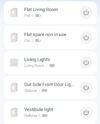
There is also the power up state. In the main, a bulb will turn on when power is restored after a power cut, but tried to get an outside light to do that last night, and it failed. The wall switched seem to be reverse, lose power, and on return they stay off. Some will not change state in a power cut, I use light switches with batteries because they do not change state with a power cut.

It may be better to say what the problem is, as there may be another option. Top of my stairs, I had a rechargeable torch, which has built in PIR, and auto lights with a power cut, so should my smart lighting fail, I can still see to go down the stairs.

 
It may be better to say what the problem is, as there may be another option.
I agree.


I suspect (from experience) it's something like OP is switching on at the bottom and finding the light goes off when they are halfway up the 3rd flight of stairs.
If that is it then operating another switch on the way up is a possible fix... however if it is a single master timer module with multiple slave buttons then subsequent operations are potentially ignored depending on the model/type.
 

If you need to find a tradesperson to get your job done, please try our local search below, or if you are doing it yourself you can find suppliers local to you.

Select the supplier or trade you require, enter your location to begin your search.


Are you a trade or supplier? You can create your listing free at DIYnot Local

 
Back
Top