• Looking for a smarter way to manage your heating this winter? We’ve been testing the new Aqara Radiator Thermostat W600 to see how quiet, accurate and easy it is to use around the home. Click here read our review.

Dimmable leds bit dimming!

Sorry, did not know you had multi-bulbs. The total however does not quite add up to 60 watts, and one really wants 60 watts when dimmed.
Neither did I originally but my instant observation of the wiring photo realised the wiring error (which I doubt affects the dimming action) but your caltulation of 58.8W is so close to 60 I imagine the dimming error will be minimal if any.
My old kitchen had a 65 watt fluorescent lamp, latter a 24 watt LED tube replaced it, son now has the house, and now 14 GU10 down lights, at 4.2 watt each that's 58.8 watt, are we going backwards?
 
Neither did I originally but my instant observation of the wiring photo realised the wiring error (which I doubt affects the dimming action) but your caltulation of 58.8W is so close to 60 I imagine the dimming error will be minimal if any.
The switch needs power to work, there will be a small volt drop even when on full, to get that power, but unlike a tungsten bulb the LED bulb may not draw current linearly through the wave form, so 60 watt of tungsten is not the same as 60 watt of LED.

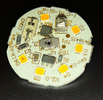
I did open one LED that used a capacitor as a current limiter, but most seem to have a chip of some sort, ⁣ bulb inner1.png I have no idea what is in that chip. I have had a problem with a shimmer, with lights staying on dim, flashing when switched off, and I gave up using switched that took power from the power going through the switch, my smart switched use 2 AAA batteries, and to dim I use smart dimmers.

OK. I see with 14 lights that is £70 to do them all, I have for my living room, used a mixture, some lights are on/off, so will dim.
 
The switch needs power to work, there will be a small volt drop even when on full, to get that power, but unlike a tungsten bulb the LED bulb may not draw current linearly through the wave form, so 60 watt of tungsten is not the same as 60 watt of LED.
I'm starting to get confused with comments so trawled Google again.
I thought I'd originally found the instruction sheet for the LAP DM400AP unit pictured and think I originally saw 60-400W for LEDs. Now don't seem to be able to find the LAP instructions.
I have the BG instructions with the same code which gives 5-100W of LED
1757522247283.png


but various vendors list as 5-50W
1757522351638.png

and max 40W
1757527789639.png


So, lost Sunray is... Has anyone found the instruction sheet for the OPs LAP DM400AP unit?
 
I also have a problem with "Dimmable" LED 1757574020061.png
1757574217650.png
what do they mean by dimmable, with what? This
1757574339259.png
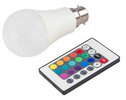
dimming switch is designed to work with Tapo smart bulbs, Lampandremote.jpgthis one comes with its own dimming controller, and we have leading and lagging, some smart bulbs display the sign 1757574020061.pngon the box, others don't, some need a hub others don't, I look for works with Google Home on the box. Even then, often you need to download some other app first and set it to work with Google Home.
In warmer countries, they went to CFL well before us. They did not want bulbs warming their homes, so we saw them use another method, they would split the lights into 1/3 and 2/3 and use two switches, so three levels of lighting, 1/3, 2/3, and full.

I used a duel smart relay, hindsight would have been better to have centre lamp unswitched and smart. Kitchen we use 4 x GU10 smart bulbs, plus under counter smart lighting.

From the start, wave form chopping dimming switches have been a problem. If the tungsten bulb failed with ionisation (flash as it failed) it would take out the dimmer switch, we do not fit semi-conductor fuses in our consumer units for lighting. The smart bulb has made it so easy, they do last a long time, and when they fail, so easy to replace. Been using then around the house now for around 5 years, I have had two fail. One within a few months of buying, the other lasted around 3 years in an outside light.

 
I'm starting to get confused with comments so trawled Google again.
I thought I'd originally found the instruction sheet for the LAP DM400AP unit pictured and think I originally saw 60-400W for LEDs. Now don't seem to be able to find the LAP instructions.
I have the BG instructions with the same code which gives 5-100W of LEDView attachment 392399

but various vendors list as 5-50WView attachment 392400
and max 40WView attachment 392410


So, lost Sunray is... Has anyone found the instruction sheet for the OPs LAP DM400AP unit?
Obvioualy ir should be pointed out that LAP should never actually be used, as it is complete an utter junk which is the homebrand of a joke shop.
 
Obvioualy ir should be pointed out that LAP should never actually be used, as it is complete an utter junk which is the homebrand of a joke shop.
Personally I have replaced far fewer LAP and BG products in my rental properties than MK and Crabtree. To put that into perspective one property I totally decorated and replaced all accessories with MK in order to have a 'quality property for rent' 25 years on there is not a single item of MK in there as I got fedup with shelling out the rediculous cost at failure, since going exclusively LAP/BG I've only had to replace the bathroom pull switch and I suspect that was due to the very heavy ceramic handle more suited to a flush handle that the tenant fitted.
 
I also use LAP, their grid system allows a socket, fuse holder, and switch on the same plate which is useful, I will admit to the position of the screws is not ideal, as one item stops you getting a screwdriver in to the other without removal, but I still use them.

However, not used their electronic devices.

With a single bulb, if you want less light, the only option is to dim it, with multi-bulbs, simply turn some off. There is no need for a dimming switch, and it has always been a problem, be it dimming switch or extra low voltage transformer, to get it so one bulb failing does not affect the other bulbs. Also, to work out the fault when it does not work, is it the bulb or the dimmer switch at fault.

I look at my desk lamp with a smart bulb in it, set to 10% to use it at night to see to go to the toilet, and realise with a dimming switch it would only have dimmed to 50% at best, i.e. half the wave form, so no question smart bulbs better than dimming switches.
 
I look at my desk lamp with a smart bulb in it, set to 10% to use it at night to see to go to the toilet, and realise with a dimming switch it would only have dimmed to 50% at best, i.e. half the wave form, so no question smart bulbs better than dimming switches.
Huh?
 
Are you meaning: to dim a smart bulb with a dimmer?
No, a smart bulb reports it will dim to 10%, I know the button I use as a doorbell push can be used as a dimming switch.
1757765037496.png
The S200D uses a button cell for power, but looks the same as any turn and push dimmer switch. But guess will only work with Tapo smart bulbs.

The mains powered dimming switch can be leading or lagging, but not both at the same time, the wave form
1757765350681.png
is cut either side of the peak, so with full dimming set, it is 50% dimmed same as putting a diode in the supply although in that case it would be top or bottom cut off. I could put an energy monitor socket in the supply, but not sure if they will 1) measure that low. 2) Give an accurate reading with that wave form.

But my desk lamp is very dim at reported 10% only just enough to see my way, which is what I want so not to wake others.
 
I'm not quite sure where you are with this.

My summary:
A filament bulb will dim from zero to 100% of brightness with a leading or trailing edge dimmer
A LED cannot dim to zero as a physical property of the way they work (although our eyes can be fooled into believing that they can)
 
Yes, but that is not zero power use, we can't see any light once the power goes below a threshold. Assuming by filament you mean tungsten, not an LED filament bulb.
Apologies yes I did mean an incandescent filament and not LED.
Yes I totally agree such a bulb will heat without any visible light radiation and theatre lighting is/was usually set to a minimum power so bulbs are warm/hot to reduce the thermal shock when turned on rapidly. In that respect the wasted few % at the bottom of the range is not much different between incandescent and LED
 

If you need to find a tradesperson to get your job done, please try our local search below, or if you are doing it yourself you can find suppliers local to you.

Select the supplier or trade you require, enter your location to begin your search.


Are you a trade or supplier? You can create your listing free at DIYnot Local

 
Back
Top