• Looking for a smarter way to manage your heating this winter? We’ve been testing the new Aqara Radiator Thermostat W600 to see how quiet, accurate and easy it is to use around the home. Click here read our review.

EV charger installation possible?

Well this seems to have kicked off quite the discussion!

The fuse in the meter box says '100A' on it.

However having rethought this, it may be better all round to see if it's possible to split the supply at the meter box (Henley block?) to a separate small CU for the charger alone. Practically this will be simple as the meter box is on the outside of the opposite wall of the garage to where the charger will be. Wouldn't be difficult to run a cable up and across the ceiling to reach the charger. Not as 'neat' as it would be nice to use the pre installed cable but maybe better all round.

I can't see any provision for CT clamps with the Easee One, and as mentioned, the one in my own house doesn't have any fitted but I guess if they are needed then it would be much easier to run them through to the meter box rather than find a way from the EV charger to the main house CU, which is through a few walls.

The CU below is the one that was fitted for my installation and (grabs popcorn) was fitted in the meter box. I believe that's now heavily frowned upon.

Thanks for your ongoing interest
Ted

1763204558385.png
 
One could consider some of the things the likes of Octopus does as unfair trading, I know my son bought his EV from Octopus and all was installed by Octopus, and his tariff is lower as a result. Even as an electrical engineer, it was not worthwhile, installing the EV charging point himself.
I can't find any reference to different tariffs based on who the installer is. As far as I'm aware the only EV tariffs they do are Go and Intelligent Go (Intelligent Drive Pack being currently unavailable for new customers), the difference being you can't be on intelligent go unless you have a compatible car and/or charger. Do you have any info on this?
 
I can't find any reference to different tariffs based on who the installer is.
That's because they don't exist.
Who installs equipment is unrelated to where electricity is purchased from and how much is paid.
People can change electricity supplier at any time and pick from a wide variety of tariffs.


I believe that's now heavily frowned upon.
Meter boxes are for supply and metering equipment only. It has never been permitted to shove other things in there.

Bandwagon companies and the sling it and wing it brigade couldn't care less, as they will be long gone when any complaints occur.
They shove things into the meter box because it's cheaper and faster than doing the job properly, which also means they can be cheaper than those who do the job properly.
 
That's because they don't exist.
Who installs equipment is unrelated to where electricity is purchased from and how much is paid.
People can change electricity supplier at any time and pick from a wide variety of tariffs.
They do as a deal, Octopus Go has at least three different off-peak tariffs, with no giving of control to Octopus 8.5p/kWh, giving them control of when vehicle is charged 7p/kWh, with the car and charging station installed by them 6p/kWh.

Yes you can change supplier, and tariffs, but some tariffs cost to leave, and some are not offered to all, and also as I found with British Gas they can drag their feet, giving you what they promise, 2 years ago their payment for export was advertised at a really good rate, but each time I phoned to get this rate, yet another excuse was given, in the end moved to Octopus, within 2 weeks I was being paid for export, they can advertise as much as they want, but I exported around 3 MWh without payment, that's a lot of money to lose.

The theory is as you write, but in practice there is a lot more to it.
 
Meter boxes are for supply and metering equipment only. It has never been permitted to shove other things in there.

Bandwagon companies and the sling it and wing it brigade couldn't care less, as they will be long gone when any complaints occur.
They shove things into the meter box because it's cheaper and faster than doing the job properly, which also means they can be cheaper than those who do the job properly.
That is also very true, I had to call the solar installers back to move what they had installed.
 
with the car and charging station installed by them 6p/kWh.
That is a 1p discount available where you lease a car from OctopusEV and also buy your electricity from Octopus Energy and have also signed up to their Intelligent Octopus Go tariff.

Who installed the charge equipment and what type it is has nothing to do with it.
 
Well this seems to have kicked off quite the discussion!

The fuse in the meter box says '100A' on it.

However having rethought this, it may be better all round to see if it's possible to split the supply at the meter box (Henley block?) to a separate small CU for the charger alone. Practically this will be simple as the meter box is on the outside of the opposite wall of the garage to where the charger will be. Wouldn't be difficult to run a cable up and across the ceiling to reach the charger. Not as 'neat' as it would be nice to use the pre installed cable but maybe better all round.

I can't see any provision for CT clamps with the Easee One, and as mentioned, the one in my own house doesn't have any fitted but I guess if they are needed then it would be much easier to run them through to the meter box rather than find a way from the EV charger to the main house CU, which is through a few walls.
The fuse carrier might say 100A, but without removing it you can't be certain what the actual fuse size is - it's common practice for smaller fuses to be fitted. You may be able to find this out from the DNO, if they don't know then most electricians wouldn't have qualms about checking it.
Looks like you're right and the easee one doesn't do load balancing without the "easee equalizer" installed as well so an EV ultra cable would provide nothing to the installation other than future proofing.
 
As a rule of thumb (remember that a "rule of thumb" is nothing more than that) . A 100 Amp fuseholder might likely be 80A max, very rarely 100A but it could be so. Sometimes oit might be 60A or 63A. other , usually lower, values are possible. I could even be a 30A length of fusewire.
If it is for a main supply for your cut out then you really need to make a (sensible) approximation with diversity, the diversity calculation needs to be realistic and with a low probability of being greatly exceeded many times. The method of calculating diversity sometimes changes due to differing situations and there is no "one and only" true way but there are common ways that work in most situations of given types in most cases and they usually hold good for a number of years and then become regarded as the accepted ways.
 
There must be 101 ways of controlling energy use in the home. Including the occupants deciding when to use items. My domestic hot water is heated by electric only when the CT coil on the meter tails detects I am exporting power.

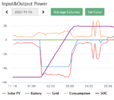
Since 00:30 to 05:30 my electric costs less, I do use the washing machine, tumble drier, and dishwasher during that time. You can see 1763292098955.png the use already hits 5.27 kW (23 amps) without any EV charging, and my fuse is 60 amps (Says 100 amp on carrier). The tumble drier, and dishwasher is easy to set delayed start, washing machine is a problem, as we use liquid soap, which can get onto the clothes before the cycle starts.

The question is if this is safe? Around 70% of all power drawn from the grid is over 5 hours at night when we are all in bed. The drier is the heat pump type, and we are aware of the problems drying clothes which have not been washed, so never do that. But we are being pushed to use more and more energy at night, and more and more of that energy is electric, I lived through the winter of discontent, so never again will I rely on electric for heating, at least not from the grid system, but I am sure if my wife wanted a shower at 2 am before going to bed, she would not think twice about the load on the grid supply.

So big question, which I can't answer, if my 60 amp fuse ruptures at 2 am, how long will it take for the supplier to renew it? And can I live in the house without grid power? I don't even know how I would ring the electric supplier to get them to come out, my landline uses cordless phones, so they will not work, and already tried to use the local phone box, only to find all it contains is a defibrillator unit, no phone. So one is relying on one's mobile phone.

OK I'm alright Jack, I have battery back-up. But it would be a lot of faffing around, and not something I want to do.

So it all comes down to a risk assessment, what is the likelihood of the EV charger causing the fuse to rupture, and if it did, what then? I made up an emergency lead, two croc clips, and a pair of cig sockets, with USB adaptors in them. So should we get a power cut, we can use spare car batteries, to keep the lights on, charge phones etc. This morning I noted this had been moved, from where I knew it was, to the top of the stairs, clearly my wife tidying up. Best laid plans, etc.

Is it worth it? The same question I asked before fitting solar panels, the major reason why I did, was the uninterruptible power supply which came as part of the installation. OK also saves me money, but the UPS was what tipped the balance.

The new EV can also power the house, as well as the house powering the EV, so getting an EV and charging/discharging point could be seen as a very good move, but this is something quite new, and old EV charging stations are likely one direction only.
 
Just as a reminder, the house is a new build, built 2022. Would this have any bearing on the likely fuse size?

Also, would it make sense/be safe for the CU Main Switch to be 100A if the main fuse is smaller than that? I'd have thought the biggest 'fuse' would be 'closest' to the incoming mains? Or is that just a switch and 100A is the max rating?
 
Just as a reminder, the house is a new build, built 2022. Would this have any bearing on the likely fuse size?
No.

Also, would it make sense/be safe for the CU Main Switch to be 100A if the main fuse is smaller than that?
The switch has to be rated the same or higher than the fuse.

I'd have thought the biggest 'fuse' would be 'closest' to the incoming mains?
I don't know what that means.

Or is that just a switch and 100A is the max rating?
Yes.
 

If you need to find a tradesperson to get your job done, please try our local search below, or if you are doing it yourself you can find suppliers local to you.

Select the supplier or trade you require, enter your location to begin your search.


Are you a trade or supplier? You can create your listing free at DIYnot Local

 
Back
Top