
• Looking for a smarter way to manage your heating this winter? We’ve been testing the new Aqara Radiator Thermostat W600 to see how quiet, accurate and easy it is to use around the home. Click here read our review.

Double oven- what would be the best flex outlet/switch options

Joined
9 Jun 2010
Messages
370
Reaction score
69
Country
United Kingdom
Hi all,

I'm refitting my kitchen at the moment and soon arriving at the point where I am installing our new hob/oven configuration. I am using the same dedicated 32amp circuit which supplied the old oven as previously recommended on here. This now will supply an induction hob on a kitchen island. I then have 4mm2 cable from this same circuit going under the floorboards and up into a temporary junction box on the wall where the ovens are going (the box just as a temp measure to keep the connections all out of the way/safe).

This is one conventional oven and one microwave oven. Separate units.

The kitchen company I'm using have handily supplied a guide as to what I should be using. With the one 4mm2 cable I have, is anyone able to advise how I configure this and what flex outlets/grid switches they'd recommend using? I clearly need to split supply of the one cable but not sure what the best way of doing this is going to be....

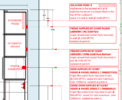
I'm not really getting the grid switch recommendation to be honest. These look as though they are for something different? Basically I have an 18mm ply board at the top of the freezer cabinet to install some isolator switches.

Thanks
 

Attachments

  • Snip20251122_10.png
    Snip20251122_10.png
    569.2 KB · Views: 24
Why have they used the word "cleint" rather than "client"?

I am not an electrician- in my limited experience, the induction hob is likely to take the biggest draw.

It might help if you list each of the cooking items (and their potential rating) so that a proper electrician can calculate the max draw and then calculate the diversity (a product rated at X draw will be expect to take slightly less- but let one of the electricians here advise you accordingly).

You did list the items in your image but typing the model numbers might be preferable if you want the electricians here to comment
 
Why have they used the word "cleint" rather than "client"?

I am not an electrician- in my limited experience, the induction hob is likely to take the biggest draw.

It might help if you list each of the cooking items (and their potential rating) so that a proper electrician can calculate the max draw and then calculate the diversity (a product rated at X draw will be expect to take slightly less- but let one of the electricians here advise you accordingly).

You did list the items in your image but typing the model numbers might be preferable if you want the electricians here to comment

Thanks

I've already had advice around the diversity and what circuit to keep it all on. It was more for the actual hardware I need in terms of fused connection units etc. Each oven is rated at 3kW. Hob is 7.5kW
 
Duel outlet plate? Two ovens in one side hob in the other
 
Duel outlet plate? Two ovens in one side hob in the other
Thanks pete01. That potentially looks ideal, and the solution I was struggling to find....

So something like this?

https://www.tlc-direct.co.uk/Products/AA45DCOP.html

Then the two flex outlets at the bottom would feed each appliance (oven and microwave oven), presumably via a FCU so I can isolate them? I should add that the hob is wired separately as this is positioned in my kitchen island, with these two ovens then in a separate wall cabinet run.
 
I didnt mean the cooker switch you linked to but I used one of those for my oven and I plugged the microwave into the socket on the cooker switch (in the cupboard above the microwave)
 
Thanks

I've already had advice around the diversity and what circuit to keep it all on. It was more for the actual hardware I need in terms of fused connection units etc. Each oven is rated at 3kW. Hob is 7.5kW

Fair play. Sorry for the misunderstanding.

When I rewired my mum's combi microwave and conventional oven, I split the 4mm into a 2 MCB enclosure box. I wanted a way of isolating each of the devices.

Downside is that I fitted a 2 MCB enclosure (which takes up space in the unit above). Upside, if one of the devices fails, it/they can be isolated rather than going to the CU and isolating it
 
Ok thanks both. I think in fairness I am probably overcomplicating this. The other factor I need to consider is that I only have 30mm clearance behind the actual cabinets so I'm struggling to surface mount anything. Thus looking at the duel outlet plate it only seems to come with the option of a 35mm surface mounted back box.

I basically need to be able to isolate the two ovens separately as you say opps...so can I just split this cable using wagos in a junction box, to feed two fused connection units that I mount in a convenient position.
 
s so I'm struggling to surface mount anything
Oven / cooker outlets should be flush mounted. If surface, then you are unlikely to have enough space to fit the appliance in front of it. They all need a 35mm or deeper box due to the size of wiring used with them.

I basically need to be able to isolate the two ovens separately
Why?
They will be switched off only for cleaning or maintenance. Neither of which requires them to be separately controlled.

grid switch recommendation
Grid switches are inappropriate for use with high loads in a kitchen. They are the favourites of kitchen designers who for reasons known only to them believe they are the solution for everything.

If isolators really must be shoved in a high level cupboard above a fridge where no one can reach them then it's this: https://www.toolstation.com/click-mode-45a-dp-switch/p10475 for the ovens/hob
and possibly this https://www.toolstation.com/click-mode-20a-dp-switch/p17782 for the fridge or freezer sockets.
 
Thus looking at the duel outlet plate it only seems to come with the option of a 35mm surface mounted back box.
No, they fit on any type of back box.
I basically need to be able to isolate the two ovens separately as you say opps
Well - you don't need to isolate them separately - you can if you want.

...so can I just split this cable using wagos in a junction box, to feed two fused connection units that I mount in a convenient position.
You can split the cable at the outlet plate.
You don't want FCUs for an oven.
 
Thanks again.

So I can get the dual outlet plate, mount that on a 35mm back box in wall? I then have my two cables for each oven. See where you are both coming from (and agree) with the point around when am I going to need to isolate them separately. What should I then be using in between my outlet plate and the two ovens?
 
Strictly speaking - heat resistant flexible cable.

2.5mm² will suffice - or 4mm² if you prefer.
Thanks @EFLImpudence sorry I meant what switch rather than cabling. Presumably I need some form of isolator?

That is what I wasn't quite following with the advice around not needing to isolate separately- which completely makes sense but then I thought I'd have to do this anyway as they need to be wired separately. If I split the wiring to feed each oven with the dual outlet plate, I need to install some form of switch.
 
I would just have the normal cooker switch which would isolate all three appliances from the supply.
I like one switch to cover all the cooking appliances but people's opinions vary.

That is what I wasn't quite following with the advice around not needing to isolate separately- which completely makes sense but then I thought I'd have to do this anyway as they need to be wired separately.
That makes no difference with regard to switches.

If I split the wiring to feed each oven with the dual outlet plate, I need to install some form of switch.
No.
 
Right I think I follow now- I was thinking about it the wrong way around and dual outlet plate first. What I should do is have one cooker switch, and then my cable from this cooker switch goes to the dual outlet plate to wire both ovens?
 

If you need to find a tradesperson to get your job done, please try our local search below, or if you are doing it yourself you can find suppliers local to you.

Select the supplier or trade you require, enter your location to begin your search.


Are you a trade or supplier? You can create your listing free at DIYnot Local

 
Back
Top