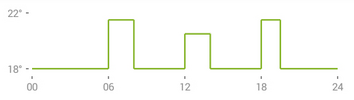
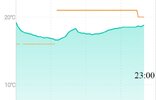
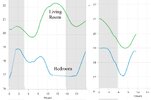
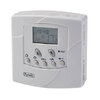
I have this one . But it's near the front door . Probably the coldest part of the house . Is this why the radiators are so hot . Because this is cold .
The lockshield valve. Should I have this fully open mate . Sorry to be a pain . I'm a joiner and this is all new to me .
Cheers mate
Had same problem with mother's house, long large radiator along the wall, then a doorway, then the thermostat then another door. Theory is great, but to get circulation with a staircase opposite the radiator is simply not going to happen. So close the lock shield valve, so rest of house can heat up, and open door, and hall freezing cold, open up the lock shield valve, so hall is warm, and rest of house is cold.
Only method seemed to be to fit a thermostatic radiator valve (TRV) the mechanical TRV has a massive droop, (difference between on and off temperatures) and it is analogue, so set at say halfway between 2 and 3, it would start to close at 17°C and not fully close until 20°C so a wall thermostat set at 19°C would switch off in fullness of time, but it would take long enough so rest of house warm first, but from 6°C after door opened to 17°C recovery was fast. This was OK with a simple warm thermostat.
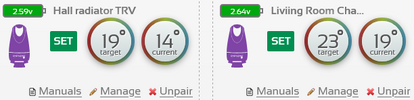
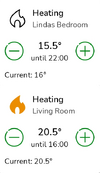
But I moved to a programmable thermostat, so now for it to work, the TRV also needed to be programmable, this is more of a problem, as the droop on an electronic TRV head is more like 1°C not 3°C, so it becomes harder to set up. So start to look at linked TRV heads, the Drayton Wiser system will auto combine the wall thermostat and TRV head if both assigned the same room name, and the Kasa TRV head can have remote sensors to control it.
The main problem, is the installers, don't live in the homes they install the systems into, except their own home, and users often have no idea of the options available. To get someone to say, I have use Tado, Tapo (Kasa), Evohome, Wiser, Hive etc. And you set it up like this, seems to be rare, we get the "we do it this way, because we have always done it this way." brigade, who are still living in the 80's before we had condensing boilers, I have also worked with the old one pipe system, steam goes in one end, water drips out the other, but only because a work on a heritage railway, where boilers still boil water, today if a boiler boils water we consider it faulty.
So in my house I have eQ-3, Energenie, Kasa, and Wiser TRV heads, I got it wrong to start with, was told Energenie worked with Nest, it does no work any more, when I got them eQ-3 were cheap, (£15 each) and I used Kasa as already using Tapo, both are TP-Link so use the same hubs, but Wiser transformed my system, it works, so once I got it working, did not need to try anything else.
Having a wireless thermostat that you can take room to room, or move around the room, to test where is the best place, is a huge advantage, until the cat sleeps on it and one is left scratching one's head why is the room so cold.
But my first two homes worked well, both open plan, so a single thermostat was enough, mother's house and this house had the thermostat in the hall, silly single place really, but one has to look at 1970's houses to understand why, the central heating was to get the home warm in the morning, before going to work, or evening having just got back, but main heating was still the open fire in the living room, at that time we wanted the living flame, central heating back then was only to warm house while one laid and lit the fire, so a thermostat in the living room would not work, as the fire would stop central heating working in any other rooms.
But today is all about each room being its own zone, with a thermostat in every room, OK that thermostat may be a TRV, but the whole concept has moved on.



 Having the loft re-insulated a few years ago with thicker layers certainly helped keep heat in the house rather than losing it through the roof and i swear the Wallrock lining paper i've used in bedrooms has made a difference.