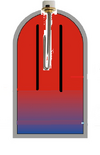
Willis Heating System

Is your complaint/issue with the system that the heat exchanger is above the tank?
Sort-of. My 'issue' relates to the fact that the feed from the Willis heater is connected above the top of the 'tank'.

Water heated by the Willis heater will rise up into the expansion pipe. When the water in that pipe eventually cools it will fall ('convection') back down the expansion pipe (back towards the heater) and/or into the main cylinder IF the water below it is hotter - that will eventually be the case in terms of movement back down towards the heater, but I don't see how it would ever be the case in terms of movement down into the main cylinder.
Does this lead you to believe that the water in the hx would just heat up and stay there, and the tank wouldn't warm at all?
Again, essentially yes. Assuming no hot water ws 'drawn off' (by taps), it seems to me that the heated water would just stay in the heater and expansion pipe, and that no heated water would get into the 'tank' other than by conduction (which I imagine would be trivial). As I wrote ...
... I can see how the Willis system would work if the feed from the Willis heater fed into some point below the top of the main cylinder - BUT I can't see that that would be essentially any different from (or superior to) having an immersion at the same point (as the 'connection') in the main cylinder.
 
Water heated by the Willis heater will rise up into the expansion pipe
So the the Willis heater must suck in at the bottom if the water is leaving at the top. If can't just be that the water that leaves does so because it expands

Liquids aren't compressible, and neither are they expandable. A plunger in a tube with rigid sides (like a syringe) when moved, draws the water in the pipe along with it. A hosepipe plunged into a water butt so it is full of water, then having one end pulled out and led down the side, will empty the butt by siphon, as water leaves the pipe from the free end, it pulls on the next bit of water, which pulls on the next, which all the way round the pipe causes water to be drawn into the submerged end

In any water circuit, if you can encourage water to move along then more water follows it. In a lazy river pump, water pumped out the output of the pump will cause more water to flow to the back of the pump to be drawn through. A lazy river is a closed circuit, 3 sides provided by the walls and floor, the top by gravity stopping the water floating away out of the system
 
I am, as yet, not convinced by the theory (maybe I have missed something) and I am not aware of robust experiments to prove or disprove - Snake Oil or not, I have no idea, there might be something I am missing.
As you will realise, that makes two of us, and, as I keep asking, I wonder if I am 'missing something' fundamental.

However, despite some of the things being written in this thread, it does all seem like pretty basic Physics to me, which is why I don't yet see why it's any different from the 'under sink thingies' - which store just a few litres of heated water for immediate availability, but reduce to a pathetic heating of water ('dribble' and/or low temp) once that reservoir of stored heated water is used up.

Maybe it's 'just me', but I've yet to see an even remotely convincing argument which explains why a significant amount of heated water would get into the main cylinder with the arrangement we're discussing (per diagram originally posted by eric).

I have to say that I can't help thinking that there has to be a reason why, if it really is 'useful', this idea has not caught on much more widely (other, perhaps, than in Ireland) :-)
 
So the bottom of the Willis heater must suck in at the bottom if the water is leaving at the top. If can't just be that the water that leaves does so because it expands
You seem to be making the same mistake as Harry. Convection does not require any net movement of water (i.e. 'water going somewhere). Convection occurs when hotter water (or whatever liquid or gas) rises and cooler water (or whatever) falls within an essentially fixed volume of water (or whatever). Give or take the minor issue of expansion, that will happen in terms of the water in a 'sealed' cylinder or air within a 'sealed' room, if there is a heat source somewhere below the top of the cylinder or room.
Liquids aren't compressible, and neither are they expandable. A plunger in a tube with rigid sides (like a syringe) when moved, draws the water in. A hosepipe plunged into a water butt so it is full of water, then having one of nd pulled out and led down the side will empty the butt by siphon, as water leaves the pipe from the free end, it pulls on the next bit of water, which pulls on the next, which all the way round the pipe causes water to be drawn into the submerged end
See above.
 
Wrong! The water moves, as does air.
Just once more, before I give up on trying to counter these assertions of yours :-) ....

.... (ignoring very small issues of 'expansion') convection within any 'system' (cylinder, set of pipework, room etc.) filled with liquid or gas does NOT require any liquid or gas to enter or leave the system - it consists of re-distribution of hotter/colder parts of the liquid/gas within an essentially fixed volume of liquid/gas.
You just contradicted yourself in one post there. The water moves, that is what a convection current is/does.
See above.
Put your hand over a hot radiator, and there will be a warm, rising, flow of air above it.
Indeed so - and that why, as I've written before and have just re-posted, the Willis system would work if the Will heater were connected to the main cylinder somewhere below its top.
However, put your hand under a hot radiator and you will (I would have said 'obviously') not feel any "warm rising flow". If you feel any heat, it will be due to radiation/conduction - essentially by definition, it could not be by convection.
Capture the hot air, in a balloon, and the balloon will rise.
Indeed so, because the air in the balloon is hotter (hence less dense) than that around and below it. That goes no way to explaining why you think that the balloon fall of hot air could fall through/into cooler air below - which is essentially analogous to your suggestion that hot water will fall from the the expansion pipe into the cylinder full of colder water below.
 
If a tube was inside the cylinder 1771682979612.pngso the immersion heater inside the tube, could one use a short immersion heater and still heat the whole of the cylinder?
 
If a tube was inside the cylinder View attachment 408347so the immersion heater inside the tube, could one use a short immersion heater and still heat the whole of the cylinder?
I wouldn't think so, and I think that what you depict/ask illustrates that separating a system into 'bits' (with 'tubes', an external Willis heater or whatever) will not alter the Laws of Physics that control convection.

Other than for small amounts of heat transfer by conduction (through water and material of cylinder), 'heated' water in the upper part of a cylinder can never significantly spread, by convection, down to parts of the cylinder below the heat source - since that could only happen (by convection) if water 'below' was hotter than that above.
 
What do you think would happen if this were all there was?
Well, without any connection to a ('pressurised') cold water source, no water could be drawn (by taps) from the pipe rising from the cylinder - but, other than that (in particular the alleged heating of water in the cylinder) it's is no different from what I've been talking about, is it?
 
..... the theoretical arguments I've presented therefore leave me wondering whether this concept is not really just a variant of the concept of the "under-sink gizmo", which provides a relatively very small amount of stored hot water, making the main HW cylinder pretty irrelevant, with hot water reduced to either a trickle or a low temp once the small amount of stored hot water has been used up?
It seems that Mr Google's 'AI' friend sort-of agrees with me ...
AI Overview said:
The Willis Immersion Heater is an energy-efficient, external water heating unit designed to heat domestic hot water from the top down, allowing for rapid, targeted heating of only the water required. Typically rated at 3kW, it provides hot water for small tasks in 5–10 minutes, making it a cost-effective alternative to heating an entire tank.
Edit: ... but it still leaves me struggling to understand what significant benefit that offers in comparison with simply having an immersion 'high up' in the main cylinder
 
Last edited:
In an attempt to understand other people's thinking, please see diagram below.

I would imagine (hope!) that most people would agree/accept that the water in the top half of cylinder A will rise to at least that of the setting of the immersion thermostat (and a bit higher than that at the top of the cylinder).

However, do some people really believe that water in the top half of cylinder B will also rise to a similar temp - and,if so, how/why?
1771693775323.png
 
You seem to be making the same mistake
You can't understand something, yet assert I must be mistaken?

Get over yourself

All your sitting here saying "in my mind, in theory, it doesn't work" isn't going to change the universe's willingness to demonstrate that it does work, so perhaps you need to pour less scorn on those who understand it trying to help you do the same

Not all cars have water pumps. Some just rely on the same principles here, to circulate water in order to redistribute heat
 
You can't understand something, yet assert I must be mistaken?
I actually think I do understand, and I certainly have the ability to identify statements/assertions that I believe to be incorrect - but I just fear that I am perhaps 'missing something', since so many people (at least, in Ireland and NI) seem to have bought into the idea of the 'system' concerned.

However, the more that people fail to present me with an argument to the contrary which I can understand and accept, the closer I come to believing that I probably am 'correct' in my thinking and that a lot of these thoughts about the Willis system may be little more than 'myth', created by people who don't adequately understand the physics.

Despite that, I remain open-minded, so would welcome any credible explanations about 'what I am missing' (not just assertions of views that differ from mine!)
 
Last edited:

If you need to find a tradesperson to get your job done, please try our local search below, or if you are doing it yourself you can find suppliers local to you.

Select the supplier or trade you require, enter your location to begin your search.


Are you a trade or supplier? You can create your listing free at DIYnot Local

 
Back
Top