No one near me wants this job - New ground rod

install a new one in the same place and connect it back up with a new clamp, and then get an EICR as soon as I can find a willing electrician? Or, during the period that the house is relying on my new rod and the EICR taking place, would I be in trouble?

Grateful

A dodge I found, in cloying tough soil, was to connect a length of pipe to a hose, turn on the tap, the pipe will then dig it own hole without effort.
 
Book an EICR in they will test it, buy a new clamp and say...

"alright mate I've done you a cup of tea and I've got you some chocolate biscuits" half hour later say " I bought a new clamp as that one looks a bit rubbish, as you seem a great electrician would you mind replacing it for me?

Then give him 20 quid extra. :) (y)
Only a lunatic would do that for a score. Going to cost hundreds.
 
That's a novel idea.

My latest brainwave is chop back the concrete immediately around the old rod, buy a threaded coupler (both old and new rods are 5/8), hope the threads match, then use SDS driver to push the old rod 4' further into the earth and this end up with an improvement. Also would avoid services risk this way. Question is, will I be able to shift the old rod down further or will the corrosion have completely gripped it. Tbh, success seems unlikely.
 
Only a lunatic would do that for a score. Going to cost hundreds.
Well yes it might be more than £20 plus tea and biscuits, it could lead to be a little (or even a lot) more problematic than ideally envisaged in the first place
 
Thanks everyone who has replied, I've been spoiled with ideas.

Ive called yet another electrician and asked for an EICR and planning to install the new rod day before he gets here. May buy one of the cheap testers mentioned above to give myself some confidence in the new rod install before switching it all back on.

Have also bought a rod couple with the plan of couple new rod to old rod and banging then both together further into the ground. Will need to cut back the concrete surrounding the first rod to start with. The coupler will create a knuckle at the midpoint thought which I imagine might will make further insertion I to the ground very hard.

Hmmm.
 
May buy one of the cheap testers mentioned above to give myself some confidence in the new rod install before switching it all back on.
No. Don’t waste your money. You will need an Earth Loop Tester. They aren’t “cheap”
Even if you had one, how would you test it? What impedance would you expect to be within the acceptable range? What would you do if it is out of limits.

Do the EICR. Then act on the findings.
 
JohnD - what is "The Titan"?
It is a cheap SDS drill with a rota stop, my SDS does not have a rota stop so will not hammer in an earth rod.
No. Don’t waste your money. You will need an Earth Loop Tester. They aren’t “cheap”
Even if you had one, how would you test it? What impedance would you expect to be within the acceptable range? What would you do if it is out of limits.

Do the EICR. Then act on the findings.
I find it is easy to spend someone else's money. But once we suggest methods costing a lot of money, the chance is nothing will get done. My problem is with an EICR we are relying on someone doing the job correctly, and in the past there have been too many drive past EICR been reported.

The same applies with other reports, home buyers reports, and Energy Performance Certificate, my old house had an Energy Performance Certificate but no one even visited and neither did we pay anyone. I did a hunt for next door but one, and found I had one.

So we have a pacific question, about an earth rod, and we know it takes seconds to test the earth system with an earth loop impedance tester Loop-test.jpg one simply plugs in, turns the dial and press the button and one has a reading as to the earth loop impedance, but the meter is expensive, so not really a DIY job, I did look at hiring, the problem is calibration which needs re-doing after each hire, so even to hire looking at £60.
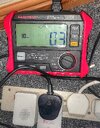
The net result is cheaper to get an electrician to test a random socket to hiring the equipment. And as I said to do a proper test on an earth rod you should be using test probes, which often simply can't be done as you can't get the distance away from the rod under test to put in the probes.

He has already said he can't get an electrician to test the earth rod, so a little pointless talking about getting one.

So nitty gritty, the reason we use an expensive tester is we are looking for a figure to write down, we want to write 1.38 Ω or less down on the minor works or installation certificate, and to get that sort of reading it needs a meter, and even the meter shown does not have enough decimal places to comply with our needs.

But to see if below the limit which BS7671 says is the maximum as above that limit it may be unstable, a plug in socket tester (with loop) will show one has a good enough earth.

I will admit some can be misleading, as often they assume one has a DNO earth system, and have a 1.7 - 1.9 Ω pass point, but most have a series of green and red LEDs to show reading of up to 500 Ω which is clearly a fail, but we expect a single earth rod to be around 60 Ω so they are good enough to see if within that range.

Where the DIY bit becomes hard, is where like my own house, we have multiple earthing systems, my home is TN-C-S and TN-S it depends on if the grid supply has failed or not, and my earth rod is only there in case the grid fails. So to test means disconnecting and reconnecting cables and wires. This does need a professional to do the work. However, with a simple TT installation using a plug in socket tester with loop will show if you have an earth. It will not test the rod, but in real terms that does not matter, if the earth is due to water pipes, earth rod, gas pipes or metal in the foundations, if it is good enough to trip the RCD then you are safe. And a plug in tester will tell you that.

 
Well if you are reying on an RCD (which is almost always the case with an TT earth rod or plae etc) then an Earth Electrode tester and an Earth Loop tester is probably the best way to consider.
You also need to consider the variation that might occour throughout the year (or its lifetime!).
Above 200 ohms should cause concern but above 100 ohms would be a better benchmark.
Around here 50 to 60 ohms is usually achieveable but even then a couple of rods two rods lengths apart does reduce it a bit if needed (two 100ohms rods will never give you 50ohms when connected together as arithmetic might suggest.
The old cooper or lead pipework in a town might have fortueusly given a better Earth once bonding connected and the electric incomming PILC armour could play a part too - although none of these may be relied upon.

I`ve seen a few of the suplies presenting of old TNS being reliant on you bonding and next doors bonding connecting to next doors earthing to e a good figure but disconnecting the bonds reveal a poor earth and gets the DNO digging up gardens and roads.

Those presenting as TNS are more akin to TNC-S in many instances anyways.
 

If you need to find a tradesperson to get your job done, please try our local search below, or if you are doing it yourself you can find suppliers local to you.

Select the supplier or trade you require, enter your location to begin your search.


Are you a trade or supplier? You can create your listing free at DIYnot Local

 
Back
Top