No one near me wants this job - New ground rod

Joined
18 Oct 2013
Messages
162
Reaction score
0
Location
Bristol
Country
United Kingdom
Hi all,

I've failed now three times to get even a quotation out of nearby electricians to do this job.

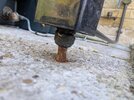
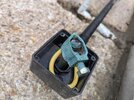
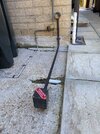
Power comes to my house overhead, and we have a ground earth rod in the back garden. For some reason, years ago, the inspection pit was installed proud of the concrete base that it passes through and the condition is poor in the following ways:

- Rod appears heavily corroded. Perhaps it's fine under the surface rust?
- Clamp cracked
- Whole thing is a bit loose (kids play football out there).

I feel it needs replacing with new one nearby, installed right to ground level ideally with recessed pit. Connected up, and tested.

What am I missing?

If you were being asked to do this job, would you prefer if the home owner had already set the new rod into the ground and just asked you for connection & test?

At the very least, surely a new clamp is needed.

Grateful :-)
 

Attachments

  • PXL_20260430_144304065.jpg
    PXL_20260430_144304065.jpg
    822.1 KB · Views: 70
  • PXL_20260430_144322803.MP.jpg
    PXL_20260430_144322803.MP.jpg
    416.3 KB · Views: 68
  • PXL_20260304_092313791.jpg
    PXL_20260304_092313791.jpg
    392.8 KB · Views: 68
Stick job on... my builder as a last resort.
At least the people showing interest will want the job.

Sort of job a local builder would take on but I often think there aren't the building firms around now.
 
What am I missing?
1% of that work is electrical. The rest is construction.

It's also going to be a right old malarkey of a job, given:
the concrete and paving all around
the very high likelihood of concealed things underground which will require a survey before anything else is done
the oil tank right next to it with the oil line attached to that very same concrete,
and there is already a joint in the line just waiting to leak.
 
Book an EICR in they will test it, buy a new clamp and say...

"alright mate I've done you a cup of tea and I've got you some chocolate biscuits" half hour later say " I bought a new clamp as that one looks a bit rubbish, as you seem a great electrician would you mind replacing it for me?

Then give him 20 quid extra. :) (y)
 
Thanks for your responses - I'm pretty sure the rod needs replacing too, not just the clamp. Perhaps I could drive a new rod in alongside the existing one and just swap it over with a new clamp, then EICR to follow?
 
Keen not to hit services (although I believe there are none in that area. Hence thinking new rod alongside old rod seems the best spot?
 
I believe you can get the rod/earth path tested, which is why I think the suggestion of an eicr.
 
Can't you dig around the rod and remove it?
Then install a new one and get an electrician to connect it.
 
Last edited:
I'm happy to pay for an EICR, house last had one in 2021 before I moved in so it would be comforting anyway.

Ive order a new 5/8 rod (same as existing), rod driver, a new box and and clamp.

Would it be legal for me to flip my master switch off, pull the old rod out (might not be easy, granted, I envisage vice grips, water, vibration, maybe a car jack), install a new one in the same place and connect it back up with a new clamp, and then get an EICR as soon as I can find a willing electrician? Or, during the period that the house is relying on my new rod and the EICR taking place, would I be in trouble?

Grateful
 
Would it be legal for me to flip my master switch off, pull the old rod out (might not be easy, granted, I envisage vice grips, water, vibration, maybe a car jack), install a new one in the same place and connect it back up with a new clamp, and then get an EICR as soon as I can find a willing electrician? Or, during the period that the house is relying on my new rod and the EICR taking place, would I be in trouble?

Grateful
I would do it as close as possible to the EICR (the day before maybe) just incase theres no decent earth from the rod.
 
Have you tried to twist/slacken the old one and put a new one in its place?
Basining on the assumption that the existing one had never hit anything untowards!

Remiinds me of my pal on a rewire.

Around the existing central heating programmer under the boiler, he pulled a cable clip and flex off the wall and then a hiss and a smell of gas.
oooh,
He asked the lady if she had ever smelt gas in that area.
Oh yes now and again in that location over the last 10 or more years but not everyday!
Similar things happen now and again with water pipes, to remove a floorboard and pull the nail out water starts to run where previously it had a drip or two that would evaporate and not ever get noticed.
 
I once ran an Earth rod as a reference for an alarm system.
Old mill premises, Flagged yard and the location I used was all soil - so I esy put an earth rod in.
They told me they were gonna concrete over 2 to 4 inches in that bit so I had a brainwave.
I cut some off the cap end of an empty 2L coke bottle, inverted it over the earth rod so the bottom of the bottle was now a top cover for the rod and clamp. The coke bottle bottom (now the top that had been keeping the concrete away from the rod and clamp) could be cut of to new ground level and with a suitable plate in place would effectively be a
custom built earth pit.

A few weeks later after concreting a drying complete I returned - They had decided, without reference to me, to cover completly with a good few inches of concrete to keep the rod and clamp "safe forever".
Aghhh !
 
Well, there is no gas in my area and the mains cables are overhead. Mains water and sewers come and and go out of the property elsewhere. I think my risk of services is therefore limited to drains/gulleys from/under the patio. It's also a bit close the the wall (foundations) but it's only a garage wall, single skin, 1970's build. The current location looks sufficiently far out to avoid footings. Soil type is clay by the way, which Google tells me is favourable for earthing.
 
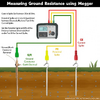
There are two ways to test the dead test is like this 1778151941524.png and the problem is getting the distance away from the main rod for the test probes, it says 30 to 50 meters, often that ends up in someone else's property so are forced to instead do a live test, and compare our earth to the DNOs earth, this is not as accurate as we are adding up the DNOs earth mats resistance, the cables' resistance, and our earth rods resistance, so the reading is on the high side.

However since we are only looking for 200 Ω or better, the unit to test this is not as expensive. A socket tester with loop 1778152538755.pngthe first one show 100 Ω, 200 Ω and 500 Ω the others I would need to check data sheets, but these will likely show if the rod is OK, a proper earth loop tester will cost more like £200 and goes low enough to see if a ring final is low enough (1.38 Ω) without RCD protection, where the cheap tester often only goes to 1.7 Ω or 1.9 Ω so even with all green lights can only test radial circuits, but in your case your not looking for the super low readings anyway, so the cheap plug in tester is good enough, and likely even cheaper to hiring a loop impedance tester.

However clearly a builder is unlikely to have the meters required for testing, and as a professional the electrician would need to give you proper readings, so would need the earth rod testing kit and the room to use it.

If I was employed to do other work, then I would consider the loop impedance tester good enough to test my work, but if employed just to fit an earth rod, then if I did not have the test gear, I would not take the job. To pay out £60 for the hire of the tester, which when I arrive I may not be able to use it, or to arrive then need to go to local town to hire a tester, is just too much hassle so I would not take on the work, unless part of a larger job.

But for you, buying a plug in tester will give you peace of mind, so that's the way I would go, and it does mean you can put in an earth rod and test it.
 
I've seen the box at a silly height before, when it was previously in a flower bed that was later levelled and concrete laid. It would have been better to reposition before laying the concrete.

I think you could cut a new square in the concrete to fit a box. If it was me I would do it round the old one. The spike can be hammered in or driven with rotostop and the concrete patched round the new box afterwards. You could do all that with a cheap SDS+ kit from Screwfux. The Titan is very heavy and primitive but ideal for this job. The guarantee will last much longer than the work.

Maybe electricians don't want to get stuck with the concrete work.
 

If you need to find a tradesperson to get your job done, please try our local search below, or if you are doing it yourself you can find suppliers local to you.

Select the supplier or trade you require, enter your location to begin your search.


Are you a trade or supplier? You can create your listing free at DIYnot Local

 
Back
Top