
You are using an out of date browser. It may not display this or other websites correctly.
You should upgrade or use an alternative browser.
You should upgrade or use an alternative browser.
Has plug and play solar now been passed, I see adverts?
- Thread starter ericmark
- Start date

- Joined
- 27 Jan 2008
- Messages
- 29,231
- Reaction score
- 3,584
- Location
- Llanfair Caereinion, Nr Welshpool
- Country

I had not noticed, but yes, however, it does seem suppliers have been jumping the gun advertising products as being DIY installable which are not.i assume its AI generated as the live and neutral are rather square??
There has also been a host of YouTube videos showing the use of plug and play solar, it hardly matters if they say this is not yet legal, they are showing how easy it is, and I am sure many have fitted these units.
So YouTube "£300 Plug-In Solar — Is This Too Good To Be True?" even if he does point out all the downsides, he links to all the components on Amazon and at £106 (plus £27 for cable) for the inverter is must be temping to jump the gun. Oh, panels another £200 so total from Amazon of £333, OK I would want brackets etc, so likely more like £400, but we are being told it will take 2 years to pay that back, where with a full system looking at 6 years plus.
I am looking at a £1000 bill to repair my gutters because the snow came off the solar panels with a rush, rather than slowly before panels fitted, so it took the gutters off with it.
... and no obvious fuse in the plug, either.i assume its AI generated as the live and neutral are rather square??
- Joined
- 27 Jan 2008
- Messages
- 29,231
- Reaction score
- 3,584
- Location
- Llanfair Caereinion, Nr Welshpool
- Country
from Gov.UK so with the firm being named in the press release, one can assume if they say it does not need an electrician they know what they are talking about.Press release was 24 March 2026 said:Retailers like Lidl and Iceland, alongside manufacturers such as EcoFlow, are working with government to enable them to be brought to the UK market.
If something is sold (legally) in the UK which comes with a fitted BS1363 plug, it's hard to see what "needing an electrician" (if such were said to be the case) would/could meanfrom Gov.UK so with the firm being named in the press release, one can assume if they say it does not need an electrician they know what they are talking about.

- Joined
- 27 Jan 2008
- Messages
- 29,231
- Reaction score
- 3,584
- Location
- Llanfair Caereinion, Nr Welshpool
- Country
It seems EcoFlow jumped the gun, and advertised plug and play solar before it has been OK'ed but the UK government, and the advertising complaints people have required them to remove the adverts.If something is sold (legally) in the UK which comes with a fitted BS1363 plug, it's hard to see what "needing an electrician" (if such were said to be the case) would/could mean
I think we all know others have also jumped the gun, and it means no one is sure about what is legal and what is not.
That may all be true, but it still would not make any sense of them saying that it "didn't need an electrician" if it comes with a fitted BS1363 plug, would it? How on earth could 'an electrician be required' to plug in such a product?It seems EcoFlow jumped the gun, and advertised plug and play solar before it has been OK'ed but the UK government, and the advertising complaints people have required them to remove the adverts.
- Joined
- 27 Jan 2008
- Messages
- 29,231
- Reaction score
- 3,584
- Location
- Llanfair Caereinion, Nr Welshpool
- Country
Yes, I totally agree with you. Plug and play should be just that, no applications or forms to fill in, and no extra bits which need connecting to meter tails, simply just plug in and it works.it still would not make any sense of them saying that it "didn't need an electrician" if it comes with a fitted BS1363 plug
However, it does seem the German system needs people to apply to use it, since I don't read German not sure what it is, but it could be landlords permission or insurance.
Each time I look there seems to be yet another report about plug in solar, or more adverts
 reading further
So add one of theseNow it's easier than ever to use solar energy! With an integrated inverter and a 5m cable with EU plug, the all-in-one MSW balcony power station makes it easy to feed solar-generated energy back into the power grid. Once installed, monitor the balcony solar panel with ease: Connect via Bluetooth or WiFi to retrieve up-to-date data on your mobile device or PC, so you can keep tabs on all the most important metrics at all times.
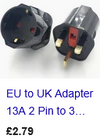 and your up and running. The EcoFlow Stream Balcony solar is still advertised, but the comment that it does not need an electrician had been removed, and the lead with 13 amp plug removed from the kit, OK for you and me where we can understand what is really on offer, but many must be buying these kits being unaware they are not as yet plug and play.
The principle is fairly simple.Obviously, to pick up the house load, the inverter would need to output at a slightly higher voltage than the mains voltage, otherwise it would not be contributing at all. Unless it were to somehow lead the mains sine wave slightly
Have an inpedance between inverter and output, then you can monitor the difference between what the inverter is trying to do and what the mains is holding it to. Then you "simply" try to output at a leading phase angle and higher voltage.
I syspect that with some of the modern electronics and software, that might not mean a physical inductor, but the orinciple remains the same.
Much the same as connecting a rotating genny - asjust the voltage to match, sync it up, turn up the voltage a little and open the tap on the engine/turbine so it tries to drive the grid a bit faster.
Naturally it would increase in both voltage and frequency. As above, to generate you are trying to drive the grid faster and to a higher voltage.When not tied to grid frequency, the output could be deliberately designed to drift high or low, so it is out of bounds, and switch ooff.off.
I'm really surprised at that. I can only assume at least one inverter lacked suitable loss of grid detection and provided a sufficiently stable "grid" to keep the rest online.Overhead supply to 4 properties was cut when the cable was snapped by a fallen tree. The "island" remained energised until engineers shut down the "plug in" solar micro generators.
I think the assumption these days would have to that there's something reverse feeding the line until proved otherwise.
This isn't a new problem, just more widespread.
A schoolfriend of mine nearly died from something similar. It was on an industrial site, the supply was isolated, the bus bars checked for dead, he was given the OK to start work - but the genny had fired up and made them live again. Massive skin burns and internal organ damage that he wasn't expected to survive.
I never heard all the details, and have never wanted to pry. Other friends have mentioned 11kV, but from a technical PoV I struggle to see how he'd have been working with that rather than 415V.
Indeed, as above.Then it didn't meet basic requirements, in regard to detecting loss of sync,
If something is sold (legally) in the UK which comes with a fitted BS1363 plug, it's hard to see what "needing an electrician" (if such were said to be the case) would/could mean
Perhaps to replace the unidirectional RCBO with a bidirectional one ? Or type A to AC ?That may all be true, but it still would not make any sense of them saying that it "didn't need an electrician" if it comes with a fitted BS1363 plug, would it? How on earth could 'an electrician be required' to plug in such a product?
Or add a dedicated radial so you don't compromise RCD protection due to the generation changing it's ability to measure leakage ?
All those come down to the risk that plugging in something like this could leave the circuit with ineffective RCD protection.
EDIT: But we all know how many tenants will ask the landlord and/or an electrician don't we ?

Rubbish!I'm really surprised at that. I can only assume at least one inverter lacked suitable loss of grid detection and provided a sufficiently stable "grid" to keep the rest online.
What do you expect to happen?
3 supplies feeding into the grid, if any are dependant on grid monitoring to maintain their operation then losing any of the other 2 will have no effect.
So in bernards case 2 inverters feeding in are happy providing power, when the DNO supply drops both inverters are happy to continiue running and 'matching' the other. The 2 most likely changes will be voltage rise and possibly change of frequency.
Pardon ?Rubbish!
See below ...What do you expect to happen?
Both of which WILL trip any properly designed and configured inverter. That is the whole point of anti-anti-islanding protection - that the inverter will NOT keep running if not connected to a "stiff" grid.The 2 most likely changes will be voltage rise and possibly change of frequency.
I the case cited, at least one inverter didn't meet that requirement. The DNO should really have given the property owners disconnection notices for their dangerous installations. But I suspect they've accepted that's a lost battle these days.
Yes, all things that might (at least ideally) 'need to be done'.Perhaps to replace the unidirectional RCBO with a bidirectional one ? Or type A to AC ?
Or add a dedicated radial so you don't compromise RCD protection due to the generation changing it's ability to measure leakage ?
All those come down to the risk that plugging in something like this could leave the circuit with ineffective RCD protection.
However, I really don't think it would be sensible for products with fitted BS1363 plugs to be 'allowed to be sold' if it was 'required' that any/all of those things be done before they were used, would it?
Please explain how the inverters can distinguish between the DNO input and the plethora of other inputs when they are all basically a 230V 50Hz sinewave generator.Pardon ?
See below ...
Both of which WILL trip any properly designed and configured inverter. That is the whole point of anti-anti-islanding protection - that the inverter will NOT keep running if not connected to a "stiff" grid.
I the case cited, at least one inverter didn't meet that requirement. The DNO should really have given the property owners disconnection notices for their dangerous installations. But I suspect they've accepted that's a lost battle these days.
This has become a very significant issue, even feeding backwards into the lost 11Kv systems.
A whole new local housing estatel has nominal PV on the roofs and kept going until the sun dropped and tyhat was with "properly designed and configured inverter"s
Last edited:
- Joined
- 27 Jan 2008
- Messages
- 29,231
- Reaction score
- 3,584
- Location
- Llanfair Caereinion, Nr Welshpool
- Country
That was always my worry. The inverters should measure but voltage and frequency and if either goes out of limits auto switch off. But they will auto switch on again as well, so there needs to be a delay between auto off, and restart.A whole new local housing estatel has nominal PV on the roofs and kept going until the sun dropped and tyhat was with "properly designed and configured inverter"s
With half a dozen solar inverters it is likely they will soon go out of limits and as long as they don't restart then very fast they all in turn trip out.
But should there be two dozen inverters then the time required will be longer, so a panel can restart before the others have tripped keeping the island running.
In the main we rely on the failure causing the voltage to drop below the limit, should the failure cause the voltage to go over the limit, it can take some time to trip. Also, we have already read about Artisan Electrics, and how they cheated and used auto transformers to stop it tripping. And he is, it seems, is an authorised installer, and instead of revoking the authorisation, the DNO gave them a three-phase supply and paid for the work to change it all.
So with that in mind why no have it DIY, seems registered installers do daft things anyway, so it makes no never mind?

DIYnot Local
Staff member
If you need to find a tradesperson to get your job done, please try our local search below, or if you are doing it yourself you can find suppliers local to you.
Select the supplier or trade you require, enter your location to begin your search.
Please select a service and enter a location to continue...
Are you a trade or supplier? You can create your listing free at DIYnot Local
Similar threads

- Replies
- 1
- Views
- 691

- Replies
- 10
- Views
- 464