

Thats how you do it, I've put one of those 50mm desk tidy things in since.
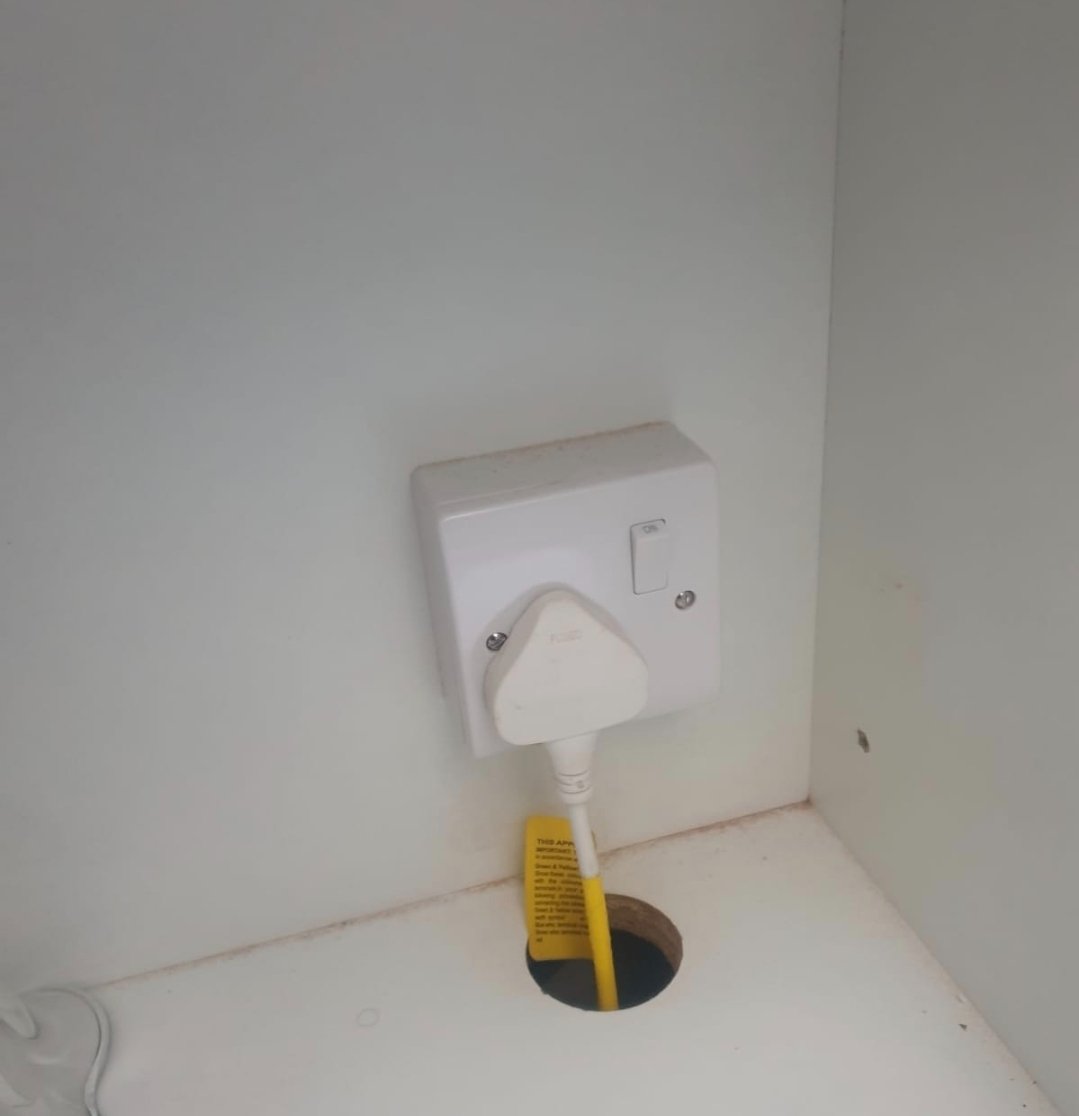

Its designed to be a portable extension lead not part of a fixed installation.....although it will work fine and is safe its not what its for so if came across it I would remove it and fix a proper back box and socket.
I'll go back to this. <134.1.1>
I think we're definitely going to have to 'agree to disagree' on thisThats how you do it, I've put one of those 50mm desk tidy things in since.

Yes C3...I think we're definitely going to have to 'agree to disagree' on this
Just to make sure I'm not doing you an injustice ... are you saying that a trailing socket lying on the floor, wired with flex that went through a hole in a shelf to a plug that was plugged into a wall mounted socket would be 'acceptable', whereas it would not be acceptable if, rather than having a plug on it's end, the flex was 'hard-wired' into a wall-mounted FCU, switch, outlet plate, connector block/Wagos (behind blank plate) etc. etc. ... and that, given that you have cited 134.1.1, you would actually give a C3 to the latter?

132.12 is about 'accessibility of electrical equipment' - presumably no problem with either what you or I were describing. 134.1.1, which you previously mentioned, is about 'good workmanship', and hence is a 'catch-all' that can mean anything to anyoneYes C3... Whats 132.12 again? ... No wrong one cant remember im out at the moment...
I'm rather surprised. It might sound like a silly, maybe even facetious, hypothetical question to ask, but your answer might possibly help me to understand your thinking, so ....But still C3 yeah agree to disagree
And we are back to 134.1.1if you still regard the 'latter situation' described in my last post as not being acceptable, would that remain the case if I super-glued the plug to the socket

 www.electriciansforums.net

I haven't checked the link as I dislike the arrogant way the site is run and no longer have an account there ...Its obviously been discussed before....similar to our discussion actually....difference this socket has no gland but, im sticking to it.
Is it within the regs to fit sockets without securing them to a wall/cupboard? | Electricians Forums
, Is it within the regs to fit sockets without securing them to a wall/cupboard?, Electrical Wiring, Theories and Regulations on Electricians Forums
Oh - in that case it looks as if I have doing some misunderstanding - since, given that you wrote ...Im never going to say an un-fixed socket is acceptable...it needs improving ...final answer.
... I presumed that you were subsequently saying that this (per pic) would be OK so long as there was a proper 'training socket ("an extension lead type socket" on the other end of the flex ...Plugged into a fixed socket? Yes.Would 3 core flex and an extension lead type socket be acceptable to you?
I don't know about "most powerful" but it could be said that it is 'all-encompassing'. If one feels that 'good workmanship' includes compliance with all explicit regs in BS7671, then 134.1.1 requires one to comply with every other reg "and more", with that "more" being so vague and subjective that it could include almost anything to any particular person!May I just comment on siting reg 1341.1.1? .... In many ways perhaps the most powerfull reg in the book or one of them and often overlooked in some respects.
Quite, as you say, the authors of BS7671 seem to agree with you since they have appreciably 'weakened' the reg (I would personally say more than "downgraded very slightly") in recent times. It's not that long ago that there was an explicit requirement to comply with MIs - strictly speaking even if (as sometimes did happen) those MIs were clearly incorrect - but today's requirement to 'take the MIs into account' allows for much discretion and judgement.However this often get thought of by the statement "Not as the manufacturer intended!" .... In other words if we use something as it was intended then always OK but if we use it not as intended is never OK! .... I strongly disagree with that interpretation. ... Yes we are encouraged to trust those who made it, indeed until recently their design was "paramount" whereas nowadays that has been downgraded very slightly to "must be taken into account".
There's a fridge on the other end of that flex.I presumed that you were subsequently saying that this (per pic) would be OK so long as there was a proper 'training socket ("an extension lead type socket" on the other end of the flex ...
Fair enough, but when you wrote this 'yes' (below) to Sunray, were you not saying that a (purpose-made) 'trailing socket' (which is what I assumed he meant by "an extension lead type socket") on the end of the flex would also be OK? ...There's a fridge on the other end of that flex.
Plugged into a fixed socket? Yes.Would 3 core flex and an extension lead type socket be acceptable to you?

.... merely answers to my questions which would help me to understand your thinking. You may think that it's obvious', but it's not from where I am sitting!John....what do you want from me?
Maybe, and I accept that as a view you're entitled to have, but the recent exchanges have not related to the OP's situation - they have been attempts to ascertain your view of the situation in which the 'floating' (not fixed to wall) socket is a 'proper trailing socket' (rather than the OP situation of a standard socket on a back box which is meant to be 'fixed')..The floating socket in the OP's post is a C3 to me all day long.
OK. that seems to answer my questions. You seem to be saying that a proper trailing socket (potentially 'lying on the floor') wired with flex is OK (no code) if the other end of the flex has a plug which is plugged into a (fixed to wall) socket, but that if the flex is connected directly to some other (fixed to wall) accessory (FCU, switch, outlet plate etc.) then it should be given a C3.A trailing extension lead socket attached to the fixed wiring is just wrong and I would want it changed and fixed. A fixed socket with a an extension lead plugged in is of no concern to me.

You do make some good points..... merely answers to my questions which would help me to understand your thinking. You may think that it's obvious', but it's not from where I am sitting!
Maybe, and I accept that as a view you're entitled to have, but the recent exchanges have not related to the OP's situation - they have been attempts to ascertain your view of the situation in which the 'floating' (not fixed to wall) socket is a 'proper trailing socket' (rather than the OP situation of a standard socket on a back box which is meant to be 'fixed')..
OK. that seems to answer my questions. You seem to be saying that a proper trailing socket (potentially 'lying on the floor') wired with flex is OK (no code) if the other end of the flex has a plug which is plugged into a (fixed to wall) socket, but that if the flex is connected directly to some other (fixed to wall) accessory (FCU, switch, outlet plate etc.) then it should be given a C3.
If that's the case then, whilst I obviously have to respect your being entitled to have that opinion, I personally find it very hard to see any 'electrical sense' in that viewpoint.
Ironically, if it were an oven we were talking about, I imagine that at least some people would probably say that it was more desirable that the flex should be hard-wired into an FCU than that it should be fed via a BS1363 plug/socket

If you need to find a tradesperson to get your job done, please try our local search below, or if you are doing it yourself you can find suppliers local to you.
Select the supplier or trade you require, enter your location to begin your search.
Are you a trade or supplier? You can create your listing free at DIYnot Local


