Plug in solar

For me, the existing panels do not get the morning sun, and while using off-peak, that does not matter, if panels produce say 10 am to 3 pm in winter, and the off-peak is 00:30 am to 05:30 am then the big gap is 3 pm to 00:30 am so panels South-West works well.

If the tariffs change however, and the 00:30 am to 05:30 am off-peak is not longer cheaper to the export payment, then to gain early morning sun would benefit a lot. But as it stands the EV tariff I am on works well for me. So plug in solar is of interest, but no reason to rush out and buy.

As it stands my iboost+ does not really help, it would be more beneficial to have a simple timer, but with solar panels to catch the morning sun, any excess would be directed into my DHW, so the iboost+ would again be beneficial storing the excess solar.

The Town and Country Planning (General Permitted Development) (England) (Amendment) Order 2026 comes into force on the same day as plug in solar becomes legal stopping it being fitted on wood, and detailing distances it can protrude from a building, I had assumed since it says (England) not valid in Wales, but reading it says "(3) This Order extends to England and Wales." So I suppose there must be a version in Welsh.

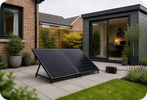
The order also covers all panels not only plug-in on how far they can stick out from the building. This 1787209354810.png it seems may not be permitted any more due to how far it sticks out from the building.
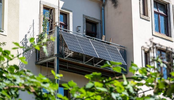
And this
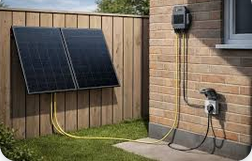
1787209663273.png
it seems not permitted from the 27th August this year.

The "installed" label seems to be likely with most. This 1787210019830.png would worry me, seems likely it would take off in the wind. I had considered one on the shed roof, but seems that's now out.
 
Last edited:
Me again , So firstly thank you all for your input. . So next question.

I beleve I can legally extend a circuit. So instead of using a plug, in order to make things safer do the new regs for plug in solar permit me to hard wire plug in solar to my 32 amp garage radial with its own rcd isolator or is that going beyond what is permitted .
 
Well, I reckon that say 12 months down the line we should see what is then permitted - initially the regs/rules cover what the Gov reckon should be the case as best they can forsee then the clever/stupid find every which way they can utilise (or accidentally/purposely) manipulate outside the original intent and then tweek instructions and rules and maybe laws in order to bring more folk inline with what is required to be allowed.
 
Me again , So firstly thank you all for your input. . So next question.

I beleve I can legally extend a circuit. So instead of using a plug, in order to make things safer do the new regs for plug in solar permit me to hard wire plug in solar to my 32 amp garage radial with its own rcd isolator or is that going beyond what is permitted .
It should use a plug, but no one will ever check that. Nothing wrong with the safety of plugging it in though, as opposed to hard wired.
 
Well, depending what the rules say if it must have a plug to plug in then it must have a plug to plug in.
Whether or not it must have is irrevelevant to the fact that electrically speaking the only difference in having the plug on is that you can choose to unplug it to isolate it, if you use a switched socket it may or may not isolate both L & N when switched offf (such as the original MK Logic range) some are DP switched some a SP switched.
So a plug and socket gives you the opportunity to unplug to isolate regardless off and switches that may be on that circuit or part of that circuit.
 
Me again , So firstly thank you all for your input. . So next question.

I beleve I can legally extend a circuit. So instead of using a plug, in order to make things safer do the new regs for plug in solar permit me to hard wire plug in solar to my 32 amp garage radial with its own rcd isolator or is that going beyond what is permitted .
If hard-wired, then no longer plug in solar. You have always been allowed hard-wired solar. There are hoops to jump through, the biggest of the hoops has been the G98/99 and getting the second MPAN number so you are paid for export.

This is still an unanswered question with plug in solar, the thought is if you can be paid for export by completing the G98, then people will actually fill it in, if not why would anyone bother?

The idea is the DNO will be aware of what solar generation is in the area, so will not in an emergency turn off an area which is actually generating power in error.

But then we look at the smart meter, it was the case where installers of solar would fit an export meter, but it seems around 2018 the suppliers decided it was not really a good idea to trust someone else's meter, and they decided with any new installations to get payment for export, the smart meter would be required.

But it seems the education program for workers with some suppliers like British Gas, were somewhat lacking, and the advisers on their help desk had no idea what they were saying or doing, and were telling people they were not being paid export due to a form being filled in with the wrong format, rather than you need to apply to the DNO for a second MPAN number.

To my mine, with plug in solar, the first requirement should be a smart meter, then we are sure meters are not running backwards, or adding export and import together, and even if a G98 form was not completed, the DNO would know what generation there is in an area.

For all I know, that may well be the case, as yet no one it seems has seen the instruction set. Or what is written on the outside of the box to be read before we buy the kit.

So for installed rather than plug in solar, which once the plug is removed, it is installed, the existing installation is tested. The simple first test, is the loop impedance. This will show the likely volt drop/raise due to current flow, and if the -6% to +10% of 230 volts is likely to be exceeded. Also, we would look at any RCD to ensure it is bidirectional and read the instructions as to what type of RCD is required, although rule of thumb says we are looking for a type A or better RCD, my inverter instructions actually state a type AC can be used, so we have to read the instructions.

We did not get a van arrive at the house and solar panels installed, it all started with a survey and inspection and testing to see if the house was suitable, and they used software to work out if all panels on one roof, or so many on each roof would work out best.

It was not lets fit solar panels and trust to the lord they will work.

This is where plug in and installed differ, however there has always been the battery pack option.

Before we got all the clever grid tie inverters, we have always the option of having two consumer units, one essential and one desirable and to plug the essential into a socket from the desirable so in an emergency it could be unplugged and plugged into a generator instead.

There are modern day variations on this theme, with battery pack/inverters which can be charged either with solar or the grid supply, and can supply items direct from their output sockets.

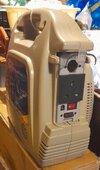
I have a very early version Back-up-power.jpg I can charge this with 12 volts from a car etc, or a transformer and the mains, and it can output 300 watts, the modern day version
1787387463975.png
often has inputs for solar panels direct, and are far more flexible to my old version, although the jump-starting options seems to have been removed. And they can output will over the 300 watt of my old unit (one shown is 300 watt) and it is up to the user if used static or portable, two units one in shed being charged and one in house being used or cables from shed to house and a single unit are all possible.

Most depends on your home, my last home would have worked well, as I had fitted a second fuse box years ago, so two ring finals one from each fuse box, each fuse box was powered from its own RCD, so if one tripped I did not lose all. This house running a second well really fourth ring final well radial would do, would be a lot of work.

I have looked at the idea of a solar panel to catch the morning sun, and a battery pack in an outside garden box, with selected sockets indoors connected to it, so if we go out, we could unplug the pack and take it with us. But more of a whim, can't really see it being worthwhile, unless the tariffs change.

At the moment, 00:30 to 05:30 I charge batteries with off-peak, which is charged at 8.625p/kWh, and I export at 12p/kWh, if these rates change, then it may be worth increasing my battery size.

Be it solar panels, a heat pump, or an EV, what we do depends on electric charges, and all other fuels are same price 24/7, and are regulated in some way. Electric at standard single 24/7 tariff has a price cap, but as soon as one signs up for a special tariff, price guarantee ends. We have seen the payment for exported solar reduce over the years, and threats of taxing EV in some way, so we have to take a gamble with electric, what will governments do? Will we have income tax on energy exported from our homes?

But for plug in solar, just 5 days left, so really just a case of wait and see.
 
This is still an unanswered question with plug in solar, the thought is if you can be paid for export by completing the G98
The answer is that you would get it if you already have an export tariff, if not then it would need professional installation to get it. Which then isn't DIY.
 
Oh dear, why does plug in require a FCU
1787395340021.png
?
The installation of a Plug-In Solar kit shall be carried out by a competent person
I thought that phrase had been dropped "Competent person. A person who possesses sufficient technical knowledge, relevant practical skills and experience for the nature of the electrical work undertaken and is able at all times to prevent danger and, where appropriate, injury to him/herself and others." So better than just being skilled!

DO NOT disconnect the PV module from the Micro-Inverter without first disconnecting the AC power. ! In no circumstances, connect a DC input when an AC connector is unplugged.
Try making sense of that?

There are warning, but written in RED, so can't read them with my Irlen Syndrome rather a daft thing to do. So just have to ignore that bit.

WARNIING: Do NOT exceed a maximum of (5) five Micro-Inverters in an AC branch circuit when using the Plug-In Solar System.
I thought the limit was one? Clearly no spell check was used when writing the instructions.

American wire gauge (AWG) with a product for the UK, really?

1.1. Switch off the power and remove the fuse for the relevant circuit before carrying out any work, or inspecting, either it, or the appliances connected to it.
So OK to use a fuse box then?

1787396684816.png

Is this really plug in solar? 1787396929823.png this is a fused connection unit (FCU) it is not in any way shape or form plug in solar complying with the regulations to be enacted in 5 days time. I stopped reading as clearly a complete waste of time, who these instructions were aimed at I don't know, but a good example of gogglygook.
 

If you need to find a tradesperson to get your job done, please try our local search below, or if you are doing it yourself you can find suppliers local to you.

Select the supplier or trade you require, enter your location to begin your search.


Are you a trade or supplier? You can create your listing free at DIYnot Local

 
Back
Top