
You are using an out of date browser. It may not display this or other websites correctly.
You should upgrade or use an alternative browser.
You should upgrade or use an alternative browser.
Removing brickwork safely.
- Thread starter camerart
- Start date


Hi 23,Probably, but go very gentle to try and keep the plinth bricks as they are, pointing colour/style will inevitably not quite match, so be less visible if the plinths aren’t redone
Ok, thanks.
C

Out of curiosity, why are you replacing them?
H
I may not have to replace them, but I'm preparing if I do.
They spalled spalled.
C
Hi J,Out of curiosity, why are you replacing them?
I may not have to replace them, but I'm preparing if I do.
They spalled spalled.
C

Do half first, then the other half.
That mortar looks really strong, which may be a reason for the spalling. But it may be just more recent repointing and, the mortar behind softer.
If the whole joint is hard, this means that you should be careful with banging the wall. Try and cut out as much as possible with the disc or if feasible repo saw and tungsten/diamond blade. Otherwise keep a sharp chisel as the mortar may be strong but brittle and tends to snap away from the bricks
That mortar looks really strong, which may be a reason for the spalling. But it may be just more recent repointing and, the mortar behind softer.
If the whole joint is hard, this means that you should be careful with banging the wall. Try and cut out as much as possible with the disc or if feasible repo saw and tungsten/diamond blade. Otherwise keep a sharp chisel as the mortar may be strong but brittle and tends to snap away from the bricks

Don't forget, you have brick 'specials' on those returns.Hi,
I may have to replace the spalled bricks shown in the photo.
Is it safe to remove them all in one go? It's below a bay window.
CView attachment 421113
Hi W,Do half first, then the other half.
That mortar looks really strong, which may be a reason for the spalling. But it may be just more recent repointing and, the mortar behind softer.
If the whole joint is hard, this means that you should be careful with banging the wall. Try and cut out as much as possible with the disc or if feasible repo saw and tungsten/diamond blade. Otherwise keep a sharp chisel as the mortar may be strong but brittle and tends to snap away from the bricks
The rest of the house is lime mortar, so I suspect the hardness is recent pointing, so no problem
C
Hi N,Don't forget, you have brick 'specials' on those returns.
I plan to cut the angle on ordinary reclaimed bricks that I have.
C
You will expose the 'core' of the brick and lose the weathering face. Not a good plan.Hi N,
I plan to cut the angle on ordinary reclaimed bricks that I have.
C
You will expose the 'core' of the brick and lose the weathering face. Not a good plan.
Hi N,
I will seal the angle with silicon liquid. Not professional, but that's the plan!
C
Path of least resistance... why not face them with sand/cement and then use a mix of PVA and Sika mortar coloured powder.
A mate of mine is an amazing brick pointer, if the brick doesn't warrant removing, he faces it.
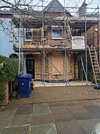
The following photos are a job where he removed the existing render- see the house next door, is was rendered at the same time in the past- He got me to cut a straight line through the neighbouring render. I then painted the exterior masonry.
The most of the red rubbers (red bricks) needed to be replaced. The photo should give you an indication of how many bricks were removed in the initial phase without compromising the integrity of the wall.
Many of the arch bricks were faced with sand and cement to keep the cost down.

A mate of mine is an amazing brick pointer, if the brick doesn't warrant removing, he faces it.
The following photos are a job where he removed the existing render- see the house next door, is was rendered at the same time in the past- He got me to cut a straight line through the neighbouring render. I then painted the exterior masonry.
The most of the red rubbers (red bricks) needed to be replaced. The photo should give you an indication of how many bricks were removed in the initial phase without compromising the integrity of the wall.
Many of the arch bricks were faced with sand and cement to keep the cost down.
That's the cause of the spalled bricks then.Hi W,
The rest of the house is lime mortar, so I suspect the hardness is recent pointing, so no problem
C
OP,
1. Can you show where any DPC is bedded - maybe its two courses down from the plinth bricks? Lack of a DPC would leave your brickwork open for rising damp.
2. Its probable that all three sides of the bay need remedial work as below?
3. A sand & cement pointing has been smeared over the original sand & lime mortar - the cement pointing needs removing & the beds & perps need grinding out to 25mm depth for a 3:1 mix of sand and NH lime mortar re-pointing.
4. Various thickness cheap discs are available eg. 2mm if needed.
5. google "cant bricks pics" - to understand whats available for corners.
Except for re-pointing with lime then leave the plinth bricks alone.
6. Start by removing a brick - grind the beds & perps - drill a few holes though the brick & gently shatter the remains using, say, a 12mm flat cold chisel.
7. Its probable that there's a cavity so beware of bridging the cavity with debris.
8. FWIW: there are no easy options or short cuts for your situation.
I dont see any air bricks - is the inside floor solid? Any signs of damp inside?
1. Can you show where any DPC is bedded - maybe its two courses down from the plinth bricks? Lack of a DPC would leave your brickwork open for rising damp.
2. Its probable that all three sides of the bay need remedial work as below?
3. A sand & cement pointing has been smeared over the original sand & lime mortar - the cement pointing needs removing & the beds & perps need grinding out to 25mm depth for a 3:1 mix of sand and NH lime mortar re-pointing.
4. Various thickness cheap discs are available eg. 2mm if needed.
5. google "cant bricks pics" - to understand whats available for corners.
Except for re-pointing with lime then leave the plinth bricks alone.
6. Start by removing a brick - grind the beds & perps - drill a few holes though the brick & gently shatter the remains using, say, a 12mm flat cold chisel.
7. Its probable that there's a cavity so beware of bridging the cavity with debris.
8. FWIW: there are no easy options or short cuts for your situation.
I dont see any air bricks - is the inside floor solid? Any signs of damp inside?
Cut the joints with a hand saw thenHi W,
The rest of the house is lime mortar, so I suspect the hardness is recent pointing, so no problem
C

DIYnot Local
Staff member
If you need to find a tradesperson to get your job done, please try our local search below, or if you are doing it yourself you can find suppliers local to you.
Select the supplier or trade you require, enter your location to begin your search.
Please select a service and enter a location to continue...
Are you a trade or supplier? You can create your listing free at DIYnot Local