
You are using an out of date browser. It may not display this or other websites correctly.
You should upgrade or use an alternative browser.
You should upgrade or use an alternative browser.
ECIR pre new c u or not
- Thread starter petend
- Start date

Some amount of testing and inspection will be required before a new consumer unit.
Whether that involves a complete EICR depends on the size, age, history and observed condition of what's there.
In any case, just having someone turn up and sling a new consumer unit in is likely to result in problems and extra expense not quoted for.
Whether that involves a complete EICR depends on the size, age, history and observed condition of what's there.
In any case, just having someone turn up and sling a new consumer unit in is likely to result in problems and extra expense not quoted for.
Changing a CU without doing at least some inspection/testing first, can put the electrician and their customer in an awkward situation, For a few reasons.
1. By installing a new CU the electrician inevitably assumes some level of responsibility for the wiring supplied by it. Some pre-existing non-compliances are able to be documented and tolerated, but there are limits to what any reasonable electrician would be prepared to connect up and energise. The new protective devices will likely have different characteristics to the old, so cabing suitability will need to be assessed.
2. Some faults (notably neutral to earth faults and borrowed neutrals) that may have gone unnoticed with an old CU can lead to immediate tripping when trying to re-energise the circuits on a modern setup.
3. Old rubber wiring may literally fall apart when worked on.
Whether that testing and inspection needs to amount to a full EICR is another matter. Some electricians will naturally be more risk-averse than others.
1. By installing a new CU the electrician inevitably assumes some level of responsibility for the wiring supplied by it. Some pre-existing non-compliances are able to be documented and tolerated, but there are limits to what any reasonable electrician would be prepared to connect up and energise. The new protective devices will likely have different characteristics to the old, so cabing suitability will need to be assessed.
2. Some faults (notably neutral to earth faults and borrowed neutrals) that may have gone unnoticed with an old CU can lead to immediate tripping when trying to re-energise the circuits on a modern setup.
3. Old rubber wiring may literally fall apart when worked on.
Whether that testing and inspection needs to amount to a full EICR is another matter. Some electricians will naturally be more risk-averse than others.
Are you preparing the property to become a rental?
I got a quote for “EICR followed by new CU if satisfactory”, discussed in some detail with the electrician.
The day came; he didn’t come himself but send a “lad”. The lad immediately popped out the cutout fuse and removed the old CU from the wall, with no testing.
Moral of the story: they’ll do what they want, don’t try to “tell them how to do their job”.
The day came; he didn’t come himself but send a “lad”. The lad immediately popped out the cutout fuse and removed the old CU from the wall, with no testing.
Moral of the story: they’ll do what they want, don’t try to “tell them how to do their job”.

- Joined
- 27 Jan 2008
- Messages
- 28,156
- Reaction score
- 3,415
- Location
- Llanfair Caereinion, Nr Welshpool
- Country

I had a CU fitted with no pre-testing, and there was one borrowed neutral, really selecting the wrong line, but I am an electrician just wanted person doing the job to do bits I am no longer able to do, and I have no problem finding the problem and correcting, but I knew I was taking a chance, with all RCBO CU likely only two circuits will fail, but this time of year not good to be without power while finding the fault.
When my new CU was fitted three years ago the electrician said that, as the system was last worked on in 1985, he would insist on doing an EICR before fitting. He charged a reduced fee for this if I went ahead with the swap. In the first hour he had found that the property had virtually no earth apart from a connection to a water pipe which was unsatisfactory. Also, no gas bonding and an unsafe connection to an outside light, which didn't work but was still live, no earthing to the lights and downlights in the bathroom which were non-compliant. So he was here for a day and a half and I was charged accordingly. No complaints at all.

- Joined
- 11 Jan 2004
- Messages
- 46,256
- Reaction score
- 3,665
- Country
Blimey, I'm 59 and feeling old and decrepit already!No, I'm 68 and retired, just wanna get a few things sorted before old and decrepit
- Joined
- 27 Jan 2008
- Messages
- 28,156
- Reaction score
- 3,415
- Location
- Llanfair Caereinion, Nr Welshpool
- Country
Yes, at 74 I realise some improvements not worth doing, will not get paid back in my lifetime.
But it was my mother who with eyesight problems and dementia, who seeing an extension lead flickering red thought it was on fire, and put it in a bucket of water, made me realise how important RCD protection is.
As to an EICR, there is no hard and fast rules as to how much needs testing, and what is pass or fail, in industry we would inspect 20% and only test more if we found faults. We would test and inspect a different 20% each time, but it does mean there is no guarantee all faults will be found. The idea is earth leakage faults and the like are found and corrected before the CU change, and an informed decision can be made, does it need all RCBO or not.
I can test my earth leakage very fast,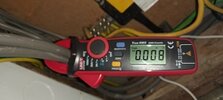 I know my earth leakage is 8 mA, that's total, can also test circuit by circuit, but not quite so easy, my point is some testing needs to be done before starting, but as to a 100% inspection and test, that is likely not required in many cases.
But it was my mother who with eyesight problems and dementia, who seeing an extension lead flickering red thought it was on fire, and put it in a bucket of water, made me realise how important RCD protection is.
As to an EICR, there is no hard and fast rules as to how much needs testing, and what is pass or fail, in industry we would inspect 20% and only test more if we found faults. We would test and inspect a different 20% each time, but it does mean there is no guarantee all faults will be found. The idea is earth leakage faults and the like are found and corrected before the CU change, and an informed decision can be made, does it need all RCBO or not.
I can test my earth leakage very fast,
I know my earth leakage is 8 mA, that's total, can also test circuit by circuit, but not quite so easy, my point is some testing needs to be done before starting, but as to a 100% inspection and test, that is likely not required in many cases.
DIYnot Local
Staff member
If you need to find a tradesperson to get your job done, please try our local search below, or if you are doing it yourself you can find suppliers local to you.
Select the supplier or trade you require, enter your location to begin your search.
Please select a service and enter a location to continue...
Are you a trade or supplier? You can create your listing free at DIYnot Local


