

Hi everyone,
I’m in the early planning stages of thinking about removing the chimney breasts from the ground and first floor of a semi-detached house. I’m looking for a sanity check on the structural approach before I engage a Structural Engineer and start the Party Wall notices.
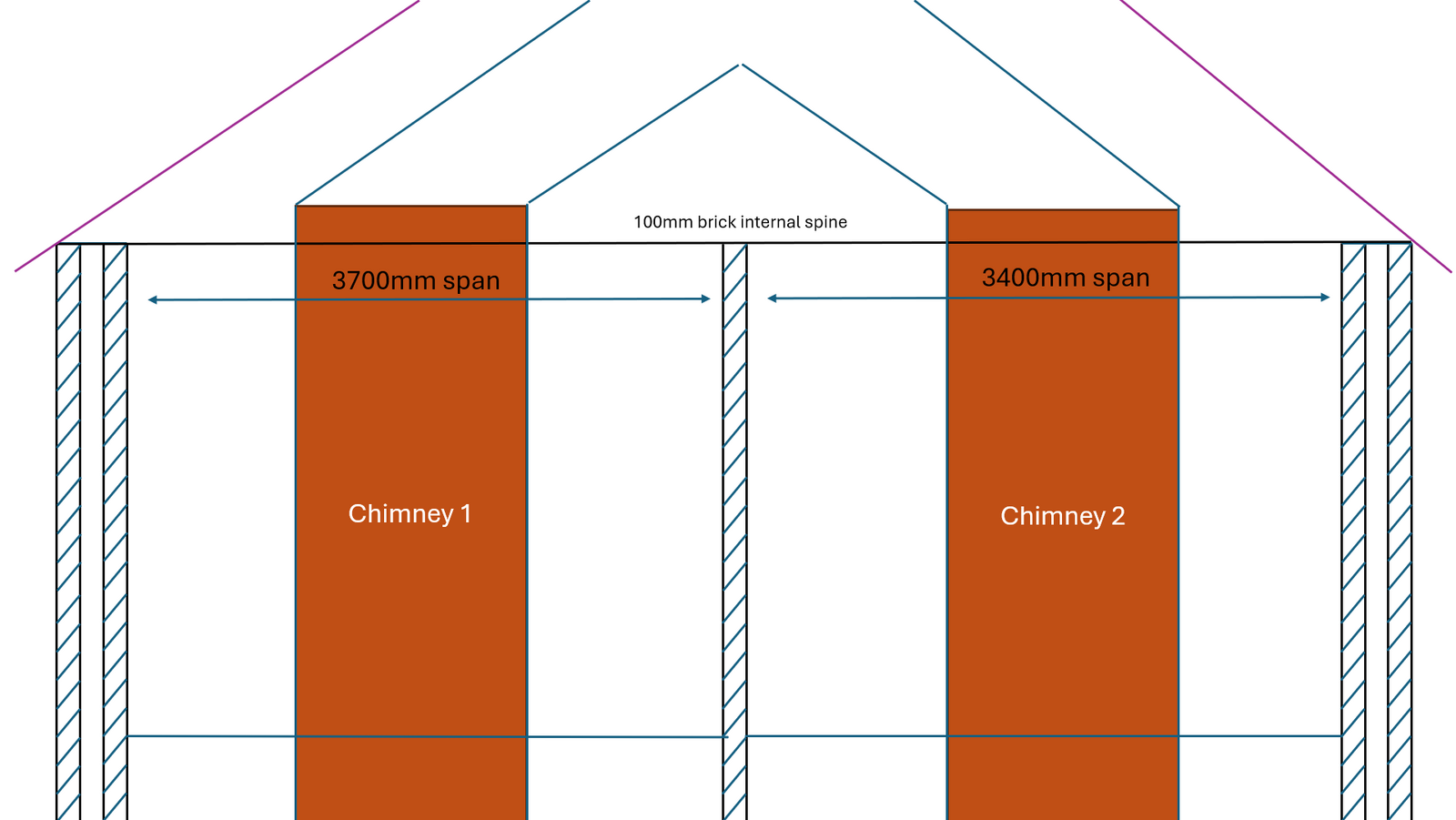
The Situation:
House: Standard UK semi-detached 1930s.
Chimney: "Gathered" flue. Two separate breasts (front and back rooms) merge into a single stack in the loft.
Constraint: From my reading, building control generally does not permit gallows brackets for this setup (especially on a party wall), so I am planning for a steel beam solution.
Party Wall: I am aware I need a Party Wall Agreement and a Structural Engineer’s calcs. Just trying to understand the likely steel layout first.
The "Proposed" Plan:
I want to avoid spanning a single huge beam the full depth of the house (front to back) due to it's height in interfering with the roof.
Instead, I’m hoping to use the central internal wall as a mid-span support?
Beam 1: Spans from Front Wall -> Central Spine Wall.
Beam 2: Spans from Rear Wall -> Central Spine Wall.
The Question:
My central spine wall is a single skin brick wall (approx 100mm).
Is it standard practice to bear two steel beams (supporting a shared stack) onto a 100mm internal wall using spreader padstones? e.g. 440x100x215
What if these 2 beams were to have end brackets and bolted together to make it a "single" UB
Or is a 100mm wall typically considered too slender for this load, forcing me to span the full depth of the house (external to external) or install brick piers/steel posts downstairs (which I want to avoid)?
Has anyone done this successfully on a half-brick spine wall without needing extra vertical supports in the bedrooms?
I feel like this is a common problem but I can't seem to find a solution.
Thanks in advance for any insights!
I’m in the early planning stages of thinking about removing the chimney breasts from the ground and first floor of a semi-detached house. I’m looking for a sanity check on the structural approach before I engage a Structural Engineer and start the Party Wall notices.
The Situation:
House: Standard UK semi-detached 1930s.
Chimney: "Gathered" flue. Two separate breasts (front and back rooms) merge into a single stack in the loft.
Constraint: From my reading, building control generally does not permit gallows brackets for this setup (especially on a party wall), so I am planning for a steel beam solution.
Party Wall: I am aware I need a Party Wall Agreement and a Structural Engineer’s calcs. Just trying to understand the likely steel layout first.
The "Proposed" Plan:
I want to avoid spanning a single huge beam the full depth of the house (front to back) due to it's height in interfering with the roof.
Instead, I’m hoping to use the central internal wall as a mid-span support?
Beam 1: Spans from Front Wall -> Central Spine Wall.
Beam 2: Spans from Rear Wall -> Central Spine Wall.
The Question:
My central spine wall is a single skin brick wall (approx 100mm).
Is it standard practice to bear two steel beams (supporting a shared stack) onto a 100mm internal wall using spreader padstones? e.g. 440x100x215
What if these 2 beams were to have end brackets and bolted together to make it a "single" UB
Or is a 100mm wall typically considered too slender for this load, forcing me to span the full depth of the house (external to external) or install brick piers/steel posts downstairs (which I want to avoid)?
Has anyone done this successfully on a half-brick spine wall without needing extra vertical supports in the bedrooms?
I feel like this is a common problem but I can't seem to find a solution.
Thanks in advance for any insights!


