
Willis Heating System

My controller (iboost+) is designed to be used if required with two immersion heaters, and will auto heat the top one first, until the thermostat turns it off, then it will start heating the bottom one. 1772383633930.png If one compares this to the Willis, the Willis is far cheaper. The iboost+ is nearly £300, that's without the cost of two immersion heaters. And for me a new tank which can take two immersion heaters or one of these 1772384235067.pngat £150 each. So the Willis system is cheaper it would seem?
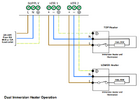
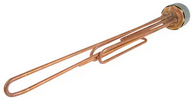
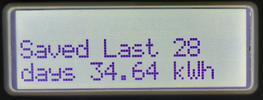
Since I already have the iboost+ then the dual element would seem a good idea, but back to the whole idea, is it worth it. At the moment I use a single 27" immersion heater, summer 1772384620514.png at 8.5p/kWh so £3 a month, so just not worth worrying about.
 
My controller (iboost+) is designed to be used if required with two immersion heaters, and will auto heat the top one first, until the thermostat turns it off, then it will start heating the bottom one. ... If one compares this to the Willis, the Willis is far cheaper. The iboost+ is nearly £300, that's without the cost of two immersion heaters. And for me a new tank which can take two immersion heaters or one of these ... <> ... at £150 each. So the Willis system is cheaper it would seem? Since I already have the iboost+ then the dual element would seem a good idea ...
I think is is all a bit tangential to a discussion about the (traditional) use of a Willis heater, but ....

.... if your aim were to heat all the water in the cylinder (which is the usual concept of a 'stored hot water' system) then I don't think that the ("iboost+ switched") dual-immersion system would offer any advantage. As far as I can see, a 'high internal immersion' or external Willis heater only offers an advantage (over a 'low internal immersion') if one primarily only wants to heat a bit of water at the top of the cylinder (since those approaches minimise mixing with the colder water below. If you want to heat the entire contents of a cylinder, it's all got to be heated, so you might just as well have just a 'low' (or 'long') internal immersion.
 
The idea was to use solar, rather than give it away for free, the first 20 months I was tied into British Gas, who would not pay me for export, as they said I had filled in their form in the wrong format, and wanted £75 if I was to leave early.

On moving to Octopus found the problem was a missing MPAN number which was sorted within two weeks. Be it in a battery, or as hot water, unless a solar panel system has some sort of storage it will be unlikely to pay for its self within a reasonable time. But the iboost+ and other controllers were really made for when export was not measured but assumed, the old FIT system, and it allows a variable amount of energy to be stored in the water. Today is not really worthwhile, like the optimiser, with fluorescent lights, things have moved on, and today often considered as snake oil.
 
The idea was to use solar, rather than give it away for free, the first 20 months I was tied into British Gas, who would not pay me for export ...
Yes, I realise that (which is why I suggested that your comment was somewhat 'tangential' to our discussion).

However, the amount of spare energy you have available from solar is the amount of spare energy you have from solar - so, if your intent were (after the solar has all been used up) to heat the rest of the water in the cylinder in some other way, then I don't think there would be any advantage in having the 'dual immersion' system you mentioned - you might just as well use the solar supply for just a single bottom/long immersion. I think that it would only be if you intended to heat just a little bit of water at the top of the cylinder that initially using a high internal (or external Willis) heater would offer a little advantage.
 
I don't understand. The post of mine you're initially quoting is mainly about the disadvantages (inconveniences) of any system which heats small volumes of water 'as needed', whereas the "this" of mine you go on to quote offers one suggestion why it might be that one tiny pair of countries of the world have made widespread use of the system, hence presumably not as concerned about the 'inconveniences' as most of the rest of us.

I am certainly saying that changing from my present system (reliant on stored hot water) to one in which I heated only small amounts of water 'as needed' would be a 'disadvantage (inconvenience) but I do agree that it would probably 'make no noticeable difference' whether the latter were achieved with an external immersion (Willis) or a conventional 'internal' one.

You mean in terms of the eventual need to replace the immersion? If so, I suppose that's theoretically correct, but I wouldn't want to endure years of ('inconveniently') having to anticipate and act upon my every single need for a bit of hot water in order to avoid potential problems in replacing the immersion a number of years down the road!

As I've recently written, in an ideal world, storing hot water is non-ideal - so, in that sense, I would agree with you -so 'instant heating' is theoretically preferable (and, in the UK at present, ideally 'instant gas' because of the large price difference of the two fuels) - but the crucial point (in relation to 'convenience') is that it must be 'instant' (not 'anticipating need and then waiting a few minutes').

However, if you want to do it "instant", 3kW electric heaters (whether internal or 'Willis') are not going to be adequate - you'll really need something like the 10.5 kW of half-decent electric showers for reasonable performance.
Sorry but in your last few posts I've really lost track of what you are saying so I think a boing time
 
Sorry but in your last few posts I've really lost track of what you are saying so I think a boing time
Since I have now almost got my thoughts clear, I think that "what I am (now) saying" can be summarised pretty briefly and succinctly:

1... Having to anticipate every single need for hot water, react accordingly and then wait (a potentially significant amount of time) for the hot water to become available is really not very 'convenient' or compatible with many of our life styles.

1a... if, nevertheless, one is prepared to accept that inconvenience, then very much the same can be achieved with either a 'top' internal immersion or an external Willis heater. The Willis system would probably be slightly more efficient and, in the very long-term, easier to replace, but there is really unlikely to be much noticeable difference. In practice, I don't think there'd even be a lot of difference even if it were a 'bottom' (or 'long') internal immersion, since the newly-heated water would only have to make one 'journey' up through the colder water above it.

1b... my one (probably now only) outstanding 'technical uncertainty' about the Willis system is that I still do not really understand how it can result in significant heating of water below the level of the Willis heater (including your example with the heater actually above the cylinder). If I'm right in my suspicion that it can't do that, then the situation is the same as with a 'high' internal immersion - that, since the position of the heating element is 'fixed', so is the maximum amount of water that can be heated by it.

1c... if one has a pretty large ('standard size') DHW cylinder, it seems a little odd,if not 'perverse', to only use perhaps 25% of it to provide 'on-demand' hot water, with the consequential 'inconveniences'.​

2... If one doesn't want the 'inconvenience' of having to 'plan' and then wait for water to be heated by a relatively small (3kW) source, that leaves us with with either stored hot water or truly 'instantly'- ('real-time') heated hot water. Storage of hot water is theoretically not ideal (due to some inevitable losses, hence some 'wastage' (of energy and money) but instantly-heated water is unlikely to be satisfactory (in terms of both temp and flow) unless one has a heat source of 10 kW or so (or~20 kW [or 2 x 10 kW] if one wants to be able to satisfactorily use a hot tap and shower simultaneously)​
 
Since I have now almost got my thoughts clear, I think that "what I am (now) saying" can be summarised pretty briefly and succinctly


1... Having to anticipate every single need for hot water, react accordingly and then wait (a potentially significant amount of time) for the hot water to become available is really not very 'convenient' or compatible with many of our life styles.​
Possibly not but the way it used to be and I truly don't recall significant problems
1a... if, nevertheless, one is prepared to accept that inconvenience, then very much the same can be achieved with either a 'top' internal immersion or an external Willis heater. The Willis system would probably be slightly more efficient and, in the very long-term, easier to replace, but there is really unlikely to be much noticeable difference. In practice, I don't think there'd even be a lot of difference even if it were a 'bottom' (or 'long') internal immersion, since the newly-heated water would only have to make one 'journey' up through the colder water above it.​
Which it does very well, particularly a long vertical
1b... my one (probably now only) outstanding 'technical uncertainty' about the Willis system is that I still do not really understand how it can result in significant heating of water below the level of the Willis heater (including your example with the heater actually above the cylinder). If I'm right in my suspicion that it can't do that, then the situation is the same as with a 'high' internal immersion - that, since the position of the heating element is 'fixed', so is the maximum amount of water that can be heated by it.​
Think of the restricted Willis vessel causing it to work like a pump
1c... if one has a pretty large ('standard size') DHW cylinder, it seems a little odd,if not 'perverse', to only use perhaps 25% of it to provide 'on-demand' hot water, with the consequential 'inconveniences'.​
Which one will have with a short top heater but not with a Willis
2... If one doesn't want the 'inconvenience' of having to 'plan' and then wait for water to be heated by a relatively small (3kW) source, that leaves us with with either stored hot water or truly 'instantly'- ('real-time') heated hot water. Storage of hot water is theoretically not ideal (due to some inevitable losses, hence some 'wastage' (of energy and money) but instantly-heated water is unlikely to be satisfactory (in terms of both temp and flow) unless one has a heat source of 10 kW or so (or~20 kW [or 2 x 10 kW] if one wants to be able to satisfactorily use a hot tap and shower simultaneously)​
Many other countries have 2 phase 40-50A instant heaters which seem to cover a whole house OK
 
As I've recently written, in an ideal world, storing hot water is non-ideal - so, in that sense, I would agree with you -so 'instant heating' is theoretically preferable (and, in the UK at present, ideally 'instant gas' because of the large price difference of the two fuels) - but the crucial point (in relation to 'convenience') is that it must be 'instant' (not 'anticipating need and then waiting a few minutes').
Unless it is per-point instant heating, or you live alone, then instant heating is not preferable in theory or practice. Otherwise you have the "excitement" of the shower running cold when someone uses a hot tap, or hot when they use a cold tap.
However, if you want to do it "instant", 3kW electric heaters (whether internal or 'Willis') are not going to be adequate - you'll really need something like the 10.5 kW of half-decent electric showers for reasonable performance.
I'm glad you said "half decent" there. Note that typically a combi will be around 30kW regardless of the minimum heating demand for the property. For our rental flat, around 2kW to keep it toasty in winter, while (AFAIK) no 30kW boiler will modulate down to that.

As to the Willis arrangement, as I see it there's little between that and an in-tank immersion - except for marginally quicker recovery times under certain circumstances. That it's popular in some places I would put down to local custom - a lot of installers will stick with what they are familiar with, and as they are common, then installers will be familiar with them, and so they remain popular just by familiarity. In other places, different things will be popular.
It's likely that they will have become popular back in the days when there was a culture of "putting on the hot water" in advance of needing it, and only when a need was planned - and in that scenario, the "top down" heat up would be an advantage (if not needing a whole tankful). I think many of us will be old enough to remember when that was a common approach to managing hot water.

These days I'd suggest there is little benefit in instant heating anyway. With heat pumps, they cannot provide the output to run a shower - so storage required. If you are using solar (thermal or PV), again, storage required for maximum benefit. If you want to take advantage of variable tariffs, again storage required for maximum benefit. And as pointed out, modern spray foam lagged cylinders will (if the pipework is also similarly lagged) have fairly low standing losses - which also aren't "lost heat" for most of the year where the cylinder is inside the property (which is the case for most houses) so it just replaces a small part of the heating output.
 
If I'm right in my suspicion that it can't do that, then the situation is the same as with a 'high' internal immersion - that, since the position of the heating element is 'fixed', so is the maximum amount of water that can be heated by it.

I said I wouldn't, but...

Your theory is very wrong, as has been explained to you multiple times. The Willis will thermo-syphon the water very effectively, drawing in cold at the bottom, hot out the top, and storing the hot, at the top of the main cylinder. Cold is drawn in at the bottom of the Willis cylinder, rises as it picks up temperature, then flows out of the top.
 
Many other countries have 2 phase 40-50A instant heaters which seem to cover a whole house OK
Indeed, but not here (UK) or I believe Ireland. As I mentioned above, customs vary significant between countries - and even between different areas within a country. Reasons will be numerous - the availability of "high power" mains supplies will be one of those. In the UK, it's only relatively recent that 60A, 80A, or even 100A supplies have become commonplace - hence the idea of having 20+kW (I'm assuming the 2 phase mentioned is something like a 480V split phase) would have been unimaginable here until quite recently.
In some countries, it's still common to pay different standing charges based on supply capacity - enforced by a supplier owned/provided MCB which I believe can be well below what we might consider practical (switch on kettle while microwave running = power goes off sort of impractical.)
 

If you need to find a tradesperson to get your job done, please try our local search below, or if you are doing it yourself you can find suppliers local to you.

Select the supplier or trade you require, enter your location to begin your search.


Are you a trade or supplier? You can create your listing free at DIYnot Local

 
Back
Top