Can an electrician swap my MCBs for RCBOs?

Joined
12 Mar 2026
Messages
9
Reaction score
0
Country
United Kingdom
Hi all,
When we moved in to our house back in 2018 we found the CU had been upgraded (seemingly anyway, it looked new to me) but when I mentioned it the seller could not provide certification. As part of the sale we got an electrician out to make sure all circuits were safe and they provided a report.

We've not had any issues since but in the interests of safety (and to provide certification should we decide to move) I thought it might be good to get an electrician out to upgrade the CU.

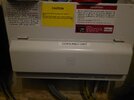
Now its an MK model (pic attached) with 2x 63a RCDs and a load of MCBS. I was thinking it might be more cost efficient for me if an electrician were to swap the MCBs for RCBOs if the existing case will take them. It seems a shame to rip the whole thing out when it’s not even 10 years old.

What are your thoughts. Will the cost difference between a whole new CU versus swapping out MCBs be negligible? Is this even something a sparky would consider? Just trying to get it clear in my head before I request a couple of quotes.
 

Attachments

  • 20260413_102208.jpg
    20260413_102208.jpg
    329.6 KB · Views: 57
  • 20260413_102218.jpg
    20260413_102218.jpg
    276.5 KB · Views: 57
Appreciate the advice - another consideration (again I want to be as informed as possible before I accept a quote) I've read about is RCBOs that need to be bidirectional should I opt for a plug in solar panel system when they're made available. Should I state to the sparky that I want them to be bidirectional or will it be assumed/expected that they will be in 2026? If there's little cost difference I'd elect for all to be bidirectional rather than the specific radial I'll be intending on using.
 
Whats wrong with it? Couple of C3s maybe

We were never provided with certification so cannot guarantee the previous house owner didn't just DIY it. Also I like the idea of RCBOs should we ever have circuits tripping - and DIY solar requires a bidirectional RCBO apparently so rather than getting a sparky to quote to replace a single MCB, I thought I'd enquire about getting the whole thing replaced so all circuits are safe and certified.
 
It’s a bit of an amateur installation but if it’s not causing issues then leave well alone
As a matter of interest... other than for the fact that the MCBs are all a bit wonky (which may have arisen subsequent to the initial installation) what is it that tells you that the installation is "a bit amateur"?
 
they provided a report
I thought I'd enquire about getting the whole thing replaced so all circuits are safe and certified.
The installation certificate is nearly the same as the electrical installation condition report, but the installation certificate can only be issued by the person in charge of the work being done.

So safety wise should be no change.
DIY solar requires a bidirectional RCBO apparently
As yet no one has a clue, the details have not been released. The problem with unidirectional RCDs is power is still fed to parts after it trips which can overheat, but with the grid tie solar inverter it is claimed they disconnect the output in milliseconds if the supply fails, so it seems unlikely any unidirectional RCD will be damaged.

I lived for years with just two RCDs, I keep considering an improvement like one of these auto resetting types temprcd.jpgor one with warning X-pole.jpg built in, but it's a lot of work for little return, and I never got around to it. This house had no RCDs in main house, so when doing the job went down the all RCBO route, for one thing it makes the consumer unit 4 modules shorter.

So in your case, if I wanted a larger DNO fuse, I note only 63 amps RCDs fitted or add a solar inverter like I have done, so although only a 60 amp DNO fuse I can have 82 amps at the consumer unit due to the 5 kW inverter, so I could not use 63 amps RCDs then while doing the work it may be worth an upgrade of the whole consumer unit, but my son fitted a new consumer unit ready for his EV, and when Octopus came to fit it, they refused to use the new consumer unit anyway. They insisted on using a dedicated one. So idea of future proofing is flawed.
 
We've not had any issues since but in the interests of safety (and to provide certification should we decide to move) I thought it might be good to get an electrician out to upgrade the CU.

In the interests of safety, it will be no safer, if the circuits are already protected by an RCD. The only advantage will be from the perspective of a fault on a circuit developing - a fault would cause a loss of supply to a number of your circuits, so not as convenient.
 
In the interests of safety, it will be no safer, if the circuits are already protected by an RCD. The only advantage will be from the perspective of a fault on a circuit developing - a fault would cause a loss of supply to a number of your circuits, so not as convenient.
Indeed, but one (albeit small) 'downside of RCBOs is that they can hinder/frustrate fault-finding to some extent, since if one trips one is given no indication as to whether it has tripped because of over-current or residual current.
 
Will the cost difference between a whole new CU versus swapping out MCBs be negligible?
It will, because most of the cost is the items inside the consumer unit, the installation of them and the testing of the circuits connected.
The actual box on the wall is an insignificant part of the total.

and DIY solar requires a bidirectional RCBO apparently
All solar PV requires that, and solar cannot be on an RCD shared with other circuits, and neither can other items such as EV charging.

The RCDs in the existing unit are Type AC which are unsuitable for solar, EVs and the majority of everything else that is in use today.
There is no surge protection either.

Suggest the whole lot is replaced, preferably with items from a manufacturer who actually designs and makes their own stuff.
MK never made any of the items for their consumer units. It has always been a licensing and labelling exercise, which is why the design of them has changed so many times over the decades.
 
All solar PV requires that, and solar cannot be on an RCD shared with other circuits

bit of a tangent now but what are your thoughts regarding DIY Solar that'll be available soon? It's very unlikely the average punter will be expected to know about the intricacies of their consumer unit- they'll be plugging their kit in to the closest most convenient socket and that'll be it.

How could this be addressed?
 

If you need to find a tradesperson to get your job done, please try our local search below, or if you are doing it yourself you can find suppliers local to you.

Select the supplier or trade you require, enter your location to begin your search.


Are you a trade or supplier? You can create your listing free at DIYnot Local

 
Back
Top