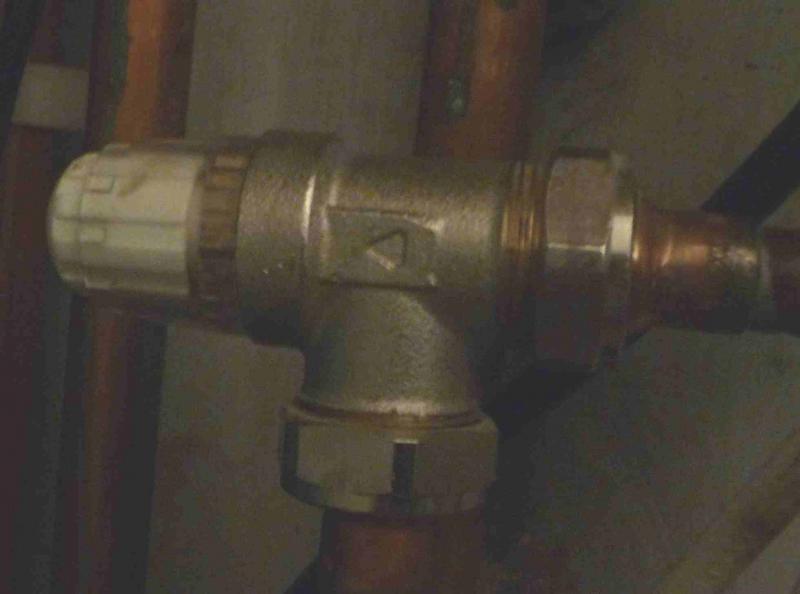
Bypass Valve still flowing when fully wound down

I think I'm onto something. Agile set me thinking.

I've looked at the thermostatic valve on the last radiator, a Drayton TRV4.
I've removed the body an measured the plunger movement as 8mm. That's all the way from Maximum down to the frost symbol. But looking at the pin in the valve it only moves 2.5mm (maybe too precise but it's not over 3mm)

Nothing I do can encourage the pin to move more.

Is this the problem?
 
hmmm iv always struggled with setting an auto bypass up, has anyone got any advise on the best way to do this? fitted a megaflow the other day, and on the auto bypass its got 0.1bar upto 0.5 bar

is 0.1 open full an 0.5 nearly shut? whats wrong with the old gate valve way of doing it?
 
Since I have the bits to hand I have measured the movement on a new TRV4 and find it to be 1.97 mm. Lets call it 2 mm.

So yours is moving too far according to your figures!

Although its probably a flow problem I would probably do a bucket test ( see FAQ ) at each valve on your problem rad to ensure there is no blockage or other valve related fault.

I dont think you have told us what happens when you turn off ALL the other rads?

Tony
 
So that theory is blown.

This morning this problem radiator was nearly stone cold. I shut down the lounge radiator and the water circuit and after about 15 minutes one of the 8 vertical fins was very hot. the return pipe was stone cold.

The rest of the radiators in the system have their lock shields virtually closed. Two of them (spare room and hall) are set to run almost off (ie only luke warm).

With the ABV evidence I think there is so much pressure built up in the system that it must force it open.

The problem radiator is on a 15mm drop from the upstairs circuit that feeds the rear of the house. The rear of the house has this radiator and 2 bedrooms above. Either of these (or together) will flow scalding water with a whiff of their Lock Shields open.

So I'm still looking at the flow through this problem radiator.
 
I've looked at the thermostatic valve on the last radiator, a Drayton TRV4. I've removed the body an measured the plunger movement as 8mm. That's all the way from Maximum down to the frost symbol. But looking at the pin in the valve it only moves 2.5mm (maybe too precise but it's not over 3mm)
The plunger is not in permanent contact with the pin. The gap between the two depends on the difference between the actual and required room temperature, i.e the valve setting. If set to 1 the gap will be small, so the liquid filled sensor will not have to expand so much before the plunger touched the pin and starts to close the valve. If set to 6, the gap will be bigger, so the sensor will have to expand more and the room will get hotter. The pin travel is only about 2mm between open and closed. Compare this to the travel of a typical wheel valve or LS valve
 

Looks like a Danfoss ARV22.

Min flow through your boiler is 20.3 litres/min (1.218 m³/hr, 0.338litres per sec).

With the pump set to 3, the head at a flow of 1.22 m³/hr is 4.08M or 40kPa .

From the Valve graph for a flow of 0.34 litres/sec and a head of 40kPa the valve needs to be set to 30.

Danfoss also suggest his method for adjusting the valve:

Before running the boiler, set the ARV22 to the maximum setting by turning the white knob clockwise until the knob is mechanically stopped.
Ensure that the radiator thermostats are set to their normal control temperature.
Turn on the boiler, and allow the temperature to stabilise, at this stage the ARV22 will be closed.
Turn the ARV22 knob slowly counter-clockwise until the valve begins to open, this can be monitored by feeling the temperature of the outlet connection of the valve.
At this stage turn the knob clockwise half a turn to complete the setting process.
Once the right setting has been established the setting can be locked using the transparent cap.


Has the valve been installed the correct way round? The horizontal pipe in your pic should Tee in to the pipe connected to the pump outlet.
 
I've looked at the thermostatic valve on the last radiator, a Drayton TRV4.
Did you balance the rads with the TRVs at their normal setting?

If so, that's wrong. You must balance with the TRV heads removed. See the link I posted earlier.

Also, the bypass must be set before balancing.
 
You have probably tried the obvious:
  • bleed the new/cold radiator
    open both valves OR
    remove head from TRV and check pin goes in and pops out in TRV
 
Thanks D_Hailsham

I concur that it is the Danfoss (don't know why it didn't come up on my searches). It is fitted with the flow coming in horizontally and leaving vertically down. The bit out of the picture is the right angled flow down from the 22mm flow pipe between the pump and the Heating zone valve.

Although in this cold weather I've not started it from cold I think it would not work as described by Danfoss.
Before running the boiler, set the ARV22 to the maximum setting by turning the white knob clockwise until the knob is mechanically stopped.
The white knob is fully in against the stop (0.6 Bar?) and it still flows. I conclude from this that the system is above 0.6 Bar. Or is this ABV faulty?

I presume from your comment to set at 30 it means 0.3 Bar. At this setting even more water flows through it so I know it's relieving something.

I'm still thinking that something is blocking the last radiator. And I'm quite disappointed to learn that the TRV is normal.

What I might try is to turn off this last radiator and see if I can get the rest of the system working normally and the ABV not flowing. Perhaps just a crude opening of each lock sheild one turn to see if the flow runs around the circuit again.

ps the balancing was done with the TRV's removed.
 
Although its probably a flow problem I would probably do a bucket test ( see FAQ ) at each valve on your problem rad to ensure there is no blockage or other valve related fault.

I dont think you have told us what happens when you turn off ALL the other rads?
Tony

I appreciate thats what I would do but it does not stop you from doing it yourself.

Tony
 
Agile thanks.

I will be doing the bucket test anyway but I'm just working out whether to have replacement valves ready at the same time. What's not clear from the FAQ is whether I should do the test with the pump running. I'm guessing that the important thing is to note how much flows over a set period then post the results back here.

It's easy to do your last test (close down all the other radiators). But as most are only a crack open I'm expecting that I will get more flow through the problem radiator and the ABV still burning hot as it deals with the increase in pressure. Of course I'd love to know that this whole thing is about balancing
 
Just realized that my valve setting info was based on the boiler producing full power. As it has been reduced to about 18kW my info is incorrect.

What is the actual output - parameter d.0.
What are the flow and return temperatures (d.40 and d.41)?

• Press the “i” and “+” keys simultaneously. The display shows “d.0”.
• Use the “+” or “–” keys to scroll through the desired diagnostic numbers
• Press the “i” key. The display shows the relevant diagnostic information.
• If necessary, use the “+” or “–” keys to change the value (display flashes).
• Save the new value by holding down the “i” key for approx. 5 seconds until the display no longer flashes.

You can end the diagnostic mode as follows:
• Press the “i” and “+” keys simultaneously.
• Do not press any key for approx. 4 minutes.
The current heating flow temperature appears in the display again.

What temperature differential did you use when balancing the rads?

Unless you have very long pipe runs and most of it is 15mm, you should not need the pump set to 3.
 
Wow. I am going to be busy tonight.

I think I watched the Vaillant engineer going through this sequence. He did give me a rapid verbal update on what he did to back off the boiler but there is no way I could remember that sequence.

As far as balancing is concerned the last Heating company went through this when they did a Power Flush. They were in for 6 hours but I don't recall any information on how they set the Lock Shields back. They did remove the TRV heads and replace with a white cap.

Since then the weather was mostly warm so the TRV's were holding back any flow. I was quite pleased in September when a couple of cold mornings happened and I could feel some warmth in this radiator. But now all the other TRVs are opening it's virtually cold.
 

If you need to find a tradesperson to get your job done, please try our local search below, or if you are doing it yourself you can find suppliers local to you.

Select the supplier or trade you require, enter your location to begin your search.


Are you a trade or supplier? You can create your listing free at DIYnot Local

 
Back
Top