Corefix drill size for thermalite blocks

Joined
27 Jul 2006
Messages
508
Reaction score
8
Country
United Kingdom
I am planning to use 120mm corefix to hang my radiator brackets off
The wall is dot and dab onto thermalite blocks

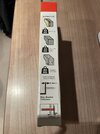
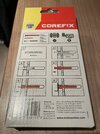
The packaging (see photos) says to use a 10 mm drill bit, however, I was wondering as the thermalite blocks are so soft, would anyone suggest that it were better to use a slightly smaller drillbit instead?

Any help and advice is appreciated
IMG_1518.jpegIMG_1517.jpegIMG_1519.jpeg
 
Thanks for the reply @noseall
It’s only an 800x600 k2 but I’d still rather be safe than sorry
I’m planning to put 4 in for each bracket and will use some of the soudal fixall as you suggested too

Would you say a 9mm or perhaps even an 8mm ?

My thought is to but a non masonry drill bit also as the blocks are so soft
 
Thanks for the reply @noseall
It’s only an 800x600 k2 but I’d still rather be safe than sorry
I’m planning to put 4 in for each bracket and will use some of the soudal fixall as you suggested too

Would you say a 9mm or perhaps even an 8mm ?

My thought is to but a non masonry drill bit also as the blocks are so soft
9mm
 
Thermalite or other thermal blocks? I've always fixed by long deep pitch screws direct into blocks (no drilling) carefully without any wallplugs. A good strong fixing that won't pull out.
 
I am planning to use 120mm corefix to hang my radiator brackets off
The wall is dot and dab onto thermalite blocks

The packaging (see photos) says to use a 10 mm drill bit, however, I was wondering as the thermalite blocks are so soft, would anyone suggest that it were better to use a slightly smaller drillbit instead?

Any help and advice is appreciated
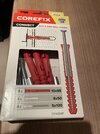
View attachment 382454View attachment 382455View attachment 382453

I have previously used them to fix shelving in my (former) garage. I built it with 220mm thermolite blocks. I then used timber battens to fix the plasterboard.

80% of the fixings tightened up. Some spinned as I was tightening them up. Over all they worked well.

I was screwing in 1.4m tall shelf struts.

I used a 10mm but, but with the hammer action off.

As per @noseall 's post, you can squirt in some "bolt fix" resin
 
Thermalite or other thermal blocks? I've always fixed by long deep pitch screws direct into blocks (no drilling) carefully without any wallplugs. A good strong fixing that won't pull out.
You have to be careful when fixing direct into friable masonry (block), with concrete screws etc, as they don't lend well to in-out or on-off scenarios i.e. fix and forget. They can soon become baggy if you fiddle about with them too much.
 
You have to be careful when fixing direct into friable masonry (block), with concrete screws etc, as they don't lend well to in-out or on-off scenarios i.e. fix and forget. They can soon become baggy if you fiddle about with them too much.
I remember when Thermalite were being pushed in the early 70's, and one of the main points was that you could screw directly into them without plugs. They soon got rid of that advertising point.
 
Thermalite or other thermal blocks? I've always fixed by long deep pitch screws direct into blocks (no drilling) carefully without any wallplugs. A good strong fixing that won't pull out.
@Scally-Ho

Thanks for your reply and apologies for the delay in replying

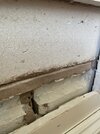
Here is a photo of the blocks

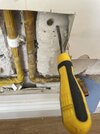
Personally, I’m not sure if they are thermal or thermalite ….. any idea from this photo please?

You can put a screw in without any real force whatsoever and likewise a screwdriver as shown

This extension was built back in 2011 if that helps also as to what products were being used by builders at the time

IMG_1526.jpeg
IMG_1527.jpeg
 
I remember when Thermalite were being pushed in the early 70's, and one of the main points was that you could screw directly into them without plugs.
In a similar vein I have seen pattresses which were fixed onto thermalites by the simple technique of skew nailing with a Passlode gun and 90mm nails. They don't seem to detach in service, but maybe that's because PB was dot and dabbed over the top.
 
My method. If it looks like the PB has a void, rather than a stud, fill with adhesive foam to stabilise (bit denser than ordinary foam). Drill a deep hole and set a brass expanding anchor on a length of stud bar (just wind up with a couple of locknuts on it). It'll be going nowhere. Locate the rad brackets over the end of the thread bar and pop a nut on.
 

If you need to find a tradesperson to get your job done, please try our local search below, or if you are doing it yourself you can find suppliers local to you.

Select the supplier or trade you require, enter your location to begin your search.


Are you a trade or supplier? You can create your listing free at DIYnot Local

 
Back
Top