maybe. But there are tariffs where the whole house changes to cheap rate, not just the car.

You are using an out of date browser. It may not display this or other websites correctly.
You should upgrade or use an alternative browser.
You should upgrade or use an alternative browser.
Cost of running dishwasher
- Thread starter Harry Bloomfield
- Start date

maybe. But there are tariffs where the whole house changes to cheap rate, not just the car.
The house consumption at night, will be at a minimum, compared to the EV charging.
Not if you have all the storage heaters on!  (and ur, The dishwasher of course, trying to bring it slightly back to the topic)
Anyway, who said anything about night time.
(and ur, The dishwasher of course, trying to bring it slightly back to the topic)Anyway, who said anything about night time.
Not if you have all the storage heaters on!
Would an EV tariff allow SH's?
Anyway, who said anything about night time.
That's when the tarrif is cheapest, I thought.

- Joined
- 27 Jan 2008
- Messages
- 29,639
- Reaction score
- 3,665
- Location
- Llanfair Caereinion, Nr Welshpool
- Country

It really does not matter what battery and inverter you have, whether built into a car, or part of a solar array, if you allow the supplier to control when you charge and discharge the battery, they will give you a better rate.Probably because the energy demand for EV's can be dynamically adjusted by the suppliers, whereas E7 demand simply cannot.
But the rates are not nationwide, some areas pay more than others. And when I looked at just Octopus, never mind any other suppliers, there are a whole range of tariffs.
It seems to have no reason behind the tariffs, compare Octopus Flux and Go, where Flux is claimed to be designed for solar with batteries, and Go is for EV users the rates Flux
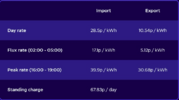 has an off-peak, standard, and peak. The off-peak only 3 hours, and the peak 4 pm to 7 pm may work out OK in summer, but winter I may well run out of battery by 7 pm and by 4 pm I am being careful what I am using, so one would need a massive battery and be active ensuring it is charged before 4 pm, so one can export at the 30.68p/kWh, for me far too much hassle.
The storage heater rate
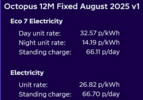 seems good at a quick glance, but the night rate is still much higher to the Go rate for EV users. And I do not need 7 hours off-peak, it takes around 1.5 hours to recharge my batteries, but the tumble drier runs for nearly 2.5 hours, and depending on when you set it, you have ½ hour or 1 hour increments of delay. Setting it to line up with a 3-hour off-peak slot can't really be done. So either to start or finish it will be using battery.
If the export rate is less than off-peak, one does not want to import more than is needed until the sun comes out, or one will end up exporting power for less than you paid for it. Not looking to make money by importing off-peak and exporting peak, but don't want to loose money. So what I want is to pay same or less for off-peak to what I get paid to export, so I do not need to view next days weather, I can just fully charge the battery, and let the system do its own thing.
So today solar has not kept up with demand
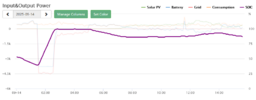 but the battery state of charge (SOC) is enough to likely reach 00:30 tomorrow when off-peaks starts without running out, as charged up overnight. But Friday exported 17.8 kWh, so the EV tariff works well, 8.5p off-peak 00:30 to 05:30 and 30.17p rest of the time, which I rarely need to draw on, and export rate at 15p/kWh so if I import more than I need, I am not loosing.
However, son with dynamic Go, is paying more like 6p/kWh off-peak, and has a special rate as car bought from Octopus, on lease, and charge point fitted by Octopus, so his rate is far less to mine. He also gets a tax break due to having an EV, it means car sales outlets, and electrical firms fitting EV charging points can't compete. Octopus has undercut them all, so for the car trade and the electrical trade the bubble has burst as far as EV's go.
If one has an "EV tariff", can the supplier distinguish between electricity being used for EV charging and that used for anything else? I would have thought not, but may be wrong. It presumably would only be possible if the EV charger could 'talk' to the supplier, maybe by somehow using a different register in a 'Smart' meter?Would an EV tariff allow SH's?

- Joined
- 18 Apr 2022
- Messages
- 7,490
- Reaction score
- 1,153
- Country
Chargepoints are required to have the ability to send and receive information to/from the supplier and the ability to respond to signals to vary the rate or time at which charging happens.
I don't think that Smart meters are, or have to be used for that, and IHNI where we are with suppliers actually implementing their side of it.
But technically a supplier could record EV use and carry out a separate rating process for that and adjust the customers bill accordingly without any smart metering.
So a customer could be on a single tariff, and have a dumb, single-tariff meter, and still pay special off-peak EV rates. Or he could be on a traditional 2-tariff one, and pay a different off-peak EV rate from the general off-peak rate.
I don't think that Smart meters are, or have to be used for that, and IHNI where we are with suppliers actually implementing their side of it.
But technically a supplier could record EV use and carry out a separate rating process for that and adjust the customers bill accordingly without any smart metering.
So a customer could be on a single tariff, and have a dumb, single-tariff meter, and still pay special off-peak EV rates. Or he could be on a traditional 2-tariff one, and pay a different off-peak EV rate from the general off-peak rate.
OK. Thanks. How is that communication achieved? If it relies on the GSM network, then they would probably have the same (very small) amount of luck in my house as a 'Smart'meter would haveChargepoints are required to have the ability to send and receive information to/from the supplier and the ability to respond to signals to vary the rate or time at which charging happens.

- Joined
- 18 Apr 2022
- Messages
- 7,490
- Reaction score
- 1,153
- Country
Fair enough, but the point made in the title of your link ("3.9 of the document") is then followed by ...
... which doesn't necessarily make us much the wiser3.10 A charge point must be configured such that when it loses communications network connectivity it is still able to charge an EV, to ensure owners are still able to charge their vehicles.
3.11 The Regulations do not specify how charge points should operate in the event of a loss of connection beyond them just being able to charge an EV.
Yes, default settings for when it allowed charging to happen, but if there were no comms, so that the supplier didn't know how much EV charging had been done, and when, I suspect that the user would not get the reduced 'EV charging rate' for their charging, would they?Presumably they'd have to operate under the default settings. But with no comms, I wonder how it knows what the time is?
- Joined
- 27 Jan 2008
- Messages
- 29,639
- Reaction score
- 3,665
- Location
- Llanfair Caereinion, Nr Welshpool
- Country
Technically yes, in practice only if installed before 2023, the solar installer could pre-2023 install a meter for export which would be assigned an MPAN number, but early 2023 this was stopped, and the supplier on new installations can only use the smart meter for billing. The supplier can be given control of devices, be it the car charger or the solar inverter, but billing now has to be with the smart meter.So a customer could be on a single tariff, and have a dumb, single-tariff meter, and still pay special off-peak EV rates. Or he could be on a traditional 2-tariff one, and pay a different off-peak EV rate from the general off-peak rate.
It seems where the teleswitch was fitted, they can use simple time switches to replace it, but they can't fit a time switch where there was no split supply in the past, which seem wrong to me.
Years ago, Scottish power supplied an internet connected device to allow better billing, similar to what the smart meter does today. But the meter was still read once a year and the bill corrected.
It seems the rules are not law, but issued by the DNO so that billing companies can swap who does the billing, so very hard to get conformation of exactly what is permitted.

DIYnot Local
Staff member
If you need to find a tradesperson to get your job done, please try our local search below, or if you are doing it yourself you can find suppliers local to you.
Select the supplier or trade you require, enter your location to begin your search.
Please select a service and enter a location to continue...
Are you a trade or supplier? You can create your listing free at DIYnot Local
Similar threads
- Replies
- 12
- Views
- 1K
- Replies
- 46
- Views
- 12K

- Replies
- 25
- Views
- 860
- Replies
- 17
- Views
- 3K
- Replies
- 13
- Views
- 21K