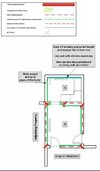
He messaged me today and said he got a company to do a damp survey last year. He showed me the proposal today. The bassically said they thing he needs a chemical DPC and some other things to solve the problem. I'm not sure if they are scamming him or not, though, as I have always heard bad things about companies ripping customers off with fake claims that chemical injections are needed.. I'll copy some of their proposal below.
The customer is a good guy, very honest, and doesn't deserve to be ripped off (not that bad customers deserve being ripped off, but still worse when it's a good guy having it done to him)
The propsal >>
"
Rising Dampness
At the time of our inspection visible signs of dampness, supported by moisture profile readings obtained with an electronic moisture meter, indicated the presence of rising dampness to some other walls indicated for treatment on the attached sketch.
The rising dampness appears to be due to the failure / deterioration of the existing damp proof course.
Rising dampness is a common, naturally occurring phenomenon caused by moisture rising via capillary action into the building fabric. Most masonry building materials can be subject to rising dampness and, without suitable protection, your property can suffer from the problem. Effects can include unsightly mineral salts, moisture staining to decorative surfaces and, in severe cases, the breakdown of wall plaster due to salt contamination.
Our method of installing a new damp proof course will control rising dampness above the level of the newly installed damp proof course. It will not control dampness below this level.
Plaster & Salts
As the moisture rises from the ground or penetrates from above, into a wall, it carries with it soluble salts which may be deposited in the wall fabric and plaster, as the moisture evaporates. Certain of these salts, in particular chlorides and nitrates, are hygroscopic; that is they are capable of attracting and absorbing moisture from the atmosphere when the relative humidity is high.
Effects
The defects noted from our inspection above will or are likely to allow moisture to be transmitted into the building fabric. Not only is this likely to spoil and damage internal finishes and decorations, but it will also put timbers within the property at serious risk from fungal decay and damage the building fabric itself. We strongly advise that you arrange for all the above noted defects to be attended to.
Recommendations
We have detailed below the items of work that [redacted] will be pleased to undertake for you, together with quotations.
Damp Proof Course
[redacted] are to:
Install a chemical damp proof course incorporating our [redacted] DryWall Diffusion Process to those walls indicated on the sketch, in accordance with the explanatory leaflet attached. Our quotation for this work is enclosed.
Our damp proof course can be installed (subject to access) in solid walls from one side only of the wall to be treated, causing the minimum of disturbance. Non-flammable and non-toxic fluid is used in the installation. There is therefore no fire risk, the property can remain occupied with a minimum of inconvenience to the occupants and will have no ill effects on you or occupants of the adjacent property.
Dry Wall Coating
To control rising dampness in a wall, in addition to the proposed DPC it is of great importance that internal plaster is capable of preventing hygroscopic salts affecting the wall surface, (please refer to our ‘Rising Damp & Re-plastering’ leaflet).
Our recommendations and comments are as follows: -
It is usually recommended that all the walls to be treated are re-plastered to an even height as indicated on the sketch, strictly in accordance with our specification for ‘DryWall Coating’ but as the walls have been dry lined full height we will have to change our specification in places so that our new plaster matches the existing but can still prevent any salt contamination into the finished wall surface.
Our quotation covering re-plastering allows for the following:-
[redacted] are to:-
Hack-off and remove existing plaster from the areas and heights indicated on the attached sketch, and clear resultant debris from site.
Re-plaster these areas in accordance with our specification for ‘DryWall Coating’.
After re-plastering, hairline cracking of the setting coat may occur. This will not present a problem regarding the efficiency of the new plaster and should be made good when decorating.
Upon removal of the existing wall plaster or render it may be discovered that an excessive amount of materials have been applied to bring the wall out to level. Under such circumstances additional labour and material costs will be incurred. Necessary “dubbing out” will be charged at £38.00 + V.A.T. per square metre for each additional 15mm thickness or part thereof.
Wall / Floor Joints
[redacted] are to:
Form a Vapour Barrier Up-stand ‘Raglet Joint’ to treatment wall / floor joints as follows: -
Prepare the surface by removing any plaster remains and wooden plugs, pointing up any large holes or voids from below the line of the DPC.
Where the original plaster extends below the floor slab, this will be raked out, cleaned and the void filled to floor level. A vapour proof slurry coating will then be applied to the wall-floor intersection up to the DPC installation level. This jointing technique will considerably reduce moisture vapour condensing on both the underside of plasterwork and the rear surfaces of skirting boards, extending their life span.
Rear Wall only -
Supply and fix a slimline mesh covered membrane to the exposed wall/brickwork using sealed plastic plugs and waterproof tape to the joints
Dot and dab fix new moisture resistant plaster boards to the same treatment areas and skim finish
Refit skirting boards and pipe boxings
After re-plastering, hairline cracking of the setting coat may occur. This will not present a problem regarding the efficiency of the new plaster and should be made good when decorating.
Note - The waterproof membrane will prevent any salts or dampness from permeating to the surface of the finished plaster during the drying out period
Skirtings
Where internal DPC, re-plastering, wall/floor joints or waterproofing works have been specified, it will be necessary for existing skirtings to be removed and subsequently replaced after the works have been undertaken.
[redacted] are to:
Remove existing skirting boards as required to undertake the treatment works, and re-fix upon completion.
The internal surfaces and bottom edge will receive a liberal coating of [redacted] timber water repellent prior to fixing, to extend the life span of the timber.
Where existing plaster is being retained, it is important that it does not continue below the line of the DPC or is in contact with any solid floor (see ‘Important Notes - Bridging’). [redacted] will ensure that any offending plaster is removed to those wall surfaces where we remove skirting boards necessary to undertake our treatment works only. You should ensure that the DPC is not bridged on any remaining wall surfaces. In the event of damage during removal of these fixed items or if they are found to be decayed and unsuitable for replacement [redacted], at your request, will supply and fix new boards at an additional cost. [redacted] cannot accept responsibility for any damage caused by the removal of such fixed items."
"
Guarantee
Upon completion of the contract our 20 Year Guarantee will be issued, protecting you against the recurrence of dampness rising through our dampproof course, offering you peace of mind for your property in the future. A specimen guarantee is available or can be viewed at www.[redacted].com. Whilst any general building and ancillary works undertaken by [redacted] are excluded from any treatment guarantees issued, you will of course be protected by your statutory rights under The Consumer Protection Act 2015."