
Do I have to ventilate a capped chimney, isn't it just like a cavity wall?

Joined
11 Mar 2011
Messages
114
Reaction score
2
Location
London
Country
United Kingdom
I've got access to my chimney stack with some other roof work going on.

It's a pretty standard, straight-up double chimney stack in an old house - one flue goes to ground floor and is still in use (lined with woodburner), the other flue goes to a disused fireplace in a first floor bedroom.

Everything I've read says that even if I take the pot off and cap the bedroom flue, I still have to leave the ventilation inside the house. I don't understand why I can't just fill it with insulation and seal it in, like a regular cavity wall (though the house is old so surrounding walls are not cavity). I get that if you are leaving it open at top or bottom then you'd need to ventilate it. But not if it's sealed on all sides. What am I missing?

If it can be done, what's the best insulation in that case? Vermiculite balls if the other flue is still in use (though has steel liner)?

I'll probably cap the chimney either way as the current pot just lets rain and cold air in from outside, which can't help anything. But would like to put insulation in and remove the ventilation grilles if possible.
 
I have a similar situation. There are probably ways, but I have been advised by my roofer and surveyor to keep airbricks for ventilation. Although for me both fire places (ground and first) are not in use and have been boarded up. My surveyor found evidence of damp on the bricked up chimney wall on the first floor and suspected moisture due to lack of ventilation. So when I had my chimney pots removed the roofer put airbricks in.

I think with these old houses and rising damp from the ground (my house just sits on moist soft clay), having sufficient airbricks is crucial also for flues.
 
You can place the airbricks to the outside air rather than using internal air.

Because the chimney is much more exposed, the risk of water getting into it is a lot higher than a cavity wall, which is much better protected by the roof.
 
I've got access to my chimney stack with some other roof work going on.

It's a pretty standard, straight-up double chimney stack in an old house - one flue goes to ground floor and is still in use (lined with woodburner), the other flue goes to a disused fireplace in a first floor bedroom.

Everything I've read says that even if I take the pot off and cap the bedroom flue, I still have to leave the ventilation inside the house. I don't understand why I can't just fill it with insulation and seal it in, like a regular cavity wall (though the house is old so surrounding walls are not cavity). I get that if you are leaving it open at top or bottom then you'd need to ventilate it. But not if it's sealed on all sides. What am I missing?

If it can be done, what's the best insulation in that case? Vermiculite balls if the other flue is still in use (though has steel liner)?

I'll probably cap the chimney either way as the current pot just lets rain and cold air in from outside, which can't help anything. But would like to put insulation in and remove the ventilation grilles if possible.
Are you saying that you want to fill the chimney with vermiculite top to bottom. If so I dont see how you can do it without having any voids, would you pour in from the top.
I dont think its a "thing" otherwise there would be loads of companies offering "stakfill" or god knows what else. I would imagine a pipe stuffed down from the top and then slowly withdrawn as the insulation is pumped in ?? to avoid -voids
 
You can place the airbricks to the outside air rather than using internal air.

Because the chimney is much more exposed, the risk of water getting into it is a lot higher than a cavity wall, which is much better protected by the roof.
I never thought of that - so instead of a vent in your boarded up fireplace you have it on the outside depending on the house of course.
Or instead of having a vent on a boarded up fireplace could you just vent directly to an already vented suspended wooden floor behind the boarded up fireplace so no vent is seen, only on a downstairs fireplace though - ovs .
 
Are you saying that you want to fill the chimney with vermiculite top to bottom. If so I dont see how you can do it without having any voids, would you pour in from the top.
I dont think its a "thing" otherwise there would be loads of companies offering "stakfill" or god knows what else. I would imagine a pipe stuffed down from the top and then slowly withdrawn as the insulation is pumped in ?? to avoid -voids
Yes I was thinking remove pot, fill from top, then cap off. The chimney is under scaffolding with a roof (redoing whole roof) so shouldn't be any rain getting in between filling and capping.
 
You can place the airbricks to the outside air rather than using internal air.

Because the chimney is much more exposed, the risk of water getting into it is a lot higher than a cavity wall, which is much better protected by the roof.
Is that true even if you cap it thoroughly? I haven't looked into it but I'm thinking Celotex at top inside flue, then some ply or slate, then dpc or lead, then a few inches of cement tapered to run water off. I've even got a spare coping stone with drip grooves I could put over it if that would be better
 
Seems a lot of layers there and I would not be using any wood up there. I dont see the need for a DPC or the celotex or the lead, just something to stop the cement falling down and then haunch it to the edges. Maybe add some waterproofer to the mix. But a strong 3-1 sharp sand should last.
 
Is that true even if you cap it thoroughly? I haven't looked into it but I'm thinking Celotex at top inside flue, then some ply or slate, then dpc or lead, then a few inches of cement tapered to run water off. I've even got a spare coping stone with drip grooves I could put over it if that would be better
Yeah moisture will permeate through the brickwork eventually. Better to ventilate it.
I never thought of that - so instead of a vent in your boarded up fireplace you have it on the outside depending on the house of course.
Or instead of having a vent on a boarded up fireplace could you just vent directly to an already vented suspended wooden floor behind the boarded up fireplace so no vent is seen, only on a downstairs fireplace though - ovs .
In theory although less keen on sub-floor as you might be bringing moisture up from that level. Or in the loft I suppose.

The other benefit of this is that you can place the air brick above the level of the insulation:

1718370805834.png


This was my original plan although in the end I didn't insulate the flue and just put the air brick down at the base of the flue. Used nice cast iron ones: https://www.blackcountrymetalworks.co.uk/cast-iron-air-bricks.htm and clay ventilated cowls. I don't think the insulation adds much really.
 
In theory although less keen on sub-floor as you might be bringing moisture up from that level. Or in the loft I suppose.
Would it not be worse with a vent inside the property as that vent will be warm air then meeting the cold damp air in the chimney, but from below the floor space its the same condition air now moving up. Possibly also an advantage to the space underneath the floor as the air movement will now be greater down there.
Hmmm still thinking. Would that then create a short cut for the air in the crawl space so it will no longer be going from front to back of the underneath of the house. As the air direction under the floor i believe is dictated by pressure from the prevailing wind so either the front or back would effectively be cut off if you have a vent going up in the middle of the room where the fireplace would be.
 
OP,
Why not post pics of the stack, and the flaunching, and the pots?
And why not use the forum search facility to see previous suggestions?

1. You dont fill redundant flues with insulation or any other material.
2. Redundant flues should be ventilated at the bottom and at the top to provide thro ventilation.
The bottom vent is best located inside the room not on the outside.
3. Redundant flues should be swept.
4. Historical soot, and chemicals, from solid fuel, will react with moisture in unventilated flues.
5. The result will be Hygroscopic penetration of the chimney breast & staining on the decorated surface.
6. The active flue with the SS flex liner shouldn't need vermiculite insulation - things have presumably worked well enough so far?

7. Pics will show much more but keep your pots - they add character to a building.
8. Various cowls can be inserted into pots that sit over redundant & active flues.
9. You might benefit from new flaunching - but pics needed?
 
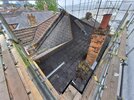
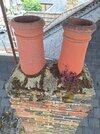
Here is the stack up close from the scaffolding.

George answered my main question - that moisture would get through chimney brickwork eventually so better to ventilate. But why doesn't that apply to any brick cavity wall?

If we do have to keep ventilation then putting an air brick in the loft instead might be a better idea as then at least I can insulate up to the top of the first floor, which would keep the main bedroom warm.

Yes I will definitely repoint and put new flaunching on the chimney while we have reasonable access to it. As you can see in the pics it's pretty shot at the top, although looks like someone has repointed about two thirds of way up so whole stack is pretty stable despite the lean.
 

Attachments

  • 1000038774.jpg
    1000038774.jpg
    538.7 KB · Views: 218
  • 1000038775.jpg
    1000038775.jpg
    600.6 KB · Views: 203
A chimneys brickwork has more surface to allow in moisture than it can cope with so needs ventilation .
Thanks yes looks like that's it.

But... so why do lined chimneys blocked with register plates at bottom not need air bricks?
 
Here is the stack up close from the scaffolding.

George answered my main question - that moisture would get through chimney brickwork eventually so better to ventilate. But why doesn't that apply to any brick cavity wall?

If we do have to keep ventilation then putting an air brick in the loft instead might be a better idea as then at least I can insulate up to the top of the first floor, which would keep the main bedroom warm.

Yes I will definitely repoint and put new flaunching on the chimney while we have reasonable access to it. As you can see in the pics it's pretty shot at the top, although looks like someone has repointed about two thirds of way up so whole stack is pretty stable despite the lean.
Once you start on that. the top blues and some of the standard bricks you will be just able to take off with your hand. So the top section will need re building I think.
Maybe a good opportunity to lower the whole lot, you say one is lined but I do not see the cap for it.
 

If you need to find a tradesperson to get your job done, please try our local search below, or if you are doing it yourself you can find suppliers local to you.

Select the supplier or trade you require, enter your location to begin your search.


Are you a trade or supplier? You can create your listing free at DIYnot Local

 
Back
Top