• Looking for a smarter way to manage your heating this winter? We’ve been testing the new Aqara Radiator Thermostat W600 to see how quiet, accurate and easy it is to use around the home. Click here read our review.

Does this earthing look correct?

Joined
14 Mar 2024
Messages
32
Reaction score
1
Country
United Kingdom
In my house's side passage I have a metal junction box just above the ground.

The external lighting comes from this junction box. It has an armoured cable input from the house and then goes to two armoured cables, one feeds the front external lights, the other feeds the rear external lights.

I was investigating the box as I wanted to permanently isolate the front external lights.

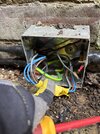
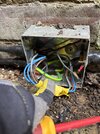
What is strange is that I noticed there are some earth coloured cables and they are connected to each other and as follows:
1) to the metal box
2) to what I presume is the metal sheath of the armoured cable to the front external lights
3) to what I presume is the metal sheath of the armoured cable to the rear external lights

But there does not appear to be an earth wire coming from the house, so is this junction box and the other wires coloured earth actually properly earthed (as these earth coloured wires just seem to be to connected to each other and other metal surfaces but not an actual earth wire coming from the house)?

Thanks
 

Attachments

  • 20250426_125024085_iOS (Large).jpg
    20250426_125024085_iOS (Large).jpg
    439.7 KB · Views: 83
It has an armoured cable input from the house
The armour of that armoured cable is probably earthed from the house. I can see a banjo with earth wire attached. The whole box is therefore earthed in that way.

I say “probably earthed” as testing is the only way to confirm that.
 
Thanks.

How can I test if it is "earthed"?

Is there a way to check if something is earther with a multimeter?

What about if I added a plug socket to this circuit and used a regular £10 socket tester which tests that live, neutral and earth are there...would that be sufficient to know it is earthed?
 
Run an extension lead from any socket to near this box, then measure resistance between the extension lead’s socket’s eath and the earth in the box with your multimeter.

It’s probably fine. It is normal to use the armour as the earth. One possible problem is that people may not understand that, make a modification, and not re-establish the earth. So it would be useful to see the other end of the cable to check if the armour has been correctly connected to an earth wire there.
 
Run an extension lead from any socket to near this box, then measure resistance between the extension lead’s socket’s eath and the earth in the box with your multimeter.

It’s probably fine. It is normal to use the armour as the earth. One possible problem is that people may not understand that, make a modification, and not re-establish the earth. So it would be useful to see the other end of the cable to check if the armour has been correctly connected to an earth wire there.
Thanks! That's a really neat way to do it. I'll give that a go tomorrow AM
 
Thanks!

I have three more questions:

1. Why are all the earth wires joined to each other with insulating tape (in my first photo)? Shouldn't they be connected by a wago connector or something? What's the purpose of wrapping with insulating tape?

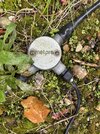
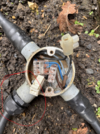
2. If the armoured cable in the garden is connected by metal conduit boxes and the armoured cables are connected by glands to the metal conduit boxes as per the second photo, does that mean as long as the first armoured cable is itself earthed, all the others will be earthed because they are 'daisy-chain' connected through the metal conduit box without needing any extra wire to connect the sheaths (i.e. the metpro conduit itself provides zero resistance between the armoured cables)?

3. I installed an additional armoured cable which i connected to a wiska box using a regular nylon gland, so the sheath isn't earthed. I was copying what I am sure an electrician did when he installed PIR lights! I guess it is really bad not to earth the armoured cable! What's the best way of earthing the sheath when I only connect the armoured cable via nylon glands? Or do I need to go and get special armoured cable brass glands?

thanks
 

Attachments

  • 20250426_125024085_iOS (Large).jpg
    20250426_125024085_iOS (Large).jpg
    439.7 KB · Views: 52
  • unnamed.jpg
    unnamed.jpg
    617.3 KB · Views: 50
Last edited:
TBH you’ll never know if the CPC is continuous OR good unless it’s tested properly

As for adding a socket - to a lighting circuit - why?
 
TBH you’ll never know if the CPC is continuous OR good unless it’s tested properly

As for adding a socket - to a lighting circuit - why?
I get the impression it's only for testing purposes.
 
1. I can’t tell what’s under the insulating tape but there could be a terminal block. They shouldn’t just be twisted and taped.

2. Yes.

3. You should use SWA glands and connect up the earths. I note Wiska have some products related to this, e.g. https://www.tlc-direct.co.uk/Products/WKEC308.html . I’m not familiar enough with this to comment in any detail.
 
3. You should use SWA glands and connect up the earths. I note Wiska have some products related to this, e.g. https://www.tlc-direct.co.uk/Products/WKEC308.html .
Eh?? The box shown has got SWA glands. The Earths seem to be connected up, but looks can deceive. Testing is the way forward.

The Wiska product you have mentioned is specifically made for the Wiska 308 box and is not appropriate for this. It wouldn't be needed anyways as the box is made of metal. Wiska needs their special product because their box is made of plastic, which is not a conductor.

So...
I’m not familiar enough with this to comment in any detail.
Perhaps best if you didn't comment then?
 
Thanks for replies.

1. While two of the connections to the metal junction box have SWA glands, one of the connections does not have - see first photo and circled in red. All three connections to the metal junction box are armoured cable, but I fitted the one using the one in a red circle using a nylon gland, so it isn't earthed. The armoured cable is also connected to the wiska box using just a regular nylon gland so it isn't earthed that end either.

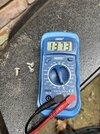
2. As ENDECOTP suggested, I did an earth test by running an extension lead close to the metal junction box and checking the continuity between the earth in the extension lead and the earth in the metal junction box. On the continuity test the result was coming it at around ~1400 - see second and third photos. Is this a problem?!?

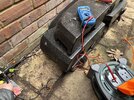
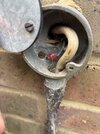
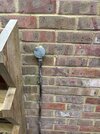
3. Fourth and fifth photos show where the armoured cable enters the house from outside. I don't know how to access this from the inside following kitchen fitting etc. The junction box itself looks like it is earthed - does that mean the SWA sheath would also be earthed and then the rest of the SWA are earthed by daisy chaining?

4. The reason I added plug sockets to the external lighting circuit (which is also on the same fuse as part of our internal lighting) is because I wanted to connect a couple of low power devices which had a plug sockets and I just figured it was the easiest way of doing it rather than adding a socket to the ring main. I know it isn't quite right, but the appliances I have connected are (1) festoon lights (power usage 48w) and (2) robot lawn mower (power usage 38w). I was also thinking of using it for a 450w pump for a bouncy castle (!). I have put signs on these plug sockets to use only low powered devices. I only have LED lights connected to this lighting circuit - both internal and external - and their max wattage if all were on would be 400w. My calculations of max load are 48+38+450+400=936w, so ~4A at max load (which I think is incredibly unlikely given we wouldn't use the 450w pump at the same time the LED floodlights are on!). I have not used a FCU when adding these plug sockets - is that a safety issue given I know what max load is and put a warning on the plug sockets? What if the plugs all have 3A fuses?
 

Attachments

  • 20250426_092658130_iOS.png
    20250426_092658130_iOS.png
    2.8 MB · Views: 52
  • 20250427_064532594_iOS (Large).jpg
    20250427_064532594_iOS (Large).jpg
    694.3 KB · Views: 59
  • 20250427_064614476_iOS (Large).jpg
    20250427_064614476_iOS (Large).jpg
    436.3 KB · Views: 55
  • 20250427_065219320_iOS.jpg
    20250427_065219320_iOS.jpg
    270 KB · Views: 59
  • 20250427_065645603_iOS.jpg
    20250427_065645603_iOS.jpg
    565.9 KB · Views: 54

If you need to find a tradesperson to get your job done, please try our local search below, or if you are doing it yourself you can find suppliers local to you.

Select the supplier or trade you require, enter your location to begin your search.


Are you a trade or supplier? You can create your listing free at DIYnot Local

 
Back
Top