• Looking for a smarter way to manage your heating this winter? We’ve been testing the new Aqara Radiator Thermostat W600 to see how quiet, accurate and easy it is to use around the home. Click here read our review.

EICR, landlord and Electrician

Landlords are responsible for appliances....it has nothing to do with any requirement under any electrical regulation, its contract law. Goods supplied must be of good working order and as such is a civil matter not a statutory matter and is a matter between the tenant and the landlord.

Sparkies just get on a do your job, inspect the fixed wiring and stop with the mission creep, if the fixed wiring is in working order then there should be no issues with a faulty appliance.
 
Landlords are responsible for appliances....it has nothing to do with any requirement under any electrical regulation, its contract law. Goods supplied must be of good working order and as such is a civil matter not a statutory matter and is a matter between the tenant and the landlord.

Sparkies just get on a do your job, inspect the fixed wiring and stop with the mission creep, if the fixed wiring is in working order then there should be no issues with a faulty appliance.

I’m going to agree with you to a point.

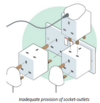
In a proper EICR we would comment on the over reliance of extension leads. I would also comment on anything that can be attached to the fixed wiring that may present a potential hazard.
 
Landlords are responsible for appliances....it has nothing to do with any requirement under any electrical regulation, its contract law.
We're not talking about contractual matters. We're talking about the legislated requirement for landlords to have 'an inspection' undertaken of rented properties and, in particular whether (as some electricians like eric seem to believe) that 'inspection' requires more than just an EICR. As so often, the problem is lack of adequate clarity in the wording of the legislation (which does not mention "EICR" at all).
Goods supplied must be of good working order and as such is a civil matter not a statutory matter and is a matter between the tenant and the landlord.
I'm not so sure about that, either. If landlord-supplied appliances were sufficiently 'dangerous', I would have thought that could well become a criminal, rather than civil, matter?
Sparkies just get on a do your job, inspect the fixed wiring and stop with the mission creep, if the fixed wiring is in working order then there should be no issues with a faulty appliance.
Again, you're talking about an EICR - and it is not totally clear whether a standard EICR is enough to satisfy the 'inspection' requirements of the legislation.
 
To say that legislators made a real mess of something that should have been black and white is a huge understatement.
As I've said, I agree that the legislation is not as clear as it should be.
And the legislation refers to a specific version of BS 7671, not the version that’s current, so what happens down the line?
Indeed, but I've discussed that here before. As I've explained, according to a friend of mine who is involved in the drafting of legislation, that is a matter of policy - governments do not like a situation in which legislation refers to not-yet-existing Standards etc., since they obviously have not been able to study those (currently non-existent) documents, which they possibly would/will not agree with - in other words, they don't like the idea of effectively giving a 'blank cheque' to the authors of Standards etc.
To be honest the legislators couldn’t have made a bigger cock up if they had tried
I wouldn't put any money on that - there is seemingly no limit to the extent to which legislation can sometimes be cocked-up :-)
 
We're not talking about contractual matters. We're talking about the legislated requirement for landlords to have 'an inspection' undertaken of rented properties and, in particular whether (as some electricians like eric seem to believe) that 'inspection' requires more than just an EICR. As so often, the problem is lack of adequate clarity in the wording of the legislation (which does not mention "EICR" at all).

I'm not so sure about that, either. If landlord-supplied appliances were sufficiently 'dangerous', I would have thought that could well become a criminal, rather than civil, matter?

Again, you're talking about an EICR - and it is not totally clear whether a standard EICR is enough to satisfy the 'inspection' requirements of the legislation.
Wrong john, we are talking about contractual matters, the contract between a tennant and landlord is governed by the law of Tort or case law, in this case a tenancy agreement has various sections within it that are sepcific and others that are implied as is the case with most case law. All landlord legislation, if such a thing ever exists , will specify what is to be expected from the contract and the case law that it is derived from. As it is the contract that allows for remedy, otherwise the tenant would not be able to seek remedy, they would need to seek remedy instead from a third party.. HSE, local council etc where that duty to enforce had been placed.

Eg In the example of extension leads, whilst a property may require extension leads to function, sockets are never where you need them, it is a contractual item, whilst a sparky could note that many extension leads are being used by a tenant, that is a contractual issue between the landlord and tenant, most new contracts contain clauses as to the use of sockets ie 1 appliance per wall socket, extension leads where used must be single socket extensions etc etc. it is up to the landlord and tenant to specify how the property is used, as failure to keep to the contract is grounds for remedy.

Where a sparkie then does something silly and writes not enough sockets due to extension lead overuse c3 he will have placed himself in a very difficult situation, 1. he will have given grounds to the tenant to seek remedy where remedy did not exist before, ie he has made a case that the property is unsafe. 2. The tenant could be evicted with a loss of deposit due to them not adhering to the tenancy.... all the while the sparkie has opened himself up to either the landlord or tenant seeking redress for him sticking his oar in where its not needed or wanted. It is up to the contract to take regard of all other legislation whether specific or implied, eg the right of inspection, the right to a safe house. Its also a right to rent out a property with all the safeguards of law struck out eg at occupiers risk contracts.

We could very well be talking about expired smoke alarms malarky when sparkies got a hard on for being fire assessors...the stupidity of coding those beggers belief - landlords are responsible for fire safety not sparkies, note away, observer but code and prevent a tenancy, open your self up to the re-letting fees and lost revenue claims. Under an EICR their job is to check the wiring so that the person appointed to maintain the smoke alarm does not get shocked when they replace it.

Case law is very difficult to overturn, that is why all legislation contains the phrase should, it can be ordered like its a must but very few regulations actually say must... as parliament does not mess with the judiciary and its precious case law.

By the way white goods are a contractual item as the landlord takes responsibility for them, something they could not do if their property was not included in the contract, otherwise in case law they would would be seen to have discharged their interest and such property can be removed by the tenant.

That is why an EICR is just that, fixed wiring as other matters are excluded or fall under different provisions either enshrined ( parliamentary) in law or explicit in common law... eg you shall not kill. It is up to the landlord to discharge their duties not a sparky to re imaging case law.

 
Wrong john, we are talking about contractual matters, the contract between a tennant and landlord is governed by the law of Tort or case law, in this case a tenancy agreement has various sections within it that are sepcific and others that are implied as is the case with most case law.
Hmmm. I'm no lawyer (but I have a daughter who is, so I'll ask her sometime), but I don't get this, since I'm not talking about anything to do with the Tenancy Agreement ....
All landlord legislation, if such a thing ever exists , will specify what is to be expected from the contract and the case law that it is derived from.
Again, I don't get this. The legislation we've been talking about (colloquially as 'landlord legislation') certainly exists, in the form of The Electrical Safety Standards in the Private Rented Sector (England) Regulations 2020 (UK Statutory Instrument 2020 No. 312). That legislation imposes a duty on private landlords to have an 'inspection' of the electrical installation undertaken prior to commencement of the first tenancy and at intervals of not more than 5 years thereafter - the problem we have been discussing is that it does not (at least in some people's minds) adequately define the nature and scope of the required 'inspection'.

I can but presume that that duty imposed by the legislation exists regardless of what is and is not in the Tenancy Agreement, and the legislation certainly says nothing about "what is to be expected from the contract".
As it is the contract that allows for remedy, otherwise the tenant would not be able to seek remedy, they would need to seek remedy instead from a third party.. HSE, local council etc where that duty to enforce had been placed.
We're not talking about "tenants seeking remedies" - as you say, if such is possible, that is down to what is in their contract. Rather, we are talking about duties imposed on a landlord by legislation, breach of which duty can result in a financial penalty imposed by the Local Authority. ...

Financial penalties for breach of duties​

11.—(1) Where a local housing authority is satisfied, beyond reasonable doubt, that a private landlord has breached a duty under regulation 3, the authority may impose a financial penalty (or more than one penalty in the event of a continuing failure) in respect of the breach.
(2) A financial penalty—
(a)may be of such amount as the authority imposing it determines; but
(b)must not exceed £30,000.
Again remembering that I am no lawyer, I would have doubted that a tenant would have a viable civil claim against a landlord because of failure to have an electrical inspection undertaken, per se, since that failure (again, per se) will not have resulted in any financial loss. If some harm resulted from some landlord-supplied item, that would obviously be a totally different matter, but that certainly is not what we are talking about.
 
writes not enough sockets due to extension lead overuse c3
This has always been a problem, this 1750350321378.pngor similar has been in the best practice guide for years. I have gone into that many houses where there is a temporary lack of sockets in one area, due to TV or computer use in that area, and the only danger is damage due to hanging items from the socket. Something like this
1750350703689.png
would not likely damage the socket, and do the same job, the only time when extension leads become a problem is when the lead goes through a doorway. Or it is left coiled up.

The contract between tenant and landlord may cause problems, where clauses like not damaging the walls, by hanging pictures etc. The RCD protection of cables in the wall, is so if someone hits the cable with a wall fixing, they are protected, but if wall fixings are not allowed, then is there a need for RCD protection of the cables?

One can have RCD sockets, and I have two pairs of them, the reason is the RCD built into the solar inverter does not comply with British Standards, and also don't want both to trip together, losing one freezer is enough.

But all we have seen is an old Wylex box, we have no idea if there are other factors, like a RCD, we have just jumped in.
 
The contract between tenant and landlord may cause problems, where clauses like not damaging the walls, by hanging pictures etc. The RCD protection of cables in the wall, is so if someone hits the cable with a wall fixing, they are protected, but if wall fixings are not allowed, then is there a need for RCD protection of the cables?
"A need" in terms of what? If one wants things to be compliant with BS 7671, then, unless they have mechanical protection or earthed metallic sheaths, all cabled buried <50mm in walls 'need' RCD protection, regardless of whether it is rented property or anything else.
 

If you need to find a tradesperson to get your job done, please try our local search below, or if you are doing it yourself you can find suppliers local to you.

Select the supplier or trade you require, enter your location to begin your search.


Are you a trade or supplier? You can create your listing free at DIYnot Local

 
Back
Top