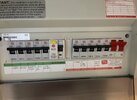
EICR Question on Upgrading to RCBO’s

Joined
2 Oct 2012
Messages
27
Reaction score
0
Location
London
Country
United Kingdom
Hi Folks,

I have a small house which I am thinking of renting. I know I will need to get an EICR to do this.

The distribution board I have was installed under the 17th edition of the wiring regulations.

This means I only have one side of the board protected by RCD.

Does anyone know if I will need to change the standard unprotected MCB’s with RCBO’s to pass an EICR now or will it just be a C3?

Thank you to anyone with the knowledge willing to tell me :-)
 

Attachments

  • IMG_8951.jpeg
    IMG_8951.jpeg
    190.7 KB · Views: 35
An EICR is not like an MOT for a car, in that there are no clear rules as to coding. The IET who with the BSi publish the regulations changed the coding from 1 to 4 to C1 to C3 in order to remove code 4 which was does not comply with current edition of wiring regulations.

However, the landlord law has one edition listed, so it has pointed to an, at the moment, new edition. The wording is still, C1 = Dangerous and C2 = Potentially dangerous, it says nothing about any regulation. But also what is included, the IET have separated out installation testing, and equipment testing, both need testing, but often it is done by different people, and an EICR would not normally include washing machines, tumble driers, cookers etc, they are considered as equipment, and this works out well where equipment needs a specialist as with the central heating boiler. But the landlord law divides into portable and non-portable, and the recognised demarcation is portable is not fixed, and under 18 kg or on wheels. Also, the IET EICR includes the DNO equipment, where the Government one does not. So government EICR would not have a fail even if meter handing off the wall.

Potentially dangerous is a daft label, as all 230 volt electrics are potentially dangerous, but to my mind, if not dangerous in 1992 when BS 7671 first came out, then to be dangerous today, something has to have changed, things have changed, like in 2008 when as long as RCD protection is used, bathroom bonding can be omitted, this was mainly due to use of plastic pipes, and today plumbers expect to have RCDs so are likely to use plastic pipes and omit bonding. We have stopped using tungsten lamps, so people can change a bulb with it switched on without burning their hands, inverter controls have arrived which can allow DC in the supply, EVs have arrived, and the list goes on.

So if an inspector says this outside socket could be used to charge an EV and to do so would be potentially dangerous, he could code it C2, never heard of that being done, but one could not say he was wrong if he did.

So looking at the consumer unit, if he were to code it C2 as no RCD, then it needs correcting by someone who is deemed as being qualified to correct it. And he would issue a paper trail which can be attached to the EICR to show corrected. But if you swapped all the MCBs for RCBOs before the inspection, then there would be no need to get someone qualified to change it.

So there is a good reason to get the home so it will have no C2 or C1s, however although wrong, I have known inspectors to be told, always find something to fail the inspection, this means someone has to work on the electrics after the inspection, so any faults missed can be blamed on someone else.

I have only seen one court case where a home was passed when clearly it should not have passed, and he was taken to court under consumer protection laws, as he had charged for something he had not done, not electrical laws.

As an inspector, as long as I list the faults, I have not broken any law, so code as C3 not C2 or LIM not FIR and there is little they can take me to court over, with a C1 fault, the inspector must make safe before leaving, so would need to lock it off, or disconnect, so it is no longer a C1. This has always been a problem when testing and inspecting premises in use, if premises not in use, then locking the door on leaving could be seen as making safe.

Personally, I think looking at a home, and saying will this pass, is the wrong approach, it should be is the home safe, be it slippery steps, no handrails on stairs, cupboards which can fall over, or electrical safety, and in the 1990's my son passed his RAE, and as well as being proud to have a 14-year-old radio ham in the family, I also wanted to protect him. So fitted all RCD protection.

In the 2000's I tried to get my dad to upgrade his house, he dug in heals and said I am not living in a building site, and refused, after he died, mother with macular degeneration, and dementia, was found to have put an extension lead with a flickering neon into a bucket of water as she thought it was on fire, lucky no one got a shock, but it was a wake-up call for me, to get house rewired and RCDs fitted.

This is the problem with a rented house, we have no idea who will be in the house, we are not there to say don't play with that, or No, that OK it not on fire. We don't know who may visit the home, and if care workers visit, it then becomes a place of work, and the electricity at work act kicks in.

When I was a little boy, my parents taught me not to play near the open fire, I was taught what to avoid from an early age, but as a landlord, you have no control over what the tenant teaches their children, so a rented house needs to be safer than an owner occupied as you have no control.

 
My advice to you is get an EICR done, then have a new CU with RCBOs and SPD along with any remedial work.
 
I have only seen one court case where a home was passed when clearly it should not have passed, and he was taken to court under consumer protection laws, as he had charged for something he had not done, not electrical laws.

From posts I've seen on this forum it seems like we could do with a few court cases where a property has "failed" when it should not have done.
 
Although I agree with you, the problem is, how can anyone claim 230 volts is not potentially dangerous?
The term is potentially dangerous defect, not simply that something with no faults could become dangerous.
 
The term is potentially dangerous defect, not simply that something with no faults could become dangerous.
I take your point. The actual wording though is "Potentially dangerous – urgent remedial action required." relating to an observation that has been made. You are right though that there being electricity present does not in itself justify such an observation, so perhaps Eric should consider stopping repeating this comment.
 
take your point. The actual wording though is "Potentially dangerous – urgent remedial action required." relating to an observation that has been made.
Yes, that's true, but it is a classification system for faults or issues. Not for use where there are no faults or issues.
 
Potentially dangerous should not include anything which is not damaged. However, @flameport is correct, we tend to consider with rental properties all circuits should be RCD protected.

But with motor vehicles, we would get a firm directive, vehicles build after set date, must have seat belts etc. This does not happen with an EICR so we see on this forum many who feel they have had a C2 code in error.
 
Potentially dangerous should not include anything which is not damaged.

Indeed not. "Potentially dangerous" is a pretty meaningless term. I have sharp knives in my kitchen. They have the potential to become murder weapons.


But with motor vehicles, we would get a firm directive, vehicles build after set date, must have seat belts etc.

Here's a motor vehicle:

1791150395660.jpeg


Is it dangerous?

Is it potentially dangerous?

You could prop it up on a stand and just look at it.

Or you could ride it like this

 
I am sure you understand my point, we don't have a list which says these things are OK, and these things are considered as requiring a code C2, the code C1 is clear enough, but the dividing line C2 to C3 is blurred, and if an inspector issued no C2s and only used C1 and C3, as long as he/she has listed the faults, then he has done his job. In fact, he could use the old code 1, 2, 3 and 4 he has still done an inspection and identified faults. There has been a court case where the inspector missed reporting faults, but as far as I am aware, not for miss coding faults?

And until the landlord law, it really did not matter what code was given, and the law says, “safe for continued use” not C1 to C3, it is the final line on the report which is important. And also “electrical safety standards” means the standards for electrical installations in the eighteenth edition of the Wiring Regulations, published by the Institution of Engineering and Technology and the British Standards Institution as BS 7671: 2018. So we have to comply with that book, not BS 7671 current at the time of installation, or do we, every edition has had in first few pages "Existing installations that have been installed in accordance with earlier editions of the Regulations may not comply with this edition in every respect. This does not necessarily mean that they are unsafe for continued use or require upgrading." so it is the does not necessarily mean that is the stumbling block. We know we have seen amendments released when a danger has been identified, like the uni-direction and bi-direction RCD/RCBOs.

But there are rules not in BS 7671, for example the height of a socket, in a home with a wheelchair user, low sockets can be damaged by the wheelchair, so building regulations stipulate a minium height from the floor, there is clearly no danger where the wheelchair can't get to, be it behind furniture or on a level with no wheelchair access.

Having lived with my mother in a wheelchair I am well aware of the damage they can cause, one only has to look at the scuff marks on the wall, but should I really fail anything in a house hold without a wheelchair user?

The same with uni-directional RCDs, if nothing in the house needs bi-directional why fail it?
 
The distribution board I have was installed under the 17th edition of the wiring regulations.

This means I only have one side of the board protected by RCD.
I think you are getting your editions mixed up, your install looks like a "16th edition" configuration to me.

Does anyone know if I will need to change the standard unprotected MCB’s with RCBO’s to pass an EICR now or will it just be a C3?

If all of the following are true.

* The inspector follows the guidance from electrical safety first (which is the closest thing we have to official guidance, but is still not particularly official)
* The inspector believes that first floor sockets are unlikely to supply equipment outdoors.
* The labelling on the CU reflects everything that is fed from the breakers
* There are no other issues not visible from what you have shown us.

Then I think the install should only get C3s and be marked "satisfactory".

That is a pretty big list of "if"s though.
 
Then I think the install should only get C3s and be marked "satisfactory".
I agree with you for an EICR not specified for rental property, it can be considered OK for continued use.

However, it is not really a standard EICR with rental property, the IET divides the inspection and testing into two groups, the installation, which does not include current using equipment, it is only the wires, sockets, and protection devices, and what it calls in-service electrical equipment, which we tend to call PAT testing.

The landlord law uses a different split, being portable or not, so that items like tumble drier and dishwasher can be included in the testing for the general house.

The general requirement has dropped code 4 does not comply with current edition of wiring regulations, but the landlord version is tided to BS7671:2018.

As an inspector, we use our judgement, and for an owner occupied home, the report is not really transferable, but with a rental, we have to expect all sorts, including wheelchairs, as to how far we take it, is up to us as the inspector.
From posts I've seen on this forum it seems like we could do with a few court cases where a property has "failed" when it should not have done.
This is a very real problem, as before the inspection any Tom, Dick or Harry can do the repairs or upgrade, but once it has failed, the law says who can repair or upgrade it. The minor works or installation certificate or even a recite for the work copied and attached to the EICR is enough it does not all have to be tested again. But, if not a real fault, then clearly it can't be fixed, as simply nothing to fix. So another EICR is the only way to show all OK.

So if an inspector does not know it's a rental, then they may pass items which when rental they would fail, but the problem is when next EICR is done.
 

If you need to find a tradesperson to get your job done, please try our local search below, or if you are doing it yourself you can find suppliers local to you.

Select the supplier or trade you require, enter your location to begin your search.


Are you a trade or supplier? You can create your listing free at DIYnot Local

 
Back
Top