
You are using an out of date browser. It may not display this or other websites correctly.
You should upgrade or use an alternative browser.
You should upgrade or use an alternative browser.
Electricians' tedious bickering
- Thread starter FingRinal
- Start date
- Status
- Not open for further replies.


- Joined
- 11 Jan 2004
- Messages
- 47,082
- Reaction score
- 4,087
- Country

I have spoken directly today to a well-known person who used to be heavily involved with the IEE, writing articles & answering the phone to technical queries.
He says the following, of the 16th edition.
Indeed, the definition of spurs does relate solely to ring final circuits.
Therefore, a spur can only exist as part of a ring final circuit and not a radial circuit.
As for the 17th, he told me he cannot comment until the OSG is published.
He says the following, of the 16th edition.
Indeed, the definition of spurs does relate solely to ring final circuits.
Therefore, a spur can only exist as part of a ring final circuit and not a radial circuit.
As for the 17th, he told me he cannot comment until the OSG is published.

Wehey!!! so despite the 17th Ed. now fully available, what we all really want to know (and probably refer to the most) is what the actual 17th OSG is going to say?! 
In the OSG therefore the more superior document? Could save a bloody fortune then
In the OSG therefore the more superior document? Could save a bloody fortune then
- Joined
- 11 Jan 2004
- Messages
- 47,082
- Reaction score
- 4,087
- Country
If I could just throw my inexperience into the ring here
Groan!
I have found this:
A spur is defined to be a "a branch from a ring final circuit" (IEE Wiring Regulations, Part 2). Consequently, there is no concept of a spur from a radial final subcircuit
- Joined
- 11 Jan 2004
- Messages
- 47,082
- Reaction score
- 4,087
- Country
If I could just throw my inexperience into the ring here
Groan!
I have found this:
A spur is defined to be a "a branch from a ring final circuit" (IEE Wiring Regulations, Part 2). Consequently, there is no concept of a spur from a radial final subcircuit
Have read the 14th Ed, A30-A57. Some of those have not been carried forward...
In the 14th, two (single) socket outlets can be fed from one non-fused spur.
In the 14th, BTW, the definition of "spur" is:
A branch cable connected to a ring circuit.

Oh dear oh dear....I'm afraid you are wrong. We are not talking about a lighting radial. We are talking about a socket final radial and standard circuit arrangements in the OSG using BS1363 accessories.
No, YOU are wrong.
Taken directly from BS7671 (the REGULATIONS, not the on site GUIDE) appendix 15, Ring and radial final circuit arrangements, regulation 433.1
Ring final circuit:

Radial circuit:
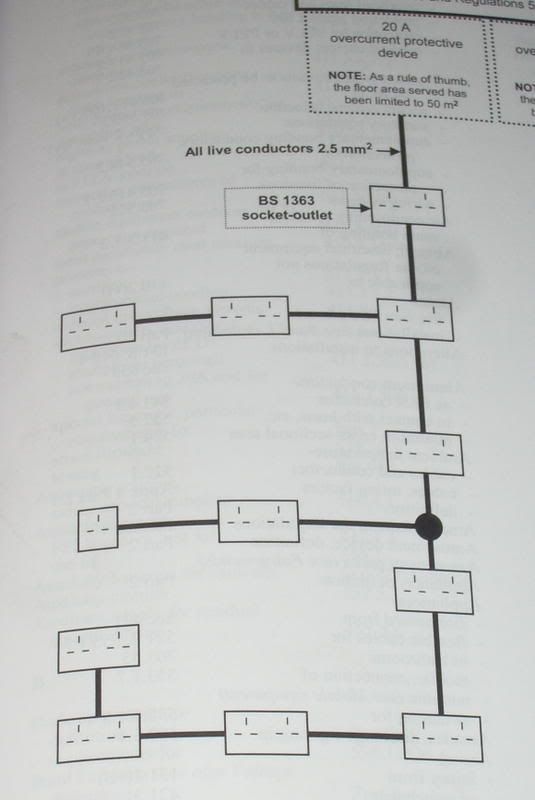
Where are the FCUs? (Clue: there arn't any)
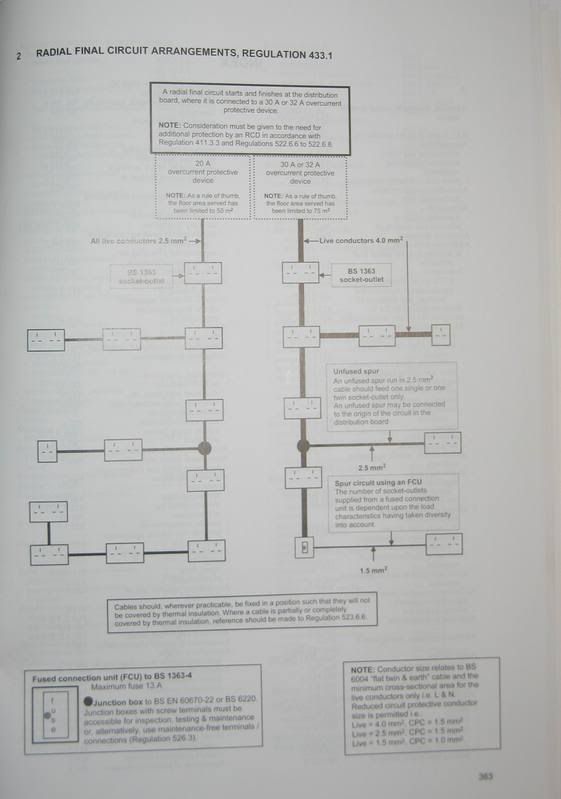
If you're talking about the definition and use of spurs and branches, in the context of the 16th Edition, then ban-all-sheds has described the situation correctly.BAS, you are wrong. That's all there is to it.
I don't see the difference between what you call two extensions and what I would call a longer radial.Two sockets at the end of radial would be two extensions.
I think you must have read something wrongly there FingRinal - whilst I don't align with the way he's presented the facts, I believe that what he's presented is indeed factual (with the exception of implying that the OSG can make "demands").If, as you say, a spur is only defined for a ring, why are you using this terminology to refer to radials?
My view is that it's not explicitly allowed, but it's allowed because it's not explicitly prohibited. It makes sense to allow it because it's not unsafe (given any constraints of overall length, voltage drop, etc.).Show me where it allows multiple branches on SOCKET radials as you describe.
This discussion is not solely about the definition of a spur. For every definition in App. 2 we can find another 10 things not defined.
This discussion is about the standard circuits arrangements and the guidance in the OSG app. 8 and what has been taught in colleges for years, is assessed by electrical schemes and is practised by electricians.
There is no distinction made (as regards to radial socket final circuits and socket ring final circuits in relation to the guidance of connecting spurs) in IEE publications, NICEIC publications, Part P Schemes, C&G syllabus, college courses etc. If anyone can show me that the majority of the above actually make a distinction and specify that socket radials can be indefinitely 'branched', I would be happy to see it.
The NICEIC refer to radials and rings as Final Circuits and then proceed to define what is and isn't acceptable for 'Final Circuits'. Note, it does not say 'Ring Final Circuits', or 'Radial Final Circuits', it refers only to 'Final Circuits' when commenting on 'spurs'. This is consistent with the OSG.
If anyone is a member of the ECA, Select, NAPIT, Elecsa, NICEIC, please call your technical helpdesk to ask what they think.
Standard circuit arrangements are promoted so as to ensure a uniform understanding and encourage the installation of 'standard' circuits. That does not mean they are the only way to satisfy the Regs, but this discussion has been about the standard use of spurs as per the OSG and what is common standard practice in the real world in the UK. They are primarily intended to take as much 'thinking' out of the process as possible.
One reason, for example, why 'branched' radials are prone to abuse and thus not specified in the OSG is the restrictiond placed on floor area served by the Standard circuit arrangements. By controlling the accepted practice of spurs, certain 'other' considerations are kept in check.
People will do as they please, but people seeking sound advice on a DIY Forum would be best served by the constraints of 'standard' design and practice.
(I don't have a 17th 'yet'. As mine is arriving on cdrom, I'm having to wait. The illustrations posted look to be 'interesting'.)
This discussion is about the standard circuits arrangements and the guidance in the OSG app. 8 and what has been taught in colleges for years, is assessed by electrical schemes and is practised by electricians.
There is no distinction made (as regards to radial socket final circuits and socket ring final circuits in relation to the guidance of connecting spurs) in IEE publications, NICEIC publications, Part P Schemes, C&G syllabus, college courses etc. If anyone can show me that the majority of the above actually make a distinction and specify that socket radials can be indefinitely 'branched', I would be happy to see it.
The NICEIC refer to radials and rings as Final Circuits and then proceed to define what is and isn't acceptable for 'Final Circuits'. Note, it does not say 'Ring Final Circuits', or 'Radial Final Circuits', it refers only to 'Final Circuits' when commenting on 'spurs'. This is consistent with the OSG.
If anyone is a member of the ECA, Select, NAPIT, Elecsa, NICEIC, please call your technical helpdesk to ask what they think.
Standard circuit arrangements are promoted so as to ensure a uniform understanding and encourage the installation of 'standard' circuits. That does not mean they are the only way to satisfy the Regs, but this discussion has been about the standard use of spurs as per the OSG and what is common standard practice in the real world in the UK. They are primarily intended to take as much 'thinking' out of the process as possible.
One reason, for example, why 'branched' radials are prone to abuse and thus not specified in the OSG is the restrictiond placed on floor area served by the Standard circuit arrangements. By controlling the accepted practice of spurs, certain 'other' considerations are kept in check.
People will do as they please, but people seeking sound advice on a DIY Forum would be best served by the constraints of 'standard' design and practice.
(I don't have a 17th 'yet'. As mine is arriving on cdrom, I'm having to wait. The illustrations posted look to be 'interesting'.)
They are from the 17th edition.
Pensdown, no reason for the half pic. It just seemed to me to be the part relevant to the discussion. Having re-read the thread, I now see that the right hand picture shows how you could have a spur from a radial circuit.
Pensdown, no reason for the half pic. It just seemed to me to be the part relevant to the discussion. Having re-read the thread, I now see that the right hand picture shows how you could have a spur from a radial circuit.

it's only a spur from a radial of the cable size is reduced, otherwise it's a branch..
from a purely design point of view, the cable has to be protected...
if it's a 20A radial then all connections made using 2.5 T+E will be branches as the cable can take the rated current of the protective device without damage..
if it's a 30A or 32A radial wired in 4mm, then any connections made with 4mm are safe, but any spur made with 2.5 would need to be protected by either limiting the potential demand ( only 1 single or double socket, limiting the max demand to 13A or 26A respectively), or by fusing down for more conections..
from a purely design point of view, the cable has to be protected...
if it's a 20A radial then all connections made using 2.5 T+E will be branches as the cable can take the rated current of the protective device without damage..
if it's a 30A or 32A radial wired in 4mm, then any connections made with 4mm are safe, but any spur made with 2.5 would need to be protected by either limiting the potential demand ( only 1 single or double socket, limiting the max demand to 13A or 26A respectively), or by fusing down for more conections..
- Joined
- 11 Jan 2004
- Messages
- 47,082
- Reaction score
- 4,087
- Country
( only 1 single or double socket, limiting the max demand to 13A or 26A respectively)
Hmm. Let's start another fierce debate!
Double sockets are rated to 13A.
No they're not.
Yes they are!
Etc....
But ONE abused twin socket will still not overload the cable.
Two could
Two could

DIYnot Local
Staff member
If you need to find a tradesperson to get your job done, please try our local search below, or if you are doing it yourself you can find suppliers local to you.
Select the supplier or trade you require, enter your location to begin your search.
Please select a service and enter a location to continue...
Are you a trade or supplier? You can create your listing free at DIYnot Local
- Status
- Not open for further replies.
Similar threads


- Replies
- 17
- Views
- 4K