
- Joined
- 27 Jan 2008
- Messages
- 29,676
- Reaction score
- 3,672
- Location
- Llanfair Caereinion, Nr Welshpool
- Country

Oil is now over £1 a litre, still works out at around 10p per kWh, but also losses with boiler and the distribution system.
These are clearly an option, as to what gas now costs I have not looked at, but burn a hydrocarbon fuel and water is released, and although my living room is showing 42% humidity at the moment, not so keen on releasing water by using bottled gas.
Heat pumps are great I am sure, but this type which I have worked on have used simple heating elements to heat the room, the heat pump is only used to cool the room, and it would mean a window replacement to fit one.
So we have this the oil filled radiator which is reasonably safe, and so can be placed as seen here, right next to the chairs, so heating the area of the room where the heat is required.
But will it waste or safe money? And that's the big question?
So last cold day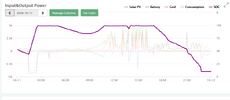 I ran out of battery, so electric costing £0.3074 per kWh around 3 times the cost of oil.
It would also have used some solar at 12p/kWh but more to the point, delivering heat direct to the point where it was required, so likely using far less energy to using the central heating, which has not been used at all this season.
No question heart of winter, want whole house heating using the oil.
But it is the Autumn and Spring I am looking at, and clearly if I don't run out of battery, the oil filled radiator is winning, but when battery runs out, what then?
The 10p/kWh for oil is if all the energy goes into the house, which clearly it does not. So AI tells me "Older Non-Condensing Oil Boilers (15–25+ years old): Ranges from 60% to 75% efficiency. Older models lose a significant portion of their heat (30% to 40%) straight out of the flue." so my 10p becomes more like 17p, so now looking for how much for the match as we put it at work.
How much for the central heating boiler to heat up all the pipe works etc, before it delivers any heat into the home?
I note in summer, when I used it to heat DHW, it would run for 20 minutes, before the return water was hot enough to turn the boiler off, and the cylinder was still not fully up to temperature.
So I have taken it that the first 20 minutes is likely used heating up the system, rather than any radiator, but this is pure guess work, but at 20 kW, it would seem if a thermostat was to fire the boiler, then at least 15 kWh is used, or £1.50 where the oil filled radiator has only use 2 kWh (60p) for the whole evening.
But at some point, the use of central heating must work out cheaper.
So this month, using the oil filled radiator makes good sense, but there must be a point when the central heating works out cheaper.
I would like the tank to last the winter, be it at start of season or end of season I have always played safe and had a top up. So just spent over £500 for the top up, I would like to be able next year to select when I refill the tank and not need a top up to ensure warm in late March and April.
So inviting thoughts on electric v oil. There is the bottled gas option, but would need to buy a heater, I don't already have one, where I have the oil filler radiator, and also the humidity problem.
I am using a smart socket adaptor for the oil filled radiator, so set to 90 minuets (using same setting as for the AC in summer, so did not forget to empty the condensate bottle) so when cold I turn it on for 90 minuets only so 1.5 kWh.
If 1 kW is not enough the radiator does have three outputs, but at the moment my thoughts are if 1 kW is not enough likely I need other rooms heating so time to turn central heating on.
But as it stands all guess work, so would appreciate what other people think. I realise grid gas is different, and I do not have that option. However the local and general heating of the home is still something to be considered.
I did talk to my son, but his house, one is open plan, so heating one room not really an option, two he has a gas fire central to the home, and three using gas not oil, and four has a modern condensing boiler which is far more efficient to my oil boiler. And the main difference is he is one of a family of four, so has children who use their bedrooms during the evenings. So for him, turning on the gas fire, no question it would save money, and it is down to if his children will stop in their bedrooms or join the family.
I have to admit, with just two of us, a five bedroom house is really too big. In real terms one bedroom is an office and one is a craft room, and the bedroom, bathroom, kitchen and living room down steps is rarely used, and in winter the motorised valves means it is not heated.
So only front kitchen, living room, and two bedrooms used every day.
The top two floors have programmable TRV heads in every room, so we can decide what room is heated and when, unlike my son with open plan. We have those things called doors. But clearly internal walls are not as well insulated as external walls.
Also loads of insulation bottom to central floor, but little between central and upper floor, so my home is not in any way a standard house.
But still thoughts on oil filled radiator v oil fired central heating will be welcome.
These
are clearly an option, as to what gas now costs I have not looked at, but burn a hydrocarbon fuel and water is released, and although my living room is showing 42% humidity at the moment, not so keen on releasing water by using bottled gas.Heat pumps are great I am sure, but this type which I have worked on
have used simple heating elements to heat the room, the heat pump is only used to cool the room, and it would mean a window replacement to fit one.So we have this
the oil filled radiator which is reasonably safe, and so can be placed as seen here, right next to the chairs, so heating the area of the room where the heat is required.But will it waste or safe money? And that's the big question?
So last cold day
I ran out of battery, so electric costing £0.3074 per kWh around 3 times the cost of oil.It would also have used some solar at 12p/kWh but more to the point, delivering heat direct to the point where it was required, so likely using far less energy to using the central heating, which has not been used at all this season.
No question heart of winter, want whole house heating using the oil.
But it is the Autumn and Spring I am looking at, and clearly if I don't run out of battery, the oil filled radiator is winning, but when battery runs out, what then?
The 10p/kWh for oil is if all the energy goes into the house, which clearly it does not. So AI tells me "Older Non-Condensing Oil Boilers (15–25+ years old): Ranges from 60% to 75% efficiency. Older models lose a significant portion of their heat (30% to 40%) straight out of the flue." so my 10p becomes more like 17p, so now looking for how much for the match as we put it at work.
How much for the central heating boiler to heat up all the pipe works etc, before it delivers any heat into the home?
I note in summer, when I used it to heat DHW, it would run for 20 minutes, before the return water was hot enough to turn the boiler off, and the cylinder was still not fully up to temperature.
So I have taken it that the first 20 minutes is likely used heating up the system, rather than any radiator, but this is pure guess work, but at 20 kW, it would seem if a thermostat was to fire the boiler, then at least 15 kWh is used, or £1.50 where the oil filled radiator has only use 2 kWh (60p) for the whole evening.
But at some point, the use of central heating must work out cheaper.
So this month, using the oil filled radiator makes good sense, but there must be a point when the central heating works out cheaper.
I would like the tank to last the winter, be it at start of season or end of season I have always played safe and had a top up. So just spent over £500 for the top up, I would like to be able next year to select when I refill the tank and not need a top up to ensure warm in late March and April.
So inviting thoughts on electric v oil. There is the bottled gas option, but would need to buy a heater, I don't already have one, where I have the oil filler radiator, and also the humidity problem.
I am using a smart socket adaptor for the oil filled radiator, so set to 90 minuets (using same setting as for the AC in summer, so did not forget to empty the condensate bottle) so when cold I turn it on for 90 minuets only so 1.5 kWh.
If 1 kW is not enough the radiator does have three outputs, but at the moment my thoughts are if 1 kW is not enough likely I need other rooms heating so time to turn central heating on.
But as it stands all guess work, so would appreciate what other people think. I realise grid gas is different, and I do not have that option. However the local and general heating of the home is still something to be considered.
I did talk to my son, but his house, one is open plan, so heating one room not really an option, two he has a gas fire central to the home, and three using gas not oil, and four has a modern condensing boiler which is far more efficient to my oil boiler. And the main difference is he is one of a family of four, so has children who use their bedrooms during the evenings. So for him, turning on the gas fire, no question it would save money, and it is down to if his children will stop in their bedrooms or join the family.
I have to admit, with just two of us, a five bedroom house is really too big. In real terms one bedroom is an office and one is a craft room, and the bedroom, bathroom, kitchen and living room down steps is rarely used, and in winter the motorised valves means it is not heated.
So only front kitchen, living room, and two bedrooms used every day.
The top two floors have programmable TRV heads in every room, so we can decide what room is heated and when, unlike my son with open plan. We have those things called doors. But clearly internal walls are not as well insulated as external walls.
Also loads of insulation bottom to central floor, but little between central and upper floor, so my home is not in any way a standard house.
But still thoughts on oil filled radiator v oil fired central heating will be welcome.