
• Looking for a smarter way to manage your heating this winter? We’ve been testing the new Aqara Radiator Thermostat W600 to see how quiet, accurate and easy it is to use around the home. Click here read our review.

here`s a good un

Status
Not open for further replies.
hi folks

last night i turned the offending trv completely off and this has stopped the noise(or at least last night and this am) so does this make me lean towards a defective trv??

NO it does not :shock: it proves nothing take the head off.

You say all the other valves are on maximum, turn then down to 2-3 and post how many start to rattle.
 
The installation appears to be another bodge job.

A TRV is fitted to the radiator where the room 'stat is sited.

The system should be fitted with a bypass as required by the manual.

Fitting an auto bypass may solve the noise. What make of TRV is it?
 
Diyitall wrote

May I suggest before you post on the subject you consult with the manufacturers, they will tell you different

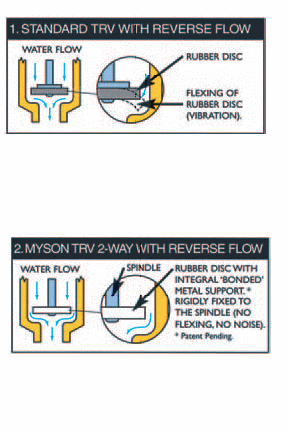
May I suggest you have a look at the pictures below from a well known manufacturer and familiarize yourself with them as you obviously cannot understand text.


MysonTRV.gif


----------------------
Bickering removed, mod9
----------------------

if you shut that valve down it can move to the next one.

Only if its fitted incorrectly also.
Namsag gave the answer to this post earlier and its a pity neither you nor the OP will listen.
 
The OP said,

My central heating will run for approx 90 mins then the water pipes start vibrating.To stop the vibration i have to turn my thermostat valve in the bedroom 1/4 turn.
This will keep the heating quiet for up to 1hr when the same must be done.


Why would it do that if reverse flow was causing the problem.


Namsag said

Sounds like your trv is on the wrong side take the head off and if it stays quiet it needs moving to other side of rad

Same question what difference will it make if you have reverse flow.

------------------------
Bickering removed, mod9
------------------------
 
If the flow is reversed it will rattle on any setting.

Adjusting the temperature will not stop the rattle and neither will removing the head.
 
If the flow is reversed it will rattle on any setting.

Adjusting the temperature will not stop the rattle and neither will removing the head.

In your opinion. :wink:
So you have obviously came to the conclusion that the flow direction is correct through the trv and that its not a bi-directional valve.
And you have this notion that the trv will vibrate when the valve is correctly fitted.
Perhaps you will englighten us. :roll:
 
The OP said,

My central heating will run for approx 90 mins then the water pipes start vibrating.To stop the vibration i have to turn my thermostat valve in the bedroom 1/4 turn.
This will keep the heating quiet for up to 1hr when the same must be done.

DIA said:
Why would it do that if reverse flow was causing the problem.
Because single-direction trv's put on the wrong end, will often only rattle at a particular flow rate, which is only establiished when other trv's in the system have moved.

DIA said:
If the flow is reversed it will rattle on any setting.
Not in my experience. Some only rattle on some settings.

DIA said:
Adjusting the temperature will not stop the rattle
Except when it does.

DIA said:
and neither will removing the head.
Yes it will, the valve is then fully open and they don't rattle, i.m.e. .
 
If the flow is reversed it will rattle on any setting.

Adjusting the temperature will not stop the rattle and neither will removing the head.

In your opinion. :wink:
So you have obviously came to the conclusion that the flow direction is correct through the trv and that its not a bi-directional valve.
And you have this notion that the trv will vibrate when the valve is correctly fitted.
Perhaps you will englighten us. :roll:

I already have ballski.

Pressure differential, most valves have an 0.5bar ish maximum head, as the valve start to close the head pressure increases and the seating bounces, turning the valve to a higher setting stops the problem until the new temperature is reached, whereas it does it again.

It would take the OP seconds to check the valve arrow and, post the make/model.

Have they got an exploding cylinder in it as well.
 
Diyitall wrote

Pressure differential, most valves have an 0.5bar ish maximum head, as the valve start to close the head pressure increases and the seating bounces, turning the valve to a higher setting stops the problem until the new temperature is reached, whereas it does it again.

Thats [rubbish]. :roll:

It would take the OP seconds to check the valve arrow

Checking the arrow proves nothing though I would suspect the flow to go through the horizontal inlet port whilst looking at the valve with the trv head being in the vertical position.
The f&r through the rad is what counts and what side the valves are fitted and its not to difficult to check that.
 
Diyitall wrote

Pressure differential, most valves have an 0.5bar ish maximum head, as the valve start to close the head pressure increases and the seating bounces, turning the valve to a higher setting stops the problem until the new temperature is reached, whereas it does it again.

Thats [rubbish]. :roll:

Ask the manufacturers

It would take the OP seconds to check the valve arrow

Checking the arrow proves nothing though I would suspect the flow to go through the horizontal inlet port whilst looking at the valve with the trv head being in the vertical position.
The f&r through the rad is what counts and what side the valves are fitted and its not to difficult to check that.

Not all valves are in the horizontal position, the arrow shows the intended flow, a hand on the pipe to see which end gets hot first would confirm the flow end.
 
Doitall how is taking the head off going to prove your theory all that is doing is leaving the valve wide open ,the valve is not going to be noisy ever in this situation .It gets noisy beause the head has reahed temp and is trying to close the valve and because of how the valve body internals are made for water to pass a certain way it is trying to stay open so in effect the valve eating starts to chatter
 
Doitall how is taking the head off going to prove your theory all that is doing is leaving the valve wide open ,the valve is not going to be noisy ever in this situation .It gets noisy beause the head has reahed temp and is trying to close the valve and because of how the valve body internals are made for water to pass a ertain way it is trying to stay open so in effet the valve eating starts to chatter

Your not listening namsag.

As the valves start to close the system head/pressure raises above the manufacturers maximum pressure differetial design limits 0.5bar in most cases

Opening the valve to a higher setting prolongs the shutting process until the higher temperature is reached. Which if you read the OP's post is what is happening.

The other valves are all turned on full and probably never get to shutting down, to answer your earlier question.[/b]

page 2 gives you the technical stuff.

http://content.honeywell.com/uk/homes/Catalogue/Non Electric/5.14 VT117E.pdf
 
Sorry just can`t see it every other valve has never shut off very very unlikely . Will wait and see the final outcome
 

If you need to find a tradesperson to get your job done, please try our local search below, or if you are doing it yourself you can find suppliers local to you.

Select the supplier or trade you require, enter your location to begin your search.


Are you a trade or supplier? You can create your listing free at DIYnot Local

 
Status
Not open for further replies.
Back
Top