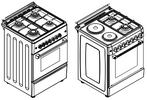
Instructions, should they be required, what should they say, etc.

OK, now making more sense, seems two models, one is an electric oven and gas hob, the other electric oven and domino hob half gas and half electric.

So we know an electric over will likely take 2–4 kW so if it had a domino hob then it will use the full 5.6 kW, but with an all gas hob, will work with 3 kW, but the connections for single phase, split phase and three-phase also confuses as one wonders again on the split, I would assume one to each ring independent and one to oven?

I can see the point in one gas burner, as a wok for an induction hob far too heavy, but why domino not sure.

But these 1787230912915.png are really two completely different cookers, why they have the same instructions seems daft.
 
Instructions are meant to be daft - I think it must be a legal requirement = 70s or 80s I remember I think oit might have been MFI or somesuch make and the instructions of building a sideboard etc and I particuilarly remember "Back 6" item and it explained how to build it but right at the end the instruction showed you to put this back 6 item in after you`d built it or something( Sort of Warthog day or something) - anyway "Back 6" was used as a swear word for years instead of cursing in front of the kids.

Most of you probably realise that MFI became Howdens!
 
Could be. Here is what I have had back via WhatsApp messaging with them. I also meant to provide a link above, but here it is: Ferre

What you do now is to write to the Chief Executive (paper letter, not email), including copies of those messages.

Say you don't know who was answering on their end, but you are sure they can find out, and that they should, because whoever it was is incompetent. At the very least they deserve an uncomfortable conversation with their line manager, and ideally be found another role in the company, for whatever their skill set is, it does not include dealing with customer enquiries.
 
Sometimes you can see that the instructions are taken as a bad conversion from chinese or something.

It can be hilarious even though it might have serious consequences - Active infra red detectors beams dualled or Quadroupled to counter false alarms from Frogs (I translated as Fog ) and yesterday the instructions in a Shark Vacuum Cleaner instruction to press the Food Pedal (I assumed meant Foot Pedal) etc etc etc.

Even the best of us make typos etc now and again but seriously some things should be proof read a few times to catch the gaffs created!
 
I can see the point in one gas burner, as a wok for an induction hob far too heavy, but why domino not sure.

I guess people appreciate the versatility of a choice of hob type, and dominos allow that to be created without using up acres of worktop. More than one company make them,so thee must be a demand. There are also combination hobs with two types of "burner" on a single surface.

I've got a 2-zone induction hob, and a separate single gas wok burner (which can obviously be used for normal pans as well) - together they are 900mm wide, 590 deep. If ever I need more than 3 at once I've got a single countertop induction hob I can whip out of a cupboard and plug in.

When I was planning it I toyed with the idea of getting one of these to provide expandable capacity

1787245420940.webp


But as you can imagine they aren't cheap, and I decided I was being seduced by the cool factor. I don't like touch controls and having to reach over pans to reach them anyway didn't seem like the cleverest idea.

They are cool though.
 
Many videos on YouTube etc, have the speech written below, and often I see the wrong word, etc, lbs instead of £ etc.

In 6 days time, the plug in solar becomes legal, and it has to come as a kit, with instructions which are a legal requirement. And what they say will be very important.

A small change in grammar, or including or missing out a full stop, can completely change what a statement says. Must or recommended is clear. But the one I remember with plumbers was "The bi-colour combination green-and-yellow shall be used exclusively for identification of a protective conductor and this combination shall not be used for any, other purpose. (This full stops was very important)
Single-core cables that are coloured green-and-yellow throughout their length shall only be used as a protective conductor, and shall not be over-marked at their terminations, except as permitted by Regulation 514.4.3."

It was read by some plumbers who missed the full stop, to only refer to single core cables, and they felt with a class II tank thermostat they could over sleeve the earth wire and use it as a live.

In real terms we all knew over sleeving of the green-yellow was not allowed, and anyway we were required since 1966 to take an earth cable to a fixed appliance (accessory) even if not used. "A circuit protective conductor shall be run to and terminated at each point in wiring and at each accessory except a lampholder having no exposed-conductive-parts and suspended from such a point." But people try to make statements suit what they want, rather than see what they were intended to say.

So a consumer unit is a type tested distribution unit, and if anything is fitted in the consumer unit which was not included in the type testing, then it's no longer a consumer unit. So it would be daft to write a law saying the fitting of a consumer unit needs notifying, one would clearly call it a distribution unit. Unless that is, if you want to include a method to get around the law.

This is where the official guides fall down, if the law has a glossary of terms, which says installed means anything over 18 kg without wheels, then that would include things like tumble driers and dishwashers, but not washing machines as they have wheels. It seems clear from the official guide the dishwasher was not intended to be included, but the law says it is for a rental homes electrical inspection.

It also refers to codes, but does not call it an EICR, so there is no requirement for an inspector to use codes, was this designed as a methods to get around reporting a fault without starting the 28 days count down, or was it an error in the way the law was written?

OK I have a wife who did an English degree, but most people don't read instructions with that knowledge, my wife got wise to the question, "You don't want coffee, do you." She always wants coffee, so answer should be no, but she would simply say "I want coffee" and avoid any double negatives.

It is of course the job of a proofreader to see missing full stops, and double negatives, so unless intentional we should not see that sort of error. But it seems it is being left to AI to catch the errors, and there is far too much cut and paste.

I know the reason why an extension lead should not be used with a fridge or freezer, is any excessive volt drop, can cause the unit not to get up to speed before the pressure builds up, so stall. Although only likely if the supply was at the lower limit to start with. However, this is not a problem with a three-phase compressor powered by an inverter, but it still says even with inverter drive fridges and freezers do not use an extension lead.

So over the years we have been programmed to ignore instructions. Common saying is, if all else fails, read the instructions. To the point now, some instructions only have pictures, they seem to assume we can't read.

 
I never read manuals or instructions

I realised later it was a mistake .

They need at least a cursory glance as you can miss stuff
 
I read the manual for an Erbauer battery drill, (Screwfix/B&Q own make) trade rated drill. It said not to leave the battery on charge unattended, so when you return at the end of a days work, you go into the depot and watch the batteries recharging?

I use Lidi's own, Parkside, the battery even has an app to tell me when charged, but I just stick the battery on charge, and walk away. No way am I going to sit there watching it re-charge.

So how much attention are we going to give to the instruction book even if we read it, be it tell us to watch a battery charge, or not to use an extension lead, likely we will never know as we have not read the instructions.
 

If you need to find a tradesperson to get your job done, please try our local search below, or if you are doing it yourself you can find suppliers local to you.

Select the supplier or trade you require, enter your location to begin your search.


Are you a trade or supplier? You can create your listing free at DIYnot Local

 
Back
Top