Many videos on YouTube etc, have the speech written below, and often I see the wrong word, etc, lbs instead of £ etc.
In 6 days time, the plug in solar becomes legal, and it has to come as a kit, with instructions which are a legal requirement. And what they say will be very important.
A small change in grammar, or including or missing out a full stop, can completely change what a statement says. Must or recommended is clear. But the one I remember with plumbers was "The bi-colour combination green-and-yellow shall be used exclusively for identification of a protective conductor and this combination shall not be used for any, other purpose. (This full stops was very important)
Single-core cables that are coloured green-and-yellow throughout their length shall only be used as a protective conductor, and shall not be over-marked at their terminations, except as permitted by Regulation 514.4.3."
It was read by some plumbers who missed the full stop, to only refer to single core cables, and they felt with a class II tank thermostat they could over sleeve the earth wire and use it as a live.
In real terms we all knew over sleeving of the green-yellow was not allowed, and anyway we were required since 1966 to take an earth cable to a fixed appliance (accessory) even if not used. "A circuit protective conductor shall be run to and terminated at each point in wiring and at each accessory except a lampholder having no exposed-conductive-parts and suspended from such a point." But people try to make statements suit what they want, rather than see what they were intended to say.
So a consumer unit is a type tested distribution unit, and if anything is fitted in the consumer unit which was not included in the type testing, then it's no longer a consumer unit. So it would be daft to write a law saying the fitting of a consumer unit needs notifying, one would clearly call it a distribution unit. Unless that is, if you want to include a method to get around the law.
This is where the official guides fall down, if the law has a glossary of terms, which says installed means anything over 18 kg without wheels, then that would include things like tumble driers and dishwashers, but not washing machines as they have wheels. It seems clear from the official guide the dishwasher was not intended to be included, but the law says it is for a rental homes electrical inspection.
It also refers to codes, but does not call it an EICR, so there is no requirement for an inspector to use codes, was this designed as a methods to get around reporting a fault without starting the 28 days count down, or was it an error in the way the law was written?
OK I have a wife who did an English degree, but most people don't read instructions with that knowledge, my wife got wise to the question, "You don't want coffee, do you." She always wants coffee, so answer should be no, but she would simply say "I want coffee" and avoid any double negatives.
It is of course the job of a proofreader to see missing full stops, and double negatives, so unless intentional we should not see that sort of error. But it seems it is being left to AI to catch the errors, and there is far too much cut and paste.
I know the reason why an extension lead should not be used with a fridge or freezer, is any excessive volt drop, can cause the unit not to get up to speed before the pressure builds up, so stall. Although only likely if the supply was at the lower limit to start with. However, this is not a problem with a three-phase compressor powered by an inverter, but it still says even with inverter drive fridges and freezers do not use an extension lead.
So over the years we have been programmed to ignore instructions. Common saying is, if all else fails, read the instructions. To the point now, some instructions only have pictures, they seem to assume we can't read.



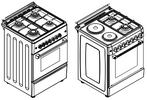 are really two completely different cookers, why they have the same instructions seems daft.


