Insulate garage door and fill gaps at side

Could do with better pics of this end:

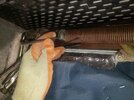
View attachment 403788

But basically that is where you adjust the spring tension. Somewhere in that block will be a grub screw or similar that clamps that block to the circa inch thick pole visible on the left of the pic (looks a bit like copper pipe in that pic) and you can also see a large silver lump with holes drilled in. You basic procedure is to find two metal rods that fit the holes well, insert one rod and hold it tense (in the opposite direction to what the spring will cause the block to spin ie in your case you will apply upwards pressure to the rod because the spring coil wants to rotate the block so the rod moves downward
When you have applied up pressure to the rod and released the grub screw, the block is free to turn. You push the one rod up until you can get the next rod in the next hole in the block, you insert the second rod, take the tension with it and remove the first, push the second rod up and rotate the block, then reinsert the first rod in the next hole

Thus you end up "walking" the block around in a circle using two rods alternately until you have tensioned the spring more. The more you load the spring to more it counterbalances the new weight of the door. Tension it just enough that it stays open
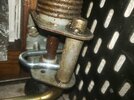
The crook pin, when inserted (see ‘crook pin(4).jpg attachment) does not lock off the shaft to prevent the shaft from rotating with the spring plug. I have successfully used the allen key and 1 toggle bar to rotate the spring plug upward (see ‘allen key and 1 pin.jpg attachment) but the shaft rotates about 90% of the rotation that the spring plug does so the spring is not tensioned very much if at all. I have used mawl grips to grip the shaft which act as shaft movement stoppers. But I do not know how to lock off the shaft such that the shaft cannot rotate at all. How do I lock off the shaft so that the shaft cannot rotate?


Please assist thanks
 

Attachments

  • 20260128_allen key and 1 pin (rotate upward).jpg
    20260128_allen key and 1 pin (rotate upward).jpg
    345.7 KB · Views: 8
  • 20260128_crook pin (4).jpg
    20260128_crook pin (4).jpg
    250.2 KB · Views: 8
  • 20260128_mawl grip.jpg
    20260128_mawl grip.jpg
    454 KB · Views: 8
You undo the grub screw with the Allen key and then use two bars to walk the block repeatedly, over and over and over again, until you've put tens of turns on the spring. Then you do the grub screw up locking the block to the shaft.
Do not undo the grub screw without having one locking bar in the block. With the grub screw undone if the central bar that carries the pulleys that wrap the lift cables is rotating nuisancely you can lock it off with grips, but it looks like your crook pin should be preventing that nuisance rotation. Turn the shaft to take up play in the cables then lock it off so it doesn't rotate as you tension the spring

In most pics you'll see of garage door springs there is a spiral line on the spring (done by the manufacturer painting a straight line on it while it was untensioned) that indicates how many turns it has on. I can't see a line on yours but if it's untensioned the line might be at the back

If the tension has been fully released it will need many turns to get back to where it was and more turns to counteract the weight of the kingspan

You can tension it by feel/experiment: put 20 full turns on it (boring I know, you'll be there a while) and see how it holds up. If it drops still, put more turns. If it is jammed open and hard to pull closed, release some tension
 
You undo the grub screw with the Allen key and then use two bars to walk the block repeatedly, over and over and over again, until you've put tens of turns on the spring. Then you do the grub screw up locking the block to the shaft.
Do not undo the grub screw without having one locking bar in the block. With the grub screw undone if the central bar that carries the pulleys that wrap the lift cables is rotating nuisancely you can lock it off with grips, but it looks like your crook pin should be preventing that nuisance rotation. Turn the shaft to take up play in the cables then lock it off so it doesn't rotate as you tension the spring

In most pics you'll see of garage door springs there is a spiral line on the spring (done by the manufacturer painting a straight line on it while it was untensioned) that indicates how many turns it has on. I can't see a line on yours but if it's untensioned the line might be at the back

If the tension has been fully released it will need many turns to get back to where it was and more turns to counteract the weight of the kingspan

You can tension it by feel/experiment: put 20 full turns on it (boring I know, you'll be there a while) and see how it holds up. If it drops still, put more turns. If it is jammed open and hard to pull closed, release some tension
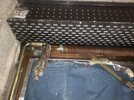
The 100mm kingspan insulation just under the block prevents me from using using two bars two bars as I can only use one of the holes in a position of 45 degrees from facing vertically down.

Do my mawl/mole grips that I put onto the central bar (see 'mawl grip' JPEG) stop the bar from rotating? The bar does lift when I push the bar upwards. Should I put mawl/mole grips onto the bar inside the left hand bracket and as per 'mawl grip' JPEG (on central bar) at the same time?

The garage door does lift if I push it upwards with some force (equivalent of about 15kg pull force needed from me to lift the door and the door itself cannot stay open without effort) so the door is definitly tensioned. I'd guess about 5 to 15 rotations tensioning should fix it.

How do I put full turns on the block given that I can't put a bar into more than 1 hole at a time? There are 2 holes on the block 1 accessed from below the other from 45 degrees from below. The RSJ above prevents any rotation from above or near above. Basically access to the block is very tight. And I tried using a flat spanner on the block integrated nut but because the spring wire comes out on top of the nut I can't get the flat spanner to sit on the nut.
 
I can’t comment on your door and mine was probably 20 years ago but I think I used a pair of rods that could be inserted into the winder. You needed to wind one up, then when a second hole appears, insert a second. Remove number one, wind number two, exposing another hole and so on.
 

If you need to find a tradesperson to get your job done, please try our local search below, or if you are doing it yourself you can find suppliers local to you.

Select the supplier or trade you require, enter your location to begin your search.


Are you a trade or supplier? You can create your listing free at DIYnot Local

 
Back
Top