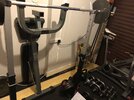
I am considering how best to line some unused garage space which I currently use as a gym (and bike workshop).
My house originally had an integral garage. Previous owners adapted this for use initially as an office space by lining the walls with plasterboard (using 1 inch battens and no insulation then installing a floating floor on top of the concrete base.
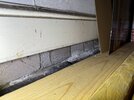
They later had part of the garage converted to a utility room. They removed the flooring throughout, but leaving some unused space still with the plasterboard lining. I’ve attached some images below to hopefully show what I mean.
I can see the garage concrete slab has a DPM and when I bought the house they had already insulated the cavity walls.
External walls of garage are breezeblock built on brick piers (my ground floor is suspended timber floors) and the garage floor itself is a concrete slab.
The only thing I have done is I had the metal up and over garage door replaced with a Hormann roller door.
All I am looking to do is to make the area more suitable/pleasant to use as a gym/workshop not convert the area. Gym is the primary use and bike workshop secondar. I will not be looking to block off the garage door in any way as I like to be able to take the bikes in and out that way and sometimes commute by bike so the door access can get a fair bit of use.
I find the current temperature fine for use as a gym. It is admittedly cold in the depth of winter, but absolutely fine to exercise in and also relatively cool in summer which is an advantage given the use.
I managed to get hold of several lengths of 38x63 Treated CLS for next to nothing so have enough of this to batten the walls and floor. I was planning to fix 8x4 ply sheets to the walls as I like to hang a lot of equipment on the walls and also frequently chop and change the fittings so figured ply would be the best balance between strength and impact resistance rather than plasterboard. I was also planning to put a chipboard timber floor on battens over DPM on the concrete slab as it is not the best to exercise on even with the rubber mats on top. I want to keep the flooring level as close to the slab as possible to maintain the overhead height for exercising.
So the simplest way I can see to achieve what I want is a floating floor system with chipboard on top of battens, with a DPM below lapped up the walls to the height of the exterior wall DPM between the brick piers and blockwork. Then batten the walls and apply the ply sheets.
I’m unsure about insulation though. I’m happy to put insulation in the walls and floor if it is a good ideas, but unsure the merits of this as one side of the room is still the roller garage door and whereas the Hormann door made a vast difference to the room temperature compared to the old metal up and over door, would there be any real benefits from installing insulation in the rest of the room as the room temperature would ultimately be dictated by the heat loss through the uninsulated garage door?
My house originally had an integral garage. Previous owners adapted this for use initially as an office space by lining the walls with plasterboard (using 1 inch battens and no insulation then installing a floating floor on top of the concrete base.
They later had part of the garage converted to a utility room. They removed the flooring throughout, but leaving some unused space still with the plasterboard lining. I’ve attached some images below to hopefully show what I mean.
I can see the garage concrete slab has a DPM and when I bought the house they had already insulated the cavity walls.
External walls of garage are breezeblock built on brick piers (my ground floor is suspended timber floors) and the garage floor itself is a concrete slab.
The only thing I have done is I had the metal up and over garage door replaced with a Hormann roller door.
All I am looking to do is to make the area more suitable/pleasant to use as a gym/workshop not convert the area. Gym is the primary use and bike workshop secondar. I will not be looking to block off the garage door in any way as I like to be able to take the bikes in and out that way and sometimes commute by bike so the door access can get a fair bit of use.
I find the current temperature fine for use as a gym. It is admittedly cold in the depth of winter, but absolutely fine to exercise in and also relatively cool in summer which is an advantage given the use.
I managed to get hold of several lengths of 38x63 Treated CLS for next to nothing so have enough of this to batten the walls and floor. I was planning to fix 8x4 ply sheets to the walls as I like to hang a lot of equipment on the walls and also frequently chop and change the fittings so figured ply would be the best balance between strength and impact resistance rather than plasterboard. I was also planning to put a chipboard timber floor on battens over DPM on the concrete slab as it is not the best to exercise on even with the rubber mats on top. I want to keep the flooring level as close to the slab as possible to maintain the overhead height for exercising.
So the simplest way I can see to achieve what I want is a floating floor system with chipboard on top of battens, with a DPM below lapped up the walls to the height of the exterior wall DPM between the brick piers and blockwork. Then batten the walls and apply the ply sheets.
I’m unsure about insulation though. I’m happy to put insulation in the walls and floor if it is a good ideas, but unsure the merits of this as one side of the room is still the roller garage door and whereas the Hormann door made a vast difference to the room temperature compared to the old metal up and over door, would there be any real benefits from installing insulation in the rest of the room as the room temperature would ultimately be dictated by the heat loss through the uninsulated garage door?