Main fuse irregularly blows, why?

Joined
8 Jul 2008
Messages
1,469
Reaction score
121
Location
Derbyshire
Country
United Kingdom
Bit of a curious one.

A flat above a commercial property where, every so often, the main fuse blows. Maybe once every year or so. Property has had a full ECIR multiple times in that period, the last one being a few months ago, along with new appliances. Has always checked out fine.

This time when the main fuse blew, the guy came as normal to replace it, however, when it was powered back up after a new fuse was re-inserted, there was a spark and a puff of smoke.

Initially the guy thought it took out two of the other main fuses which are there for other properties, but then seemed to suggest the spark came from an earthing connection.

After a check of all the other fuses, everything was fine. The property powered back up, no issues with tripping on the consumer unit.

There were no issues with any odd appliances being connected inside the property recently nor anything running at the time to cause an issue. The washing machine had been on but the cycle was finished.

The guy from the power grid was adamant it must be property side.

When this first happened, from memory, there was major work being done outside on the main road, apparently there is a major electrical junction under the road, and it was always assumed this was the cause, some kind of surge. But that may have just been coincidental guesswork. I can't remember who posited that idea.

Granted there is only basic information there, but if there is an issue, it must be something multiple ECIRs have missed. So I was more getting opinions on where the issue may lie, or what might cause such a irregular issue. Especially if it is likely to be property side.
 
Any photos?
Could the flat be powering the shop below, or other flats?
Strange things going on outside in the road can cause odd things to happen inside - but best to concentrate on the property side.
 
Bit of a curious one.

A flat above a commercial property where, every so often, the main fuse blows. Maybe once every year or so. Property has had a full ECIR multiple times in that period, the last one being a few months ago, along with new appliances. Has always checked out fine.

This time when the main fuse blew, the guy came as normal to replace it, however, when it was powered back up after a new fuse was re-inserted, there was a spark and a puff of smoke.

Initially the guy thought it took out two of the other main fuses which are there for other properties, but then seemed to suggest the spark came from an earthing connection.
Did the spark occur when removing the earth conductor?

Is it a tncs supply?
 
Two things -
1 is the cable from the fuse/cutout to the flat above - what kind of cable is it, and how is it routed, does it have it's own fuse/breaker or just relying on the main supply fuse?
2 is the possibility that the fuseholder/cutout itself is failing, such as it's a black phenolic type which is becoming conductive due to moisture or other contamination.

Neither of those would normally be covered on an EICR.
 
Thanks for the replies, I appreciate I have limited information at the moment, it's not something I am directly involved in, but thought this forum might be the best place to at least get an idea where the problem may lie for further investigations.

The spark seemed to occur as the main isolating switch was switched on after a new fuse had been installed. At first it seemed like either the same fuse blew or one of the other two (one is for the commercial property, not sure what the second is for) but, then it turned out all the fuses were fine, and it seemed like the spark came from an earth connection near the mains fuses.

Alas, I forgot to take a photo of the set-up.

@flameport the meter itself is in the cellar of the commercial property, along with the mains fuse and an older looking (older commercial style? (big and metal)) isolator switch. Then there what looks like a pretty beefy cable going to the consumer unit in the property which is dual RCD type in a metal unit.
 
Cable from the isolator to consumer unit is damaged, or someone has tapped into it to obtain electricity and have someone else pay for it.
 
Cable from the isolator to consumer unit is damaged, or someone has tapped into it to obtain electricity and have someone else pay for it.

I could see it potentially being the first. But I would think the second is very unlikely.

What kind of checks outside those of the ECIR should I focus on to isolate any issue (again I appreciate I have given you all limited information).

Edit: A bit more info

The flat has always had it's own supply.
The commercial supply (office below) used to be three phase but was converted to single a while back.

So at the moment there are three mains fuses, one for the flat, one for the office, and the third one, I assume, is just a dead end, I will have to check but I can't think what it would be for.

In addition, I have been told is that when the fuses have blown in the past, it has been the commercial (office) one. And this, is totally independent from the flat supply, other than being in close proximity. Which just adds to the curious nature of these fuses popping.

I'll try and get a photo of the set-up for tomorrow.
 
Last edited:
OK, photos! Some of the info I have given above may have been slightly incorrect, but I was only going by memory.

Location: Cellar

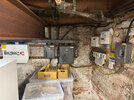
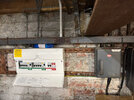
This is the overall set-up

meter11.jpg

As you can see it has some historic commercial grade isolators from yesteryear. It used to be a 3 phase supply to the commercial property, but this was converted to become a single phase.

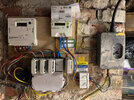
Some close-ups

meter3.jpg
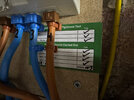
So, the isolator to the right is for the flat, as is the right most fuse, with the meter just above. That is the fuse that blew. The large black cable from the isolating switch goes to the consumer unit in the flat.

The supply for the office is made up of those 3 fuses to the left and the meter to the left.

So, the network guy came and replaced the fuse in the right most enclosure, and when he flipped the isolator switch, there was a spark/arc and a wisp of smoke. Initially he thought the same fuse, or one of the other fuses had immediately blown. But it turned out they were all fine.

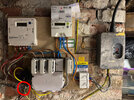
He then determined the spark had come from an earth connection here. Or somewhere in that area at least.

meter3a.jpg

Now, some important context. The previous times these fuses have popped it has been on the commercial side. Two different fuses from the bank of three have popped in the past, at different times. This is over the period of maybe 3 to 4 years.

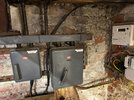
To the right of of all this stuff are the main isolator switches for the supply as a whole (I think).

meter10.jpg

and to the right of these the consumer unit for the commercial office.

meter9.jpg
The whole set-up was upgraded a lot in the recent past around when it was converted from triple to single phase. As you can see the back board is all in good condition.
meter12.jpg


The only other information I can think pertinent is that while the cellar is dry, it can have a fairly humid feel to it. How bad the humidity gets I can't say for sure, but that chipboard backboard has not degraded, so not damp i guess.

Thoughts on all that?

I appreciate any help or thoughts on areas to investigate.
 
Last edited:
As you can see it has some historic commercial grade isolators from yesteryear. It used to be a 3 phase supply to the commercial property, but this was converted to become a single phase.
There still appear to be three phase conductors leaving the "shop" meter and going to the big isolator, whether they go anywhere beyond that one can't tell from the pics.
 
There still appear to be three phase conductors leaving the "shop" meter and going to the big isolator, whether they go anywhere beyond that one can't tell from the pics.
I can't answer that I'm afraid.

All I know is that it used to be a three phase supply due to the previous commercial occupancy. But when the network realised it no longer needed that kind of supply, they converted it to a single phase supply. How that has been carried out I'm not sure but I always wondered why it still had all the visual appearance of a three phase.
 
As you say it looks like a normal 3ph supply to the large isolator, as plugwash says what happens after that is all guesswork but if the only service is that consumer unit then most likely only a single phase picked from that isolator.
There is no actual need to inform energy provider they are only using a single phase and my limited experience in the matter is there is no difference in cost for a 1 or 3ph supply or using 1 of the 3 phases.
However all of that aside, I doubt very much that any of that will affect the flat supply unless there is some link/fault between the services after they leave that area.
I can't see detail of that earthing arrangement but it does appear to look a bit green and due for an upgrade from it's appearence, especially if there was a crackle or spark there. That could point toward an earth fault in the flat side of things.
When was it last inspected?
 
ECIR was 5 months ago, and a lot of the components there got revamped and upgraded when it was switched from three phase to single. That was in the last 10 years or so. But it gets regularly inspected. Consumer unit for the office and the flat was all upgraded in the last 5 years I think.
 
Going back to what @flameport briefly mused.

With it being in a cellar, that can get a bit on the humid side, especially with the heat as of late. What are the chances of moisture shorting out the mains fuses?

This might explain why the supplies two separate supplies have had mains fuses going (see above in bold). Is the the only thing that could affect them both other than the supply side, an environmental factor? Or is there a common factor linking the office and flat in another way?

Unless there is anything else that looks out of ordinary and suspect from the images.
 
Last edited:
With it being in a cellar, that can get a bit on the humid side, especially with the heat as of late. What are the chances of moisture shorting out the mains fuses?

Without evidence of damage, where the fault due to moisture occurred - I would say minimum chance of it being due to damp. Even less likely, it would happen to two different services, without it again immediately, taking out the fuse. Breakdown, due to moisture, will immediately carbonise the conductive path.
 

If you need to find a tradesperson to get your job done, please try our local search below, or if you are doing it yourself you can find suppliers local to you.

Select the supplier or trade you require, enter your location to begin your search.


Are you a trade or supplier? You can create your listing free at DIYnot Local

 
Back
Top