new house electrics

Mind you, they presumably could have left it as two circuits, each with their own MCB on the same RCD (which would have been no less compliant with 314.1 than was combining them into a single circuit), but for some reason they didn't do that. Maybe it was done by an 'electrician' who didn't realise/understand that (s)he could do that?
Two separate MCBs for circuits which share a common neutral is not permitted either, 314.4
The only options were to put both onto the same MCB, or rewire the circuit.
 
Two separate MCBs for circuits which share a common neutral is not permitted either, 314.4
I suppose one can read 314.4 that way, but it seems a little odd (at least, as you've worded it) since, if they were on separate MCBs (on the same RCD) their neutrals would be connected to the same neutral bar - which is surely the ultimate case of 'sharing a common neutral'! Of course the so-called 'borrowed/shared neutral' is often really a 'borrowed/shared line', and that's rather different!

Kind Regards, John
 
I would agree with flameport it has never been permitted, but where there is no RCD then often the person splitting the circuits just didn't realise what was happening.

Using twin and earth for the connection between the two switches and borrowing a line also has other problems. Mains hum is transmitted to any vulnerable device. It would seem not banned but still considered bad practice. Specially today with so much RF gear in the house.
 
Using twin and earth for the connection between the two switches and borrowing a line also has other problems. Mains hum is transmitted to any vulnerable device. It would seem not banned but still considered bad practice. Specially today with so much RF gear in the house.
Having 'unaccompanied' (i.e. 'unpaired') current-carrying conductors can (and does) produce mains hum in audio equipment etc., but I can't really see how it could affect 'RF gear'.

Kind Regards, John
 
Hi all,

Thanks for all the input on this, very interesting.

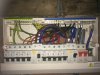
I did have a further look at the consumer unit tonight. I've attached a photo. IMG_2894.JPG

I think over the weekend I'll have to one by one switch of the 'socket' circuits and work out what goes dead for each one. I'm looking to decorate the kitchen soon and add a couple more sockets so I need to work out what's what circuit wise.

Circuits

1.5 Will more than likely have two conductors in the MCB, one that was upstairs lighting circuit and the other downstairs lighting circuit, borrowed/shared neutrals will not all the two circuits to be split across two RCDs, but there is no reason they could not still be two lighting circuit on two individual MCB on the same RCD, so you can still have two lighting circuits providing they are not split across the two RCDs.
True, it does have two conductors so it looks like both lighting circuits have been combined.

For circuit 2.2 that was for an old immersion heater, there's not one anymore. We've got a neon switch in the kitchen for it and I've then traced it to a blanked off box in the airing cupboard.

Circuit 1.1 which the installation certificate says live 10 mm2 and cpc 5 mm2 doesn't actually have anything connected. I don't know where the '1'pont connected comes from. The house has got a mixer shower and there seems no signs of any wiring in the past to an electric shower.

So it's just the 4 socket circuits I need to work out whats feed from what. I guess 1.1 and 1.2 will be two rings, one downstairs and one upstairs.

Cheers,
Paul
 
The box will allow two RCBO's to be fitted. Moving the lights to a RCBO (which is a MCB and RCB combined) will mean if the sockets trip the RCD you will not loose lights. However neutrals also need moving I would say not really a DIY job.
It would seem you can do the same as I did and use the old immersion heater supply for some extra sockets or supply to oven (Not cooker or hob).
Unless you get problems with RCD's tripping I would not bother modifying what we have talked about with borrowed neutrals means it would be easy to end up with problems if you modify and with modern LED and CFL bulbs there is not much load on the lights so no real reason to split.
When the quartz halogen spot lamps became the in thing many people over loaded the lighting circuit and splitting was common to get the extra power required. Ceiling roses being rated 6 amp simply using a 10A MCB was not an option. However as time has gone on people realised although it may be trendy in real terms the 50mm spot lights were hot to work under and forever needed changing as they failed. Swapping for LED reduced the heat and the need to replace all the time and also the load on the lighting circuits. So today no need to have lighting circuits split.
 
The box will allow two RCBO's to be fitted. Moving the lights to a RCBO (which is a MCB and RCB combined) will mean if the sockets trip the RCD you will not loose lights. However neutrals also need moving I would say not really a DIY job.
A lot more than just moving the neutrals, surely? The CU (busbar arrangement) would have to be re-configured to provide a non-RCD way for the RCBO - so, I would say certainly not likely to be a 'DIY job'.

I suppose a lot depends upon what the OP wants to achieve. In the absence of faults, the present arrangement works fine. Doing as you suggest would, as you say, prevent all the lights being taken out by a fault on some other circuit. That would be convenient in the (very rare) event of a fault occurring, and would probably address one of the present non-compliance issues - but that issue could probably also be addressed by provision of a battery-operated (or backed up) light or two.

We are all assuming that the two lighting circuits have been combined because of some interconnection between then ('borrowed neutral' etc.). Although that seems very probable, I would think that the first thing an electrician should do would be to confirm that such an interconnection actually does exist. If, by any chance, it doesn't, then the lighting circuit could obviously simply be re-split, with one on each of the RCDs (in the 'usual' way).

Kiind Regards, John
 
what annoys me about that setup is that if the RHS RCD trip's (and can't be reset) you have lost all lights, and most of the sockets in the house!

You are left with about 1 working socket and an oven.

Therefore no electricity at all in most rooms, completely against the intention of dual RCD.
 
If one lamp blows you will loose all lights in the house!

I would be moving the lights over to the left hand side (if wires will reach) and splitting it to 2 MCB's.

If you find out what the socket circuits do, we could give more advise.
 
what annoys me about that setup is that if the RHS RCD trip's (and can't be reset) you have lost all lights, and most of the sockets in the house! ... You are left with about 1 working socket and an oven. ... Therefore no electricity at all in most rooms, completely against the intention of dual RCD.
Indeed - which is why most people would probably say that it's non-compliant with 314.1/314.2.

Kind Regards, John
 
If one lamp blows you will loose all lights in the house!
Yes, if the blowing lamp causes an MCB (or even RCD) to operate. That is, of course, the situation which many of us lived with for a substantial part of our life!
I would be moving the lights over to the left hand side (if wires will reach) and splitting it to 2 MCB's.
One can certainly argue that (as a single circuit), the lights would be better on the other side. However, as for splitting into 2 MCBs, as has been said, IF there is a persisting interconnection between the circuits (and, if not, we are discussing a non-problem!), it would probably be non-compliant to split the circuit onto two different MCBs.

Kind Regards, John
 
As you have said yourself, the neutral ends up connected to the same neutral bus bar.

I suppose one can read 314.4 that way, but it seems a little odd (at least, as you've worded it) since, if they were on separate MCBs (on the same RCD) their neutrals would be connected to the same neutral bar - which is surely the ultimate case of 'sharing a common neutral'!Kind Regards, John

I know what I would have if it was my house. I wouldn't want to be in darkness everytime a lamp blew.
 
As you have said yourself, the neutral ends up connected to the same neutral bus bar.
That's true, but I was really commenting on the wording of flameport's statement (about circuits "sharing a common neutral"). The 'borrowed/shared neutral' terminology is a bit misleading. The real problem is that with an interconnection between two circuits, there may be potentially live parts of one circuit even when it appears to be 'switched off' (at its MCB) - and I think that is, in this context, what 314.4 seeks to prevent.
I know what I would have if it was my house. I wouldn't want to be in darkness everytime a lamp blew.
As I implied before, a blowing lamp doesn't necessarily cause any device to operate. Indeed, although it was quite common in the days of incandescent lamps/bulbs (because of the common very-high-current 'mode of death' of such items), since 'moving on' I think it's now many years since I last had an MCB trip as a result of a lamp/bulb dying.

Kind Regards, John
 

If you need to find a tradesperson to get your job done, please try our local search below, or if you are doing it yourself you can find suppliers local to you.

Select the supplier or trade you require, enter your location to begin your search.


Are you a trade or supplier? You can create your listing free at DIYnot Local

 
Back
Top