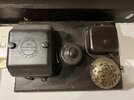
• Looking for a smarter way to manage your heating this winter? We’ve been testing the new Aqara Radiator Thermostat W600 to see how quiet, accurate and easy it is to use around the home. Click here read our review.

Old House Mystery: 6-Bell Servants’ Call Box – 2 Still Missing, Any Ideas?

Joined
10 Nov 2007
Messages
7
Reaction score
0
Location
Warwickshire
Country
United Kingdom
Hi all,


I’m hoping someone here might have some experience or ideas with old servant bell systems.


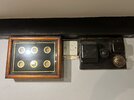
Our house dates back to the 1600s, and in the kitchen we still have the original bell indicator box with six flags (see photos below). The system still partly works — the push buttons in the lounge and dining room both operate as they should, triggering the bell and flipping the corresponding flags on the box. The front and back door buttons also work perfectly.


That leaves two unknown indicators. My guess is that they were originally for the two main bedrooms upstairs, but there’s no sign of the old push buttons anywhere in those rooms.


It might sound like a daft question, but does anyone have any tips on how to trace where those missing bell circuits might have run, or where the original buttons could have been located? I’d love to get the full system working again — not to annoy my wife, I promise — but to restore a bit of the house’s history.


Cheers,
Jim
 

Attachments

  • IMG_3175.jpeg
    IMG_3175.jpeg
    263.8 KB · Views: 89
  • IMG_3177.jpeg
    IMG_3177.jpeg
    474.5 KB · Views: 93
  • IMG_3176.jpeg
    IMG_3176.jpeg
    315.9 KB · Views: 92
  • IMG_3178.jpeg
    IMG_3178.jpeg
    239.4 KB · Views: 92
Alll I can suggest is lifting some floorboards.
The buttons were likely located within range of the bed. But where was that?
 
Hi all,


I’m hoping someone here might have some experience or ideas with old servant bell systems.


Our house dates back to the 1600s, and in the kitchen we still have the original bell indicator box with six flags (see photos below). The system still partly works — the push buttons in the lounge and dining room both operate as they should, triggering the bell and flipping the corresponding flags on the box. The front and back door buttons also work perfectly.


That leaves two unknown indicators. My guess is that they were originally for the two main bedrooms upstairs, but there’s no sign of the old push buttons anywhere in those rooms.


It might sound like a daft question, but does anyone have any tips on how to trace where those missing bell circuits might have run, or where the original buttons could have been located? I’d love to get the full system working again — not to annoy my wife, I promise — but to restore a bit of the house’s history.


Cheers,
Jim

I formerly lived in a house where some of the rooms did not have fixed bell-pushes, but sockets for 2A round pin plugs, where a portable bellpush on a wanderlead could be connected.

I recall one was in the middle of a bay window, in the skirting of a main bedroom, so the bedhead could have been positioned on either side. One was close to a fireplace in a main room. Temporary bell pushes were useful if the occupant was unwell, or an important guest was staying.

You come across these things when taking up floorboards, or possibly in the loft.

My room was the former housekeepers bedroom, so did not have one. You could recognise servants rooms by smaller skirting, less fancy windows, and no picture rail, no ceiling coving or plaster rose. The maid's room was the same. They were also smaller.

There may be one in the hall to call for assistance with coats and bags. There might have been one in the bathroom. The dining room and withdrawing room must have had them, and the men's smoking room, if any.

BTW the flag panel might have been retrofitted as a used device, so might not correspond with actual circuits in the house.
 
The system still partly works — the push buttons in the lounge and dining room both operate as they should, triggering the bell and flipping the corresponding flags on the box. The front and back door buttons also work perfectly.


That leaves two unknown indicators. My guess is that they were originally for the two main bedrooms upstairs, but there’s no sign of the old push buttons anywhere in those rooms.
It is likely that "remodeling" has taken place - over the last Centaury -
and the Bell Pushes and wiring have been disconnected.

(The two indicators on the right have no conductors connected to the relevant terminals !)

Maybe a tone tracer?
That may be of some assistance.

However, even if you DO locate the existing wiring - and then extend it to new Bell Pushes -
I suggest that you exercise a great deal of caution,
since centaury old wiring is unlikely to meet modern standards, even for Extra Low Voltage Wiring!

I strongly suggest that you
modify the connections to all the incoming/outgoing wiring
(behind the "apparatus" shown in Photos #1 and #2)
to ALL of the Bell Pushes
to include an in-line Fuse of the lowest value which allows one of the "indicators" to operate in EACH circuit
or
install one such fuse in a "common" feed to them.

Then, IF/WHEN a fault occurs in the "ancient" wiring
a fire in the walls is less likely.
(Separate fuses would make it easier to determine the circuit location of any fault if/when it does occur.)
 
Last edited:
Must admit I do appreciate the ingenuity of old techniques, some of them were very clever too.
A joy to behold.

Some of the famous builds of the old engineers Like Brunel to name just one. the mechanical and electrical disciplines of old were really imaginative and I commend them alongside modern stuff like the Moon landings and the Falkirk Wheel.
Oh I could name many many more both ancient and modern.
 
A neodymium magnet might help locate any (magnetic) metals left in the system.
 
I'm making a total guess that this is the layout but it really matters not
1760257845059.png


And internally connected thus
1760258004037.png


Does that help with tracing the 'missing' wiring?
 
You’ll probably find that the wiring runs in the walls are in steel conduit. You might be able to find that with a modern wall scanner.
 
It might sound like a daft question, but does anyone have any tips on how to trace where those missing bell circuits might have run, or where the original buttons could have been located? I’d love to get the full system working again — not to annoy my wife, I promise — but to restore a bit of the house’s history.

As above, it looks as if those two circuits, have not been implemented, but...

If you do find any wires for them, you can trace wires with a gadget which puts an electronic tone on them, at the end. You are then able to trace the run of the wire, with a little tone detector unit.
 
The wires don’t actually look that ancient, maybe post-WWII. If the insulation doesn’t feel crumbly at the terminals I wouldn‘t worry about that part.

In order to use a tone tracer you‘d need to find the wires at the panel. If you can’t find them, I‘d run new wires, pretty much anything will do, it’s 12 V and low current for short periods of time. There‘s two wires to each button, one common from the transformer and one going to each individual flag.
 
I guess that you could try to find some buttons that match the existing, architectural salvage yard / eBay etc and modify them to trigger a wireless transmitter ?

That would save running new cable through the house if you can’t resurrect the old system.
Then use the receiver to trigger the one in the servants quarters?

I know that it’s not the original name but running wires around a house can be a real pain.
 
The wires don’t actually look that ancient, maybe post-WWII. If the insulation doesn’t feel crumbly at the terminals I wouldn‘t worry about that part.

In order to use a tone tracer you‘d need to find the wires at the panel. If you can’t find them, I‘d run new wires, pretty much anything will do, it’s 12 V and low current for short periods of time. There‘s two wires to each button, one common from the transformer and one going to each individual flag.
It may not be as low current as you imagine, the wire showing looks like it might even be modern 1.0mm² T&E, I'd be tempted to not deviate too far from there.

Without knowing exactly that the products are it's fairly likely they are low resistance solenoids and bell in series, that was certainly a popular system.
 

If you need to find a tradesperson to get your job done, please try our local search below, or if you are doing it yourself you can find suppliers local to you.

Select the supplier or trade you require, enter your location to begin your search.


Are you a trade or supplier? You can create your listing free at DIYnot Local

 
Back
Top