Plug tops / Plug caps?

TRVs obviously existed, and were very widely used, long long before anyone had heard of modulating boilers.
Condensing boilers were developed in the Netherlands in the late 1970s.
Modulating central heating boilers, which adjust their output to meet demand rather than turning on and off, became mainstream in the UK following the mandatory implementation of condensing boilers on April 1, 2005.
I had a non condensing in my house 1979 approx, but my sister around 1990 had a condensing boiler, and her house was the first I saw with one direction TRV heads, later versions were bidirectional.
Where are these thermostats located? What aspect of their 'flavour' removes the need for wall thermostat(s)?
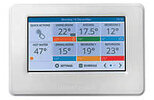
The first I saw was Honeywell EvoHome, originated from the "Hometronic" system launched by Honeywell in 1996, EVO-home1.jpgtoday the Drayton Wiser allows I think around 9 thermostats be they TRV or wall mounted to be linked to the hub, some makes the TRV links to the wall thermostat/hub, others use an independent hub, I find only need one bedroom with a linked TRV head, as once boiler is fired by one, other TRV heads will work anyway. Personally I like having a wall thermostat, mounted on an internal wall, I know I can set the temperature higher or lower with voice commands, but I just like the idea of a wall mounted unit, even if strictly not required.
What do you mean by that?
There is one make where the lock shield is part of the TRV, it was it seems designed to make the setting of them up easier. Think the green bit shown here
1771401487169.png
is the Lock Shield part of the valve. Never used one, just know they exist.
They would presumably be 'new-fangled' ones!
As to what is 'new-fangled' it seems from the 90s to present day the TRV has been evolving, year by year, we had wax, and bellows, with the mechanical types, and uni-directional to start with, had to be fitted on the inlet side, no option to fit on return side, then bi-directional came out, the law required zones, and it seems people read the law different to each other, some LABC considered the TRV created zones, but many plumbers seemed to think it needed time as well as temperature control to be considered as a zone.

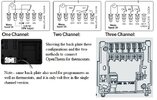
So the whole way the modulating boiler works requires gradual turning of zones on/off, or many zones, the EPH I know do a thermostat which can be set to master and many slaves, but most thermostats even when they have OpenTherm, say it should not be used with multi-zone versions of the thermostat, EPH seems to be the odd one out. Wiser do a three channel hub, and Hive have some way to link thermostats, I think the universal base Thermostat back plate.jpgis asking for problems where the same base can take a volt free and non volt free hub/thermostat/programmer, and it is a pain to test, as once hub is fitted you can't access terminals.
But today with a modulating boiler, one has little option, if you want it to modulate correctly and gain the latent heat but to control all with the TRV heads, which, if one feels the new laws require time settings for the zones, the only option is to use electronic heads.

I had a problem in parents house, the thermostat fitted,
84067_P.jpg
was very clever, it used a mark/space ratio to stop the heating over shooting, and would slowly increase the off time as it approched the set point and after, which completly messed up the modulating boiler, I would have worked great with the boiler I have in this house, but each time the modulating boiler was turned off, it restarted at full output, so it worked, but not in an ecomical way.

With modern central heating, we need analogue controls. OK turning on/off twice a day, but not 10 times a day, it seems the law has resulted in installations which don't suit the boilers being used. Instead of it making the boiler more efficent, it has made them in many cases less efficent.

I know my children used their bedrooms to do homework in, and when children left home, those rooms became an office, or a craft room, so the whole idea of splitting the heating upper floor and lower floor is flawed. My dinning room is not used at the moment, so set to 12°C actually sitting at 13°C, but without electronic heads on my TRV I could not really do this.
 
I had a non condensing in my house 1979 approx, but my sister around 1990 had a condensing boiler, and her house was the first I saw with one direction TRV heads, later versions were bidirectional.
in 2026, I still have a non-condensing boiler, and also ~40 year-old 'mechanical' TRVs.
The first I saw was Honeywell EvoHome, originated from the "Hometronic" system launched by Honeywell in 1996, .... today the Drayton Wiser allows I think around 9 thermostats be they TRV or wall mounted to be linked to the hub, some makes the TRV links to the wall thermostat/hub, others use an independent hub, I find only need one bedroom with a linked TRV head, as once boiler is fired by one, other TRV heads will work anyway.
As to what is 'new-fangled' it seems from the 90s to present day the TRV has been evolving, year by year, we had wax, and bellows, with the mechanical types, and uni-directional to start with, had to be fitted on the inlet side, no option to fit on return side, then bi-directional came out,...
I need to do some reading/learning sometime, since I don't yet really understand what the new-fangled ones actually do.

In my current relative ignorance, I suspect that they might not really be true "TRVs" at all (at least, as I see it). I would say that a true 'TRV' would have temperature sensing which directly (usually mechanically) controlled the valve with which they were associated. However, if the new-fangled ones can be linked and/or connected to a 'hub', it sounds as if they may actually have separate/'independent' temp sensors and valves, with the valve being able to be controlled remotely [presumably on the basis of information received from the sensor(s) ]. Is that remotely correct?
.... There is one make where the lock shield is part of the TRV, it was it seems designed to make the setting of them up easier. Think the green bit shown here .... is the Lock Shield part of the valve. Never used one, just know they exist.
I'm not totally sure what you mean by the 'lock shield part'. As I understand it, the traditional (separate) lock shield valve serves to allow one to control ('limit') the flow through a radiator when the 'primary' (manual or TRV) valve was open - in other words, the lock shield effectively imposes a minimum on 'how open' the valve(s) controlling the radiator can be. I've often wondered why they didn't make the 'primary' vales able to do that but, as you imply, it was perhaps thought easier to set things up if that minimum could be set 'separately' (with a different valve)
the law required zones, and it seems people read the law different to each other, some LABC considered the TRV created zones, but many plumbers seemed to think it needed time as well as temperature control to be considered as a zone.
As you imply, it sounds as if some people (and LABCs) were/are just daft, since I think it's easy to argue that TRVs represent the ultimate in zoning - far more so than simply splitting the installation into two 'zones', which they all seem to accept :-)
But today with a modulating boiler, one has little option, if you want it to modulate correctly and gain the latent heat but to control all with the TRV heads, which, if one feels the new laws require time settings for the zones, the only option is to use electronic heads.
Is that inevitably the case? Can boilers not 'modulate' on the basis of the return temp, regardless of what is controlling the radiators?
 
In reverse order.
Is that inevitably the case? Can boilers not 'modulate' on the basis of the return temp, regardless of what is controlling the radiators?
To be frank, I am not sure what a modern boiler can do, they did base their output on the return water temperature, but they have so much more now with weather compensation etc, so I can't really answer that.
As you imply, it sounds as if some people (and LABCs) were/are just daft, since I think it's easy to argue that TRVs represent the ultimate in zoning - far more so than simply splitting the installation into two 'zones', which they all seem to accept :-)
Yes, I have seen and heard so much where clearly the designer simply did not really have a clue. I do have two zone valves, but the flat and main house are really two different properties using the same boiler, in the main house the TRV is king.
I'm not totally sure what you mean by the 'lock shield part'. As I understand it, the traditional (separate) lock shield valve serves to allow one to control ('limit') the flow through a radiator when the 'primary' (manual or TRV) valve was open - in other words, the lock shield effectively imposes a minimum on 'how open' the valve(s) controlling the radiator can be. I've often wondered why they didn't make the 'primary' vales able to do that but, as you imply, it was perhaps thought easier to set things up if that minimum could be set 'separately' (with a different valve)
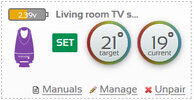
I have a differential thermometer, so I should be able to set it all up, however in real terms, with a modulating boiler, I found it was better to just get it somewhere near, then use the reading from the TRV heads to fine tune the lock shield valve. The problem is the TRV takes time to close. So if too much water can flow, the radiator gets stinking hot, before the valve can close, so the room over shoots. So we have Flat Battery TRV.jpgtarget and current, and current should not exceed the target unless heat coming from some other source, so if current exceeds the target, then the lock shield needs closing a bit. I never bothered with the differential thermometer, as I had the time to tweak the lock shields until spot on.
In my current relative ignorance, I suspect that they might not really be true "TRVs" at all (at least, as I see it). I would say that a true 'TRV' would have temperature sensing which directly (usually mechanically) controlled the valve with which they were associated. However, if the new-fangled ones can be linked and/or connected to a 'hub', it sounds as if they may actually have separate/'independent' temp sensors and valves, with the valve being able to be controlled remotely [presumably on the basis of information received from the sensor(s) ]. Is that remotely correct?
Not all are the same, Energenie claims to have two sensors the water one compensates the air one, Wiser has some sort of memory, and can work out how long it takes to warm up the room, so you set time and temperature, and it decides when it needs to start heating. Even the cheapest head I have, the eQ-3 will detect a sudden drop in temperature and translates that it is due to a door or window being opened and allows you to program in a time for heating to turn off, so you can unload one's car without pumping heat outside. And midday every Saturday it exercises and resets itself, it motors fully open then fully closed and then returns to setting, to prevent the pin from sticking and ensure it knows limits of travel. The cheap one only shows the target temperature, and can be manually set at the TRV, mine also have blue tooth, but all it does, is save you bending down, to set it, and it has no hub, the Energenie however does not have the option to set it without a hub, it claimed to work with Nest, but works the wrong way around, the Kasa can be self-contained, but the hub is cheap enough, and it can also use wall mounted sensors if you want, the Wiser is likely the best of the bunch, and can cause the boiler to fire. The Kasa could also cause the boiler to fire, but through a wall mounted thermostat rather than a hub.

So with Wiser the hub can be at the boiler which in my case is not in the main house, where the Kasa need the hub/thermostat to be in the heated area. Since I don't have the cables installed boiler to living room, could not use the Kasa thermostat, but could use the Wiser hub.
in 2026, I still have a non-condensing boiler, and also ~40 year-old 'mechanical' TRVs.
I still have a non-condensing oil boiler in this house, could be 40 years old, and the flat has mechanical TRV heads.

But heating a 5 bedroom three-story house with a 20 kW boiler, and realised the last occupants used an open wood burning grate for heating, to turn on central heating, it had to be turned on upstairs, then go into the flat to turn on pump, it was not only supplied from two different fuses, it was supplied from two independent distribution units one fuse box and one consumer unit, and to put it simple, it was a complete mess. They had clearly thought if they used two pumps, they could select if flat or main house or both were heated, what actually happened is with one pump the water circulated in one direction and with the other one reverse direction.

So I had to design both water and electrical controls from scratch, and found only two cores of the triple and earth cable was connected, and it changed colours, no idea where the junction box was, so fitted Nest Gen 3, so those two wires were only 12 volts, and could carry info as to if just hot water, or central heating and hot water was required, already had 4 energenie TRV heads from mother house, which were claimed to work with Nest, but they didn't. I added another 5 eQ-3 TRV heads, and left the toilet/shower room with a manual one, plus 4 manual TRV heads in the flat. Added two motorised valves so flat and main house truly independent, but the plumber left the two pumps, I had expected it to be reduced to one, so needed a relay so pump and boiler independent so either pump could be run with same boiler.

It didn't work, main problem was the hall cooled to slow, one can adjust how fast the room heats with the lock shield valve, but not how fast it cools. So Drayton Wiser fitted in parallel with a wall thermostat in living room, and linked TRV in wife's bedroom, and that's near enough, the odd Kasa TRV head was to replace an energenie head smashed by carpet fitters, the hub doubles as a doorbell.

Here endeth the first lesson, I did not know it all, it did not work like either mother's or my old house. But odd, it is actually cheaper to run, not sure if because using oil instead of gas, or better control, but it is cheaper even when house is far larger.
 
I don’t remember when I started to use “plug top” but it’s mainly used by me when a long extension is being used. If I was up a ladder or around a corner, I’d say “pass me the plug top” to differentiate which end of a long extension I wanted.

Speaking of which, does anyone call a 4 way/6 way a “monkey board”?
 

If you need to find a tradesperson to get your job done, please try our local search below, or if you are doing it yourself you can find suppliers local to you.

Select the supplier or trade you require, enter your location to begin your search.


Are you a trade or supplier? You can create your listing free at DIYnot Local

 
Back
Top