
Thisand this
I would not expect to heat in the same way,
Why? Given enough time, all of the water above the bottom of the element, would IMHO, gain a similar level of temperature. Your wider cylinder, would simply take longer to get there.

This
Harry - I do think that you should reconsider your use of the word "obvious". You're throwing it around all the time but, as I've said, although I don't regard myself as being particularly unintelligent and/or particularly lacking in knowledge about Physics, I personally find some of your assertions to be anything but 'obvious'.John - it is so very simple, and obvious....
I totally agree, and it's what I've been saying all along. That is the question being asked by my Poll question and what you've just written appears to be a clear indication of a "No" answer from you, so I don't really understand why you appear to be 'frightened'/reticent to register such a voteIn a normal cylinder, using a normal immersion heater, the heater will only heat the water, which is above the element, and perhaps slightly below - all due to the heat convection currents set up by the element, which begin soon after the element is switched on.

For a start, as I've said before, during this discussion I have never been thinking or writing about a vertical element. However ...Now, imagine a vertical element ...
Do you mean "the cold inlet" of your tube (aka Willis heater housing)? If so, for a start, the dimensions of Willis heater sis such that I imagine the heater element must get down pretty close to its bottom., contained within a narrow tube, only open to the cylinder at the top, and the bottom. The convection current then is rather different. The heated water flow has to exit at the top of the tube, and has to be drawn in at the bottom. That process will continue, until the water drawn in at the bottom, causes the stat to open, because the stat is measuring the temperature of the water going past it. Thus, the system has the ability to heat water in the cylinder to a lower depth, than the end of the element, almost down the cold inlet.
As above, I don't really see that your 'tube' makes any appreciable difference to anything, whether within or outside of the cylinder. In fact, as I've just written, the cylinder is really just a 'wide tube'.Now imagine that same tube, mounted alongside the main HW cylinder, with a pipe connecting it top and bottom - we get the very same flow of hot in the top, cold out the bottom, from the HW cylinder - that is a Willis. ...
This is where I have a problem. Per what you agreed at the start (above) I would not expect the water in your tube below the element to get appreciably heated (other than slightly/slowly, by conduction). Per EFLI's 'levelling' concept, that would mean that the heated water in the main cylinder would also be more-or-less restricted to the region above the Willis element. There would therefore not be any significantly heated water at the bottom of the main cylinder to be drawn into the bottom of the Willis (to 'open the thermostat'). In that situation, what I suggest would probably happen is that the water above the level of the Willis heater would get hotter and hotter until it eventually boiled, with that lower down still essentially 'cold' (until it eventually got heated by conduction).... Again the stat will remain closed, until it begins drawing hot water from the lower pipe, once the level of HW has 'spread' down that far.
Once I got my head around the basic concept of the Willis heater, I have repeatedly agreed that it will offer some 'benefit' (over an internal immersion), since heated water does not have to pass through cooler water whilst travelling up to the top of the cylinder. However, I'm not convinced that that 'benefit' will be particularly marked (since the heated water has to pass through cooler water only once), and hardly an issue at all when comparing a Willis with a 'high-up' horizontal immersion.A major difference, is that a normal immersion heater installation, when switched on, gradually heats the entire water contents, which is above the lower tip of the element - whereas, the Willis process does not quite so much, mix cold with its hot. The result is a gradually increasing store of HW, better defined, at the top of the HW cylinder.
Quite so - I don't see why whether a wide cylinder, a narrower cylinder or a very narrow cylinder ('pipe') makes any appreciable different to the concepts.Why? Given enough time, all of the water above the bottom of the element, would IMHO, gain a similar level of temperature. Your wider cylinder, would simply take longer to get there.


I was trying to point out how a room is so much different to a cylinder. I am sure we all at school put some solder around ice in a test tube to hold ice at the bottom of the tube, and boiler water in the top of the test tube, but that is long and thin.Why?
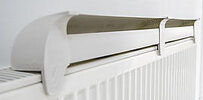 as the radiators with TRV control are not running as hot, we have always had these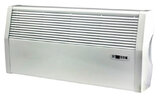
 fan assisted radiators, but they need a good flow, and with condensing boilers, the return hot water turns the boiler output down, they would be better plumbed in series rather than parallel when fan speed controls how much heat into each room. With the old non-condensing boilers we could mix radiator types, but the new boilers monitor the return water temperature.
As above, I don't really see that your 'tube' makes any appreciable difference to anything, whether within or outside of the cylinder. In fact, as I've just written, the cylinder is really just a 'wide tube'.
As the tank becomes squatter, then the whole situation changes, we have all bathed in the sea and realised how much colder the sea gets to swim in as we get further from the shore, and my own measurements in my living room have shown how the temperature in the same room can vary a lot as it does not mix.
Not top to bottom but side to side at the same height.
I have in the past wanted the variation, having the air around the windows cold, is not a problem unless sitting at the window, my first house had picture windows front and back, and the hot air central heating pushed the hot air to the cold single glazed windows, latter houses had radiators and circulating water, and the air at the windows remained cold.That variation, is due to uneven mixing of the air, heat sources, and perhaps solar gain. It is the reason why they suggest that even in cold weather, that a fan can help, especially a ceiling fan, pushing the warmer air at the ceiling, down.
That was my point.That, is because where the sea is shallow, it has less depth in for the mixing to take place from wave action, less cold water to mix with.
I use to for stress relief and pre-heating on welds, and if you got a draft started in a pipe, "the chimney effect" it could cause rapid cooling of the pipe, so we had to be careful to block the ends up to stop the draft, I have had on a 36" pipe the cover come off, and trying to get it back on, was a real problem, didn't make that mistake twice.

I can’t help thinking that’s perhaps everybody thought it obvious that an apple would fall down from a tree quite naturally all on its own unless it was physically attached to the tree and that was the only thinking keeping it up there until a bloke called Newton started to wonder what actually pulled that apple downwards rather than leaving it happily floating in the air . Folk probably thought him to be crackers until they realised that he was not .
I do not yet understand the alleged mechanism of 'drawing cold in at the bottom'.Then you are wrong! The element will act like a pump, drawing cold in at the bottom, hot out the top, by convection currents. Which is the basic principle to the Willis system. ....
Fair enough, but, as I recently wrote, something is only "obvious" to someone if they believe it to be "obvious" - and, of course, any individual's 'beliefs' may be incorrect!... It makes little difference to the Willis system, how long the element is - the heated water will still be 'pumped' out of the top, cold drawn in at the bottom, and will repeat it - it is blatantly obvious to me.
I'm not sure that I will be able to find a funnel of an appropriate size. However, I have to say that if I'm understanding correctly what you are suggesting would happen, I would regard that as extremely 'strange'!If you doubt thee physics, the principle John, then try this..... A kettle, or even a pan filled with water. Find a funnel, of similar size to the base. Placed it in the pan, such that it is fully covered by the water. You will find that the heated water rapidly flows out the top of the funnel. Depending on how gently the heat is applied, you may get a level of heated water, appear at the top surface.
Quite so. "Obvious" is very much in the eye of the beholder (sometimes 'most beholders') at a particular point in time, is not necessarily "obvious" to everyone and does not necessarily remain "obvious" with the passage of time.I can’t help thinking that’s perhaps everybody thought it obvious that an apple would fall down from a tree quite naturally all on its own unless it was physically attached to the tree and that was the only thinking keeping it up there until a bloke called Newton started to wonder what actually pulled that apple downwards rather than leaving it happily floating in the air .
Fair enough, but, as I recently wrote, something is only "obvious" to someone if they believe it to be "obvious" - and, of course, any individual's 'beliefs' may be incorrect!
You are sounding increasingly like that maths teacher of mine! Maybe someone else here may be a better teacher than you, in that they can help me understand rather than just assert their own views?
On the basis of your assertions, do I take it that you agree with Sunray that a Willis heater will 'work' ('as intended') even if it is located well above the top of the main cylinder?
I'm not sure that I will be able to find a funnel of an appropriate size. However, I have to say that if I'm understanding correctly what you are suggesting would happen, I would regard that as extremely 'strange'!
I have to disagree, because I think there is a lot that needs to be discussed ...If you accept that warm air, or water, naturally rises then there is nothing more to discus.
That's silly. The amount of discussion indicates that it's not all that 'simple', and some aspects have certainly been questioned.Because the theory, and physics is so very simple, and cannot be questioned.
Not true. I did initially wonder how it could work at all, but with the help of a couple of people here eventually understood how it was working. I therefore now have no problem in agreeing that it 'works' in the sense of allowing a small proportion of water at the top of the main cylinder to be heated without having to rise through cooler water - hence a little more efficient than an internal immersion, but probably not appreciably so in the case of a 'high up' horizontal immersion.The Willis system works, in many thousands of applications, so how can it not work. You seem to be suggesting it cannot possibly not work, and exactly the way I describe.
As above, I remain far from convinced.As I have said before, in regard to that - yes I do believe it will work, but I am less certain of how well.
Still sounds very strange to me, but I'll defer further comment until I've seen if I can find the needful to enable me to conduct the experiment!Nowt strange about it at all - try it. Even try a drop of food colouring on the inside of the funnel, then you will see the flow.
I seem to remember the experiment when doing 'O' level physics. I remember the experiment as I had an expensive fountain pen, and the experiment was done with acetone, and I got it on my fingers, and melted my expensive pen. But I failed my 'O' level physis.but there will be virtually no change in level of water at the top
I have to admit that, albeit a very long time ago, my education/'qualifications' in Physics did quite a lot better than that.... But I failed my 'O' level physis. ... Also failed to pass 'A' level, but that was due to a mix-up in exam dates.
That always makes me laugh! Have you never heard the loud sound of smashing glass when they tip the contents of bins into recycling trucks? I'm sure that some people will put Pyrex into recycling bins, so, whether they like it or not, by the time the truck gets back to its depot, it must contain a lot of bits of smashed up borosilicate glass in amongst bits of 'standard glass'.... Pyrex is a real problem with recycling, as if put in with standard glass, it does not mix, and has to be removed from the batch, this is why recycling will not accept broken glass, as they can't identify any pyrex.
I think you probably have a good imagination (or super-human eyesight!), because I would think that the amounts of expansion we're talking about are probably pretty minisculeI note even making a cup of coffee, pour in boiling water to near the top, and there is still room for milk, as the cup expands and the liquid level drops.

If you need to find a tradesperson to get your job done, please try our local search below, or if you are doing it yourself you can find suppliers local to you.
Select the supplier or trade you require, enter your location to begin your search.
Are you a trade or supplier? You can create your listing free at DIYnot Local

