
Simon did say that was the flow rate without the accumulator. With the accumulator the flow is too high too measure, other than in seconds to fill bath.doitall said:Ok so you 18 litres a minute at 3bar standing pressure, you could easily have 18litres a minute flow rate at the outlet without the accumulator at that pressure.

You are using an out of date browser. It may not display this or other websites correctly.
You should upgrade or use an alternative browser.
You should upgrade or use an alternative browser.
Poor pressure on a megaflo??
- Thread starter davecon1
- Start date
- Status
- Not open for further replies.
chrishutt said:Simon did say that was the flow rate without the accumulator. With the accumulator the flow is too high too measure, other than in seconds to fill bath.doitall said:Ok so you 18 litres a minute at 3bar standing pressure, you could easily have 18litres a minute flow rate at the outlet without the accumulator at that pressure.
No he didn't, he said the standing pressure.
The flow rate can be measured even at 18 gallons a minute and above.
Putting an accumulator on an incoming mains like that is at best misguided. If you do it yourself you don't have to pay the installation cost, and if you have a cosy relationship with the manufacturer you could get a nice little deal perhaps, but for normal customers, being sold something on the basis of what it can do using the above as an example is almost a confidince trick.
Do you have a license to use that word oilman?oilman said:almost

doitall said:Ok so you 18 litres a minute at 3bar standing pressure, you could easily have 18litres a minute flow rate at the outlet without the accumulator at that pressure.
chrishutt said:Simon did say that was the flow rate without the accumulator.
doitall said:No he didn't, he said the standing pressure.
simond said:Without accumulator, the water main delivers 18 l/m and a standing pressure of 3 bar.
chrishutt said:doitall said:Ok so you 18 litres a minute at 3bar standing pressure, you could easily have 18litres a minute flow rate at the outlet without the accumulator at that pressure.chrishutt said:Simon did say that was the flow rate without the accumulator.doitall said:No he didn't, he said the standing pressure.simond said:Without accumulator, the water main delivers 18 l/m and a standing pressure of 3 bar.
Standing pressure and Operating pressure under drawoff conditions could be a world of difference.
Of course, that point's been made enough times in this thread. But that has nothing to do with the debate we've just been having about what Simon did or did no say.doitall said:Standing pressure and Operating pressure under drawoff conditions could be a world of difference.

Hello Chaps
Now I have measured the flow rate coming into my bath.
I should explain that my flow jug is only calibrated up to 22litres per minute, and if I tried to put it under the tap I would just end up soaking myself and the bathroom.
So in the absence of more sophisticated test gear, my son and I have just timed how long it takes to fill a 12 litre calibrated bucket. Unfortunately, this didn't work very well either, because when the hot and cold tap are on, very little of the water stays in the bucket.
So, for the first draw off of 12 litres we just opened the cold tap to lessen the flow. Time taken to fill bucket (plus some wastage on the rebound) was 14 seconds. This gives a flow rate of around 47 litres per minute.
We then immediately ran off a whole bathful of water, say 120 litres.
Straight away, we then ran the bucket test again, but this time the pressure allowed us to open both the hot and cold taps and control the bucket; the bucket filled up in 9 seconds. Which is 80 litres per minute.
If in the first instance I could have opened the hot and cold taps and held the bucket and got all the water to stay inside (impossible) the flow would definitely have been better than 80 litres.
The pipe run from the accumulator and unvented set up is in 22mm and is 20 metres long from our utility room. The bath taps are Aqualisa Axis lever arm mixer.
The Dualstream has been set up by my chaps to work on 3 bar mains, the pressure gauge on the combi valve confirms the incoming pressure.
Frankly, I knew the flow rate was good and our customers have always been impressed, but I've never actually measured it. The performance has always been too obvious. I'm rather surprised what it achieves, even after a large draw off.
Not bad for filling a bath. Looks like the bets are off!
PS: Unless someone knows better.....
Now I have measured the flow rate coming into my bath.
I should explain that my flow jug is only calibrated up to 22litres per minute, and if I tried to put it under the tap I would just end up soaking myself and the bathroom.
So in the absence of more sophisticated test gear, my son and I have just timed how long it takes to fill a 12 litre calibrated bucket. Unfortunately, this didn't work very well either, because when the hot and cold tap are on, very little of the water stays in the bucket.
So, for the first draw off of 12 litres we just opened the cold tap to lessen the flow. Time taken to fill bucket (plus some wastage on the rebound) was 14 seconds. This gives a flow rate of around 47 litres per minute.
We then immediately ran off a whole bathful of water, say 120 litres.
Straight away, we then ran the bucket test again, but this time the pressure allowed us to open both the hot and cold taps and control the bucket; the bucket filled up in 9 seconds. Which is 80 litres per minute.
If in the first instance I could have opened the hot and cold taps and held the bucket and got all the water to stay inside (impossible) the flow would definitely have been better than 80 litres.
The pipe run from the accumulator and unvented set up is in 22mm and is 20 metres long from our utility room. The bath taps are Aqualisa Axis lever arm mixer.
The Dualstream has been set up by my chaps to work on 3 bar mains, the pressure gauge on the combi valve confirms the incoming pressure.
Frankly, I knew the flow rate was good and our customers have always been impressed, but I've never actually measured it. The performance has always been too obvious. I'm rather surprised what it achieves, even after a large draw off.
Not bad for filling a bath. Looks like the bets are off!
PS: Unless someone knows better.....

 You're damned if you don't get good flow and damned if you do.
You're so right, Chris. I've come this far (in this thread), have been roundly criticised for not supplying measurements, and when I do I get lambasted for water wastage.
Oilman - it is my bath and I can fill it as fast as I want. I'm sure you were the one that said earlier that it was almost a confidence trick.... and asked for actual figures...........
Let's all remember we started this with a guy in Wimbledon with a leaky Megaflo (nothing new) asking how he could improve his flow rate.
NB: We wash our vans in recycled rainwater using a hose at our HQ; rainwater doesn't leave streaks. Don't know why we didn't do it earlier.
Oilman - it is my bath and I can fill it as fast as I want. I'm sure you were the one that said earlier that it was almost a confidence trick.... and asked for actual figures...........
Let's all remember we started this with a guy in Wimbledon with a leaky Megaflo (nothing new) asking how he could improve his flow rate.
NB: We wash our vans in recycled rainwater using a hose at our HQ; rainwater doesn't leave streaks. Don't know why we didn't do it earlier.
For what it's worth Simon, I congratulate you on sticking with it, despite getting more than your fair share of hostile postings. You've certainly made a few of us think very carefully about the merits of accumulators, even if it doesn't result in sales for you.
So, if I may, to summarise:simond said:Now I have measured the flow rate coming into my bath.
1. Without an accumulator, your mains pressure is 3 bar.
2. Without an accumulator, your mains flow rate is 18 l/m.
3. With the accumulator, you can achieve 80 l/m after running off 120 litres.
4. The accumulator capacity is 450 litres.
So is the accumulator providing more than four times the mains flow rate? If so, is it correct to infer that the accumulator is providing more than four times the mains pressure?
If so, then the invention is truly remarkable.

That isn't true.DoItAll said:in the example the 2 Chris's work out, the accumulator would best deliver 12litres a minute.
I was hoping to hear the bath would fill in 30 seconds!
The flow you're getting is much the same a standard pump of a similar head might provide, with such a low pipework resistance (each side of a twin):
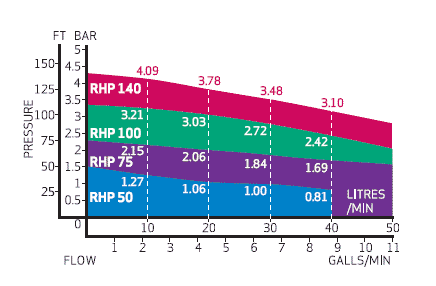
Yes and no.Softus said:So is the accumulator providing more than four times the mains flow rate? If so, is it correct to infer that the accumulator is providing more than four times the mains pressure?
If you filled a 200 litre cistern from a mains supply providing just 1litre per minute then tipped it over your head you could experience 200 times the mains flow - but not for long.
The pressure would depend how high the cistern was...
---
If the flow at the bath tap were only 18 litres/minute, the dynamic pressure, at the point in the plumbing where the accumulator is, would be much lower off the mains if the pipework took that route.
Even at 40 l/min (one tap, one pipe, one tank) he's only losing about a bar from the tank to the tap (about 6m in the pipe if it's straight). Say the pressure at the tanks having discharged some water is 2 bar (could work it out but its late). That implies that the resistance of the mains is such that he must be losing of the order of 2 bar between the road and the tank point. (Making 1 bar at the tank point, half the pressure so half the flow... roughly...)
If the main to that point is 15mm equivalent, it would need to be 40 metres equivalent length - perfectly feasible.
[Edit - That was working with 18 l/min through a 15mm pipe. In this house however the H & C both have to be fed by the mains because there's no storage so the pressure drop is over a metre head per metre run in 15mm. If the mains were replaced by 28mm its resistance , and the head lost through it, would go down by a factor of 6, and those measured flow rates again become perfectly achievable.]
You can have any flow rate you like if - as explained in earlier posts - you get the resistance low enough.
So nothing surprising in the figures measured.
The only surprise is what these particular pressure vessels cost, when there are other means of achieving similar or better performance in a smaller space.
Softus wrote;
So is the accumulator providing more than four times the mains flow rate? If so, is it correct to infer that the accumulator is providing more than four times the mains pressure?
The accumulator is certainly boosting the flow rate - up to 4 or 5 times the incoming flow rate in the test.
The accumulator will also make the working pressure closer to the standing pressure in the delivery of the water to the tap, because of the volume available.
Without an accumulator, at 18 litres per min, as you reach the max flow rate the working pressure falls off significantly. Because the accumulator has such a large volume, showers etc, even three running simultaneously, will still be invigourating to say the least.
Even at 1.5bar, the working pressure is impressive for this reason. So it doesn't boost pressure per se, just makes better use of what you have.
The comparison between pumps and accumulators is a good one, and one we regularly discuss with customers. Accumulators negate negative and positive pressure pumps, are completely silent in operation, store potable water, continue to work in a power cut, and do not wake everyone else up in the house. My company does not specify shower pumps because of the potential call backs.
So is the accumulator providing more than four times the mains flow rate? If so, is it correct to infer that the accumulator is providing more than four times the mains pressure?
The accumulator is certainly boosting the flow rate - up to 4 or 5 times the incoming flow rate in the test.
The accumulator will also make the working pressure closer to the standing pressure in the delivery of the water to the tap, because of the volume available.
Without an accumulator, at 18 litres per min, as you reach the max flow rate the working pressure falls off significantly. Because the accumulator has such a large volume, showers etc, even three running simultaneously, will still be invigourating to say the least.
Even at 1.5bar, the working pressure is impressive for this reason. So it doesn't boost pressure per se, just makes better use of what you have.
The comparison between pumps and accumulators is a good one, and one we regularly discuss with customers. Accumulators negate negative and positive pressure pumps, are completely silent in operation, store potable water, continue to work in a power cut, and do not wake everyone else up in the house. My company does not specify shower pumps because of the potential call backs.

DIYnot Local
Staff member
If you need to find a tradesperson to get your job done, please try our local search below, or if you are doing it yourself you can find suppliers local to you.
Select the supplier or trade you require, enter your location to begin your search.
Please select a service and enter a location to continue...
Are you a trade or supplier? You can create your listing free at DIYnot Local
- Status
- Not open for further replies.
Similar threads


- Replies
- 11
- Views
- 2K
