• Looking for a smarter way to manage your heating this winter? We’ve been testing the new Aqara Radiator Thermostat W600 to see how quiet, accurate and easy it is to use around the home. Click here read our review.

Pressure Reducing valve query

Joined
27 Sep 2022
Messages
296
Reaction score
23
Country
United States Minor Outlying Islands
Hi,

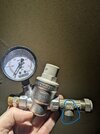
In attached picture what's the highlighted screw for on non return valve? This is to attach a filling loop for a sealed system.
Thanks in advance.
 

Attachments

  • pressure reducing valve.jpg
    pressure reducing valve.jpg
    240.2 KB · Views: 43
1st off, that's the wrong gauge, that only goes up to 1 bar on a 3 bar PRV.

That could be a verifiable check valve and the plastic cap is the verifiable section. It could also be an outlet for a gauge for a gauge. Hard to say, take it off and see what's underneath?

That PRV has been made up though, with different sections added. The check valve looks like it has been added as well as the male nipple outlet.
 
OK - TBH a 3 bar PRV wouldn't normally be used as part of a loop for a sealed system. Anytime a PRV would be used as part of a boiler setup would be say to protect a combi and ensure the cold mains inlet didn't exceed 3 bar.

A (R24) filling loop needs an isolating double check valve on the cold mains side, an isolation valve on the system side and a braided hose to connect. If you are looking to have the loop provide a system pressure gauge then you do get filling loops with integrated gauges.

1764796760414.png
 
There should really be a valve on both ends of a filling loop to allow it to be fully isolated.

You get 2 kinds of double check valves, verifiable and non verifiable - one would usually have a screw that can be removed to see if the valve is passing, the other doesn't, I've never seen a check valve like that that will take a gauge.

If you look at my pic, the one at the top has the screw, that's the verifiable double check valve, the one on the bottom is just a valve with a body section that the gauge screws into. If the valve on the right of your pic is a check valve then I wouldn't think that plastic cover would be for a gauge as it would be in the middle of the check valve but again if you take it off and have a look.
 
valve on both ends of a filling loop to allow it to be fully isolated
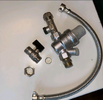
This is what has been bought on ebay store. I am trying to put it to seal my system from OV.
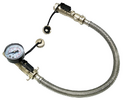
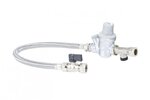
I have attached a Robofil Auto fill loop from internet. Picture on the left is the actual photo that I bought.
 

Attachments

  • Screenshot_20251204-210758.png
    Screenshot_20251204-210758.png
    782.7 KB · Views: 9
  • Robofil_Auto_Fill_Loop_Complete_Wit_PRV-1.jpg
    Robofil_Auto_Fill_Loop_Complete_Wit_PRV-1.jpg
    12.8 KB · Views: 6
Last edited:
Not normally what would be used for a filling loop. As suggested, no need for the PRV. Only thing that is missing really is the double check valve with an isolator unless a gauge is needed then the pic I attached is really the normal setup.

I presume the OV boiler can be run sealed?
 
Nope - Autofills were used over here a while back and were dropped quickly. The last thing you want is an automatic control on the fill side. If the system did spring a leak then the autofill would just keep pumping mains pressure water into the system without any intervention and if not found quickly could cause a significant flood. Even then if it was just a small leak then that needs to be know so it can be found and fixed and not have the system pressure perpetually filled up creating the perfect conditions for system corrosion.

That and a 3bar PRV is too high for a sealed system, systems shouldn't really be set more than 1.5bar cold.
 
Again, I wouldn't use an always open autofill, for the reasons I stated. I wouldn't want to be out for the day, fitting goes and that is then being fed by an open ended supply.

If you did want to use it then the PRV would need to be dropped to a suitable system pressure yes.
 

If you need to find a tradesperson to get your job done, please try our local search below, or if you are doing it yourself you can find suppliers local to you.

Select the supplier or trade you require, enter your location to begin your search.


Are you a trade or supplier? You can create your listing free at DIYnot Local
 
Back
Top