• Looking for a smarter way to manage your heating this winter? We’ve been testing the new Aqara Radiator Thermostat W600 to see how quiet, accurate and easy it is to use around the home. Click here read our review.

RTS turn off

Energy Saving Trust said:
When your RTS meter is scheduled to be switched off, your energy supplier should let you know at least two weeks beforehand.
as no one has a three-week holiday in August.

November 2023 I found I needed a Smart Meter, three visits before fitted, finally fitted January 2024, but lacking the new MPAN number for export, can't blame the solar panel installers, as can't get MPAN number for a meter no yet fitted. Moved suppliers end of April 2025, two weeks latter the MPAN number sorted.

In my case, I was only loosing money, annoying, but not life-threatening, for the heating system to fail, is far more serious. It seems so easy, one buys a plug in electric heater, 1754307862373.png1754307979513.pngand one has heat again. But I have seen other old age pensioners, just because this old guy can sort things, does not mean all can sort things, and @SUNRAY shows how what should be simple, can go very wrong.

Leaving instructions that they need to get an electrician in to reconfigure their heating CU wiring.
That must be wrong, it is up to the supplier to do all required, for some thing the customers requests, like my asking for a smart meter due to having a PV array installed, yes, I have to arrange my new stuff, to line up with the meter, but to change existing to new system because the supplier wants it done, that is down to the supplier.
1754308817130.png
Seems loads of room to me! The smart meter is smaller than the RTS unit, and once smart meter fitted, RTS unit is not required. Yes the consumer units (CU) should not be on the DNO board, and I had it where there was not enough room for new smart meter, and my solar installer had to return to move their CU, when they found not enough room, they aborted fitting the smart meter, until after the CU was moved. And to be fair, when the smart meter was fitted, he also fitted all new tails, and made a neat job of it all.

He said he was not permitted to change the fuse, but he did tell me that a 60 amp one was fitted, which was all I wanted to know, he did not realise CT coils need to go the right way around, but other than that, an excellent job.

Seems the suppliers have a problem with their training program.
 
as no one has a three-week holiday in August.

November 2023 I found I needed a Smart Meter, three visits before fitted, finally fitted January 2024, but lacking the new MPAN number for export, can't blame the solar panel installers, as can't get MPAN number for a meter no yet fitted. Moved suppliers end of April 2025, two weeks latter the MPAN number sorted.

In my case, I was only loosing money, annoying, but not life-threatening, for the heating system to fail, is far more serious. It seems so easy, one buys a plug in electric heater, View attachment 388859View attachment 388861and one has heat again. But I have seen other old age pensioners, just because this old guy can sort things, does not mean all can sort things, and @SUNRAY shows how what should be simple, can go very wrong.

That must be wrong, it is up to the supplier to do all required, for some thing the customers requests, like my asking for a smart meter due to having a PV array installed, yes, I have to arrange my new stuff, to line up with the meter, but to change existing to new system because the supplier wants it done, that is down to the supplier.
View attachment 388867Seems loads of room to me! The smart meter is smaller than the RTS unit, and once smart meter fitted, RTS unit is not required. Yes the consumer units (CU) should not be on the DNO board, and I had it where there was not enough room for new smart meter, and my solar installer had to return to move their CU, when they found not enough room, they aborted fitting the smart meter, until after the CU was moved. And to be fair, when the smart meter was fitted, he also fitted all new tails, and made a neat job of it all.

He said he was not permitted to change the fuse, but he did tell me that a 60 amp one was fitted, which was all I wanted to know, he did not realise CT coils need to go the right way around, but other than that, an excellent job.

Seems the suppliers have a problem with their training program.
All of this sits on a sheet of ply which I suspect was just the builders work so no specific DNO backboard. I'm kicking myself now for not taking pics but my gut feeling is meter is wider the the RTS so not enough space between Fuse and CU for a meter. BTW they are both 8 way wylex boards and the 24hr is mounted portrait.
As a quick example of width of RTS Vs meter for comparison:
1754322606647.jpeg


I'm not saying nothing can be moved or changed, in fact I suggested they should replace with a modern CU which could potentially create plenty of space.
 
Just received a call: provider says he must provide adequate space for the SM but they will return Monday next week to assess the situation.
 
I still feel the problem is the suppliers, not the customers, and to tell the customer they need to get an electrician to sort out the suppliers' problem is really not on.

I would agree the old Wylex board is past it best by date, my only board has just gone into the bin, changed ages ago, but never got around to binning it.

However, mine was changed by a friend for me, and still parts alone resulted in a bill of near £400, I could afford it, but that does not mean everyone can afford to change their distribution unit when the supplier wants it changing, one should be able to change it to suit the client, not the supplier. Oh, just seen your post, that's more like it, seems wrong smart meter fitted, maybe the correct one is wider, with me, they left the boxes the meter fits in, to show the solar installers what space was required.
 
I still feel the problem is the suppliers, not the customers, and to tell the customer they need to get an electrician to sort out the suppliers' problem is really not on.
I agree. He asked me if I could do the work for him and that was my advice. I called him again Saturday morning to confirm the wiring as it's very cramped and the wiring is very much bunched and obscurred and I'd started doubting it had been left unmetered, then again after Rodders link to the SM. He called provider today and got that answer.
I would agree the old Wylex board is past it best by date, my only board has just gone into the bin, changed ages ago, but never got around to binning it.

However, mine was changed by a friend for me, and still parts alone resulted in a bill of near £400, I could afford it, but that does not mean everyone can afford to change their distribution unit when the supplier wants it changing, one should be able to change it to suit the client, not the supplier. Oh, just seen your post, that's more like it, seems wrong smart meter fitted, maybe the correct one is wider, with me, they left the boxes the meter fits in, to show the solar installers what space was required.
I changed CU's in 2 of my rentals in 2020, including the CUs, certs and labour both came in under £400, I wouldn't do anyhing myself in my rentals which require certs to avoid any conflict of interest.
 
Last edited:
I changed CU's in 2 of my rentals in 2020, including the CUs, certs and labour both came in under £400, I wouldn't do anyhing myself in my rentals which require certs to avoid any conflict of interest.
Maybe because mine has 14 RCBOs around the same did not pay labour cost it was a favour.
 
Maybe because mine has 14 RCBOs around the same did not pay labour cost it was a favour.
(y)mine were only 4 and 5 circuits, I opted for BG dual RCD despite a respected poster on here describing then as "Ultra cheap non-compliant junk":)
 
I had a caravan until COVID, and it was supplied from a post with an RCD and MCB or RCBO into a special consumer unit, one button could swap lives, if the supply had line and neutral swapped, and another RCD, so the whole caravan ran on a pair of 30 mA in series RCDs, not in parallel as in a house. OK there was 12 volt lighting, and gas cooker, but it went against all in 314.1 Every installation shall be divided into circuits and that is because it follows the requirements for caravans and caravans parks.

Basic size matters, background leakage is caused by capacitive and inductive linking, as well as the many filters installed in equipment, and with a small home one can get away with two RCDs in parallel, I am glad I did not try to get away with 2 RCDs, as I have had faults like ingress of water, and been able to simply switch off the affected circuits. And to comply with 314.1 the lights and the sockets need to be split in the same way, my sockets are side to side, and lights up and down, so could not ensure a problem with a power outlet would not plunge me into darkness, however an emergency torch
1754389026367.png
can remove the danger, I use one at the top of stairs in case of a power cut, did consider having lights on the UPS supply, but we have gone a little OTT with lighting, and it would reduce how long central heating and freezers would run for.

But my houserooms are only heated as and when required, I have fitted two motorised valves and nine programmable TRV heads to allow me to select when rooms are heated, and also ensure not overheated, and my oil bill has gone down. When one looks at Eco 7 charges
1754390691031.png
the night rate is half of day rate, but does that compensate for heating all rooms 24/7? I would think Autumn and Spring often rooms are heated when not required, my kitchen heating depends on what is being cooked, my living room heating depends on how much sun through the windows, when Eco 7 came out, overnight was ¼ of the cost of day rate, now only ½ and not sure if it still pays to heat rooms just in case required. And once people find it cheaper without Eco 7, they will not return to using it, and the suppliers will have a problem supplying power as and when required.
 
I had a caravan until COVID, and it was supplied from a post with an RCD and MCB or RCBO into a special consumer unit, one button could swap lives, if the supply had line and neutral swapped, and another RCD, so the whole caravan ran on a pair of 30 mA in series RCDs, not in parallel as in a house. OK there was 12 volt lighting, and gas cooker, but it went against all in 314.1 Every installation shall be divided into circuits and that is because it follows the requirements for caravans and caravans parks.

Basic size matters, background leakage is caused by capacitive and inductive linking, as well as the many filters installed in equipment, and with a small home one can get away with two RCDs in parallel, I am glad I did not try to get away with 2 RCDs, as I have had faults like ingress of water, and been able to simply switch off the affected circuits. And to comply with 314.1 the lights and the sockets need to be split in the same way, my sockets are side to side, and lights up and down, so could not ensure a problem with a power outlet would not plunge me into darkness, however an emergency torch View attachment 388960 can remove the danger, I use one at the top of stairs in case of a power cut, did consider having lights on the UPS supply, but we have gone a little OTT with lighting, and it would reduce how long central heating and freezers would run for.

But my houserooms are only heated as and when required, I have fitted two motorised valves and nine programmable TRV heads to allow me to select when rooms are heated, and also ensure not overheated, and my oil bill has gone down. When one looks at Eco 7 charges View attachment 388970 the night rate is half of day rate, but does that compensate for heating all rooms 24/7? I would think Autumn and Spring often rooms are heated when not required, my kitchen heating depends on what is being cooked, my living room heating depends on how much sun through the windows, when Eco 7 came out, overnight was ¼ of the cost of day rate, now only ½ and not sure if it still pays to heat rooms just in case required. And once people find it cheaper without Eco 7, they will not return to using it, and the suppliers will have a problem supplying power as and when required.
Well if those figures are typical I feel you have a valid point, however removing NSHs from rental properties will automatically drop the energy assessment down the table and possibly make them unrentable.
 
Well if those figures are typical I feel you have a valid point, however removing NSHs from rental properties will automatically drop the energy assessment down the table and possibly make them unrentable.
I note my fathers-in-law old house, still has an energy rating less than mine, due to having solar panels, even though the panels are not connected. I would think if the night storage heaters are left in place, the energy rating would not change, even if not used.

I looked at the Energy Performance certificate for my house.
1754406482486.png

Well, must have forgotten his glasses, as the cylinder thermostat built into the immersion heater. And what has the bulbs used got to do with the house energy rating, if I have got any tungsten bulbs, I don't know where.

The primary energy use for this property per year is 197 kilowatt hours per square metre (kWh/m2).(House is 150 m² so 29,550 kWh/year) minus 14,381 and 3,670 so 11,499 kWh for lighting, (31.5 kWh per day) and total for house around 10-12 kWh per day?
1754406777426.png

I would think my oil fired heating is rather poor, and not sure how I could work out those costs, but
1754406956048.png

Now that is something I can work out, at least the second one, energy needed for DHW, as my iboost+ tells me how much I am using, this has gone up, as was using a 9 inch immersion heater, and am now using a 27 inch one. So two figures 9 inch = 260 kWh per year, and 27 inch = 789 kWh per year, now I realise only an estimation, but factor of nearly 5 times, that is some massive error.

The heating google tells me 600 gallons of 28 sec gas oil is around 26,000 kWh, and I use a tank full around per year, OK some used in winter for DHW, but seems that one is out the other way around by a factor of 2.

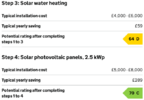
This 1754407748195.png has to take the biscuit, one if fitting PV solar cells, why would anyone fit water ones, over 22 months mine have produced 10,000 kWh, at the lowest rate of 4p/kWh that's £200 per year, but if I exported it all, that's £750 per year, and if I used it all £1250 per year.

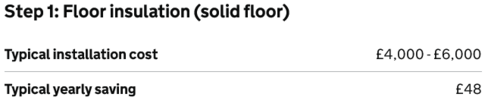
So it does seem the Energy Performance Certificate has lost the plot, and the first suggestion kind of shows how silly, 1754408919174.png so 83 year pay back time, the best place for an Energy Performance Certificate is in the bin, they are so far out, to be laughable.
 
Copy and paste from my friends email:

XX phoned at 09:00 to say they had looked at the fitters photos and they'd like to visit today. 2 people arrived about 11:00 and spent a while checking the seals and comparing it with the photos then turned off the fuseboxes and removed the big fuse, the contactor box, the connector blocks and tried to put the new meter where the contactor box was but it is too wide. The new the meter is taller then the first one so yes they did wire it first before mounting it. Now the 2 red wires to each fusebox go to 2 different terminals on the meter, the grey to the heaters fusebox goes to the meter and the grey to the normal fusebox goes to the big fuse and now just one brown and blue wires. Does that sound ok?
I tried to chat with the woman but she didn't give much away past saying I had the wrong meter.


So my interpretation of that is
1754437900592.png
Slightly unusual where they have put the 24h neutral though but I reckon there was only 25mm between the meter and head, if that is now closer it may have been easier to get the smaller blacks in than a 25mm²

I reckon they didn't want too much of their valuable energy stolen :ROFLMAO: but full marks for sorting it and in 24 hours.
 
That is nearly as I would have expected, I would have thought the neutral would use a Henley block, but seems unlikely to make much difference either way, but now it should work as normal, the meter doing the switching.
 
1754478463330.png

Have to disagree. Since I am my own meter reader, my skills are right up there with them.
I will hold up my hands, and admit I gave up, pressing the buttons I get all sorts, and my attempts to work out what they all are has failed, I could see my peak use, but not my off-peak use, lucky the app also tells me what I have used both from Octopus and the Solar panel, plus the IHD so I can work out what I am using, but I tried to take photos of all the info it gives,
Smart meter reading 4.jpg
PC, and around 20 readings in all, missed some off with ID numbers, not tried since moving to Octopus, but only way I could tell British Gas they had an error was to quote the number Octopus gave me when taking over the account. The picture shows peak rate, 31.31p/kWh, but not the 8.95p/kWh off-peak, and as to what Total (ind) Q1 means I have not a clue. Or total (net) v total (sum) or Rate 02 Act ImP it will be interesting to see what our export meter reader makes of all the photos.
 

If you need to find a tradesperson to get your job done, please try our local search below, or if you are doing it yourself you can find suppliers local to you.

Select the supplier or trade you require, enter your location to begin your search.


Are you a trade or supplier? You can create your listing free at DIYnot Local

 
Back
Top