
Small concrete pier foundations – how do you normally form and level them?

Have you seen a building site? You need to smother the thing in concrete slop and mud, see how well it works then. I suspect not at all.

It would be level, but its height would be an unknown.

It's very easy to build multiple supports or anything else to a very accurate level - just bang upright bits of scrap wood into the ground next to whatever you're building, then run a laser level at whatever height you want and mark it on the posts. Then build to this height. You could build an unlimited number of bases this way, all very accurately, with nothing more than some bits of wood, a marker pen and a cheap laser level.

E.g...

 
Last edited:
OK I can see your thinking, but we don't normally put a simple cylinder on ground as we want to spread the load.

Economics then kicks in. Most of the time concrete is cheaper than labour so dig hole and fill. No shutters, no backfilling and compacting the ovrebreak. Or if you're at the back of beyond and concrete is expensive then you can afford to pay proportionately more for shutter and labour.

Your method would mean: dig hole, concrete base, wait to set a bit, set your tripod (you're on hard concrete so not easy or maybe wet concrete so removing legs without disturbing coumn a problem), fill the tube, wait again for some setting, strip tripod and backfill.

The already invented system widely used has a simple plastic form shaped like an upside down funnel which produce an insitu version of Rusty's Easypads. Dig hole set form fill with concrete, backfill round. All done in 1 hit
I think I didn’t explain the sequence clearly enough. There is no separate concrete base poured first.
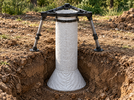
The idea is: dig the hole, place the tripod over it, level it, then attach the flexible stay-in-place sleeve. The sleeve is closed at the bottom and has an enlarged section at the base, so it works more like a bag than a conventional tube.
Then the concrete is poured directly into that sleeve in one operation.
Part of the reason for using the sleeve is to separate the concrete shaft from direct contact with the surrounding soil along most of its length. If concrete is simply poured against the sides of the excavation, the soil and the concrete interact directly, which can be undesirable where frost movement or soil movement is a concern.
I’ll attach a picture because it explains the concept much better than the CAD images alone.
 

Attachments

  • file_0000000018008210876268e3074c1227.png
    file_0000000018008210876268e3074c1227.png
    3.1 MB · Views: 8
Have you seen a building site? You need to smother the thing in concrete slop and mud, see how well it works then. I suspect not at all.

It would be level, but its height would be an unknown.

It's very easy to build multiple supports or anything else to a very accurate level - just bang upright bits of scrap wood into the ground next to whatever you're building, then run a laser level at whatever height you want and mark it on the posts. Then build to this height. You could build an unlimited number of bases this way, all very accurately, with nothing more than some bits of wood, a marker pen and a cheap laser level.

E.g...

This system wasn’t really designed for professionals in the first place. I’ve poured a lot of concrete piers myself in different ways, so most of these operations always felt routine to me.
The idea only came to me after I watched a friend with no construction background struggle with the same job — spending a huge amount of time setting the piers, preparing the formwork and trying to get everything right.
Of course, it still hasn’t been tested on a real jobsite, so I don’t know yet how well the support will survive repeated use in concrete, mud and water. That’s exactly what the prototype testing is for.
But even if it ends up being effectively disposable or only good for a few pours, my preliminary cost estimate still puts it below many of the methods people commonly use now.
 
It probably does have a purpose if we're talking DIY level stuff.

I take it all back, it looks like a worthy thing now I've seen what it looks like.

Can the height be adjusted per column? I'd be worried about the ability of the average DIYer to compact the concrete within it - you may end up with a lot of air in there as it's fairly narrow in relation to its height. I'd suggest it probably needs rebar in it, perhaps some sort of pre-formed tube or something. In which case it's going to be even harder to compact.

As ever with these Dragon's Den things, don't re-mortgage your house and/or gamble a ton of money on it. It may be a tiny niche of a market and/or may not be possible to be sold for more than the production cost - which will be fairly high from the look of it.
 
Last edited:
It probably does have a purpose if we're talking DIY level stuff.

I take it all back, it looks like a worthy thing now I've seen what it looks like.

Can the height be adjusted per column? I'd be worried about the ability of the average DIYer to compact the concrete within it - you may end up with a lot of air in there as it's fairly narrow in relation to its height. I'd suggest it probably needs rebar in it, perhaps some sort of pre-formed tube or something. In which case it's going to be even harder to compact.

As ever with these Dragon's Den things, don't re-mortgage your house and/or gamble a ton of money on it. It may be a tiny niche of a market and/or may not be possible to be sold for more than the production cost - which will be fairly high from the look of it.
Thanks for the thoughtful comment. Yes, each pier can be adjusted independently in height.
My current concept is for the flexible sleeve itself to be available up to about 10 ft long, depending on the required hole depth. The support system has roughly 3 ft of height adjustment.
I’m currently considering two sleeve diameters: about 8 in and 6 in.
On compaction, I agree with you. The support system itself doesn’t solve that problem. For a narrow reinforced pier, a concrete vibrator would still be the most reliable way to compact the mix. Reinforcement would also still be required where the structural design calls for it.
So this system is really only intended to solve the forming, positioning and height-setting part of the job. It doesn’t replace the normal concrete-placement, reinforcement or compaction process.
In theory, the setup and adjustment should be quick, but I don’t want to claim that yet. The prototype tests will have to prove the actual installation speed, reliability and durability.
 
A problem I see is that you either do one at a time, or have multiple tripods. I've never used them but you can get cardboard tubes for piles which can be easily lasered and sawn off at the correct height before filling, then you can do several at once...
 
A problem I see is that you either do one at a time, or have multiple tripods. I've never used them but you can get cardboard tubes for piles which can be easily lasered and sawn off at the correct height before filling, then you can do several at once...
Yes, that’s correct — if several piers are being poured at the same time, each one would need its own support.
Whether that is economically reasonable depends heavily on the final price. My current estimate still needs to be confirmed by the printed prototype and real testing.
If the target cost holds, the support is cheap enough that even limited reuse could make sense. I would expect it to survive at least a few pours before concrete contamination or wear becomes a serious issue.
So the real question is not whether one support is needed per pier, but whether the cost per completed pier ends up lower or more convenient than the alternatives. That’s something the prototype tests should answer.
 
I think I didn’t explain the sequence clearly enough. There is no separate concrete base poured first.
The idea is: dig the hole, place the tripod over it, level it, then attach the flexible stay-in-place sleeve. The sleeve is closed at the bottom and has an enlarged section at the base, so it works more like a bag than a conventional tube.
Then the concrete is poured directly into that sleeve in one operation.
Part of the reason for using the sleeve is to separate the concrete shaft from direct contact with the surrounding soil along most of its length. If concrete is simply poured against the sides of the excavation, the soil and the concrete interact directly, which can be undesirable where frost movement or soil movement is a concern.
I’ll attach a picture because it explains the concept much better than the CAD images alone.
OK making more sense but it's still only doing the same thing as a plastic mould except rather less robustly.

The second point is that you'd need several tripods unless you were going to limit the production to one at a time and also if you're looking at diy then they'll likely get little use before job complete and they're redundant.
 
OK making more sense but it's still only doing the same thing as a plastic mould except rather less robustly.

The second point is that you'd need several tripods unless you were going to limit the production to one at a time and also if you're looking at diy then they'll likely get little use before job complete and they're redundant.
That’s fair, but for a DIY user the economics may work differently. They don’t necessarily need enough supports to pour every pier at once — they could do the foundation in two or three pours and use fewer supports.
The other point is cost. Based on my current estimate, the retail price of this system is very low. Even if it were treated almost as a disposable system, it could still come out cheaper than some common alternatives using Sonotube, braces and associated hardware.
Of course, that’s still theoretical until the prototype is built and tested, but that’s the reason I think the idea may still make sense for DIY use.
 
On compaction, I agree with you. The support system itself doesn’t solve that problem. For a narrow reinforced pier, a concrete vibrator would still be the most reliable way to compact the mix. Reinforcement would also still be required where the structural design calls for it.
I'd expect your fabric liner to bulge or burst if you used a concrete vibrator inside it. There would be 20mm pebbles firing around inside in all directions.

I'd suggest it's probably one of those brainwave things that probably won't work in reality. If cardboard tubes are already available then really the problem's already been solved for the small number of DIYers who actually have a need for this.

Plonk tube down, put laser level on and chop the surplus off with a hand saw. Shove a few plastic packers under if it's not level, check it's vertical while filling. Job done, no need for a tripod and no worries about it bursting under pressure.
 
I'd expect your fabric liner to bulge or burst if you used a concrete vibrator inside it. There would be 20mm pebbles firing around inside in all directions.

I'd suggest it's probably one of those brainwave things that probably won't work in reality. If cardboard tubes are already available then really the problem's already been solved for the small number of DIYers who actually have a need for this.

Plonk tube down, put laser level on and chop the surplus off with a hand saw. Shove a few plastic packers under if it's not level, check it's vertical while filling. Job done, no need for a tripod and no worries about it bursting under pressure.
 
A wild thought... if cardboard former tubes are already available then is there a gap in the market for a means of forming that wider base shape as shown above? E.g. some sort of single-use former that slots into the base of a cardboard tube?

Or even just a stand-off spacer that jacks it up by a selected amount so it splurges out to fill the hole at the bottom. I don't think contamination with the soil is an issue, otherwise every house in the UK would fall down. I'd suggest it adds resistance to sinking by letting the concrete grip the edges of the hole.
 
A wild thought... if cardboard former tubes are already available then is there a gap in the market for a means of forming that wider base shape as shown above? E.g. some sort of single-use former that slots into the base of a cardboard tube?

Or even just a stand-off spacer that jacks it up by a selected amount so it splurges out to fill the hole at the bottom. I don't think contamination with the soil is an issue, otherwise every house in the UK would fall down. I'd suggest it adds resistance to sinking by letting the concrete grip the edges of the hole.
Not quite — the system isn’t designed around a cardboard tube at all.
It uses its own flexible stay-in-place sleeve with an enlarged base. The support is adjusted to the required finished pier height, and the sleeve is set to match that depth/height.
So no cardboard tube is needed. The dense woven sleeve itself acts as the permanent form for the pier, including the widened base.
 

If you need to find a tradesperson to get your job done, please try our local search below, or if you are doing it yourself you can find suppliers local to you.

Select the supplier or trade you require, enter your location to begin your search.


Are you a trade or supplier? You can create your listing free at DIYnot Local

 
Back
Top