"Superglue" as wood hardener

Joined
16 Jun 2006
Messages
13,122
Reaction score
3,197
Location
London
Country
United Kingdom
I am currently working on an exterior in Chiswick. The ends of the barge boards required a bit of timber splicing. Naturally, I removed most of the rotten timber but some areas were quite "punky". I didn't have any wood hardener with me, so used a filler knife and super glue. It seems to have worked better than the Tetrosyl wood hardener that I normally use... and the biggest advantage is that I was able to sand the timber flat after 20 minutes. Downside- I ended up with loads on my hands and it costs a lot more (that said, I only used half a bottle).

I will definitely consider using it to deal with interior MDF window boards which have been water damaged in the future- primarily because of the rapid curing time.
 
When you add baking soda into it, it certainly does create a hard filler that can be sanded down and painted.
I have used this trick and it worked for me.
 
my thoughts on superglue

hard hard hard and no flex so expansion and contraction may in time cause cracking in the finish it could possibly also start to delaminate the glue "patch" from the soft material at the point the glue finishes and untouched wood starts
please please share how it goes warts and all in a few weeks time a years time and in many years time as it helps others learn from others experiments
and for what its worth you cannot be wrong or fail with an experiment just not the best or expected outcome hoped for but not sharing means others will make the same mistake very unessiserally
(y)
 
Last edited:
I think I've seen all the tiktok and insta videos of this wonder-product use of CA glue and bicarb and cotton wool.

As big-all says, it's very rigid, so the longer term use in timber and flexible plastic is questionable. But admittedly all the repairs look lovely in a 30 second video.

As a hardener, I'm not sure that CA is thin enough to soak into the wood fibres, and therefore may effectively act like a varnish and stay on the peripherals - which makes a delamination risk over time greater.

Having said that, if you are aware of the limitations and risk, then it may well be appropriate for some uses. Internal on a relatively stable material like MDF in dry conditions comes to mind.
 
my thoughts on superglue

hard hard hard and no flex so expansion and contraction may in time cause cracking in the finish it could possibly also start to delaminate the glue "patch" from the soft material at the point the glue finishes and untouched wood starts
please please share how it goes warts and all in a few weeks time a years time and in many years time as it helps others learn from others experiments
and for what its worth you cannot be wrong or fail with an experiment just not the best or expected outcome hoped for but not sharing means others will make the same mistake very unessiserally
(y)

Valid point. I hadn't thought about that.

Delamination? I was applying epoxy resin filler over the top and then painting it. I don't see why the other proprietary wood hardeners would be any different. I used to use the Timberbuild 2 part epoxy wood hardener, but found it would stay sticky over pre-existing paint (for days). @jobandknock recommended the Tetrosyl cellulose based stuff. It works, but doesn't seem to penetrate as deep.

Thanks for the heads up. I will keep an eye on it though.

I had recently seen videos where people turning wood on lathes used super glue to harden timber.

I thought I would give it a try.
 
OP,
You are working on barge board tails & you: "removed most of the rotten timber" - but you left in areas that were "quite punky" why? why did you leave the rot in the barge boards? - and claim to have used "timber splicing" for the repair.
"splicing" is the wrong carpentry term for you to use. I very much doubt that you used any kind of splice.
If the tail is rotten (quite punky) then you cut out beyond any signs of rot, & use a simple butt joint for fixing the tail piece.

Why fool around with the wet rot when it would be easier to eliminate it entirely?
 
OP,
You are working on barge board tails & you: "removed most of the rotten timber" - but you left in areas that were "quite punky" why? why did you leave the rot in the barge boards? - and claim to have used "timber splicing" for the repair.
"splicing" is the wrong carpentry term for you to use. I very much doubt that you used any kind of splice.
If the tail is rotten (quite punky) then you cut out beyond any signs of rot, & use a simple butt joint for fixing the tail piece.

Why fool around with the wet rot when it would be easier to eliminate it entirely?

Jesus wept, you really can be hard work.
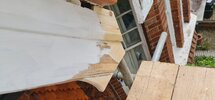
reeisatwat.jpg

Is the above not spliced? Square edge cuts glued with a dedicated "1" hour epoxy resin. No screws used.

Along the length of both barge boards there where numerous 0.2 to 0.5mm shallow cracks. I enlarged the cracks, used the super glue (as a wood hardener) and then used the semi- flexible "1" hour epoxy resin.

I could have used the 2 part wood hardener recommended by the manufacturer, but I have found that it is great on unpainted timber but stays sticky where it meets painted finishes for ages. The timber above and below was "punky" (read: fiberous). It wasn't rotted.

Here you go, there is a link for the manufacturer, tell them that you are a polymath and know everything and that they are stoopid. I am sure that they would love your feedback.

[email protected]

Frankly, I don't understand why you seem to need to be so combative. I have previously agreed with some of your posts. Often, you, on occasion, come across as the scary bag lady with a beard that shouts at pigeons.

Set up a go fund me page so that you can seek professional help- I will donate the minimal permissible amount. At a guess, you will be able to purchase a button, or half a button. I don't care. Oh, maybe you can buy some bread crumbs to entice the pigeons to increase the volume of pigeons to shout at.

I would say that I pity you, but, to be honest, I can find few redeeming factors that allow me to empathise, or sympathise with you.

I would add that I am not a pigeon. Feel free to malign me and shout at me- I really do not care. I love this site because because I value feedback from knowledgeable people. Sometimes you are one of those people. In this case you are not.

I have never claimed to be an expert in all areas on which I comment. Can you honestly say the same thing?

Interacting with you is awfully tedious. I have never blocked comments from fellow members, but, seriously, you are hard work.

 
Poster #7,
You seem to have doubts about your abilities, are you working for pay?

Punky means the barge board is in the early stages of rotting. It means soft, spongy decaying wood.
Fibrous (not "fiberous") simply means a material contains fibres it does not mean punky - meat for instance contains fibres but its doubtful that you were gluing your Sunday dinner to the barge board.

Anyhow, in the spirit of Cinco de Mayo I wish you well - if you think I ever might help you with a bit of advice then simply ask & I'll do my best to respond.
 
Jesus wept, you really can be hard work.


Frankly, I don't understand why you seem to need to be so combative. I have previously agreed with some of your posts. Often, you, on occasion, come across as the scary bag lady with a beard that shouts at pigeons.
that's his Mom
 

If you need to find a tradesperson to get your job done, please try our local search below, or if you are doing it yourself you can find suppliers local to you.

Select the supplier or trade you require, enter your location to begin your search.


Are you a trade or supplier? You can create your listing free at DIYnot Local

 
Back
Top