Switch wire. 2 of 3 are live!

None of them work reliably enough to be useful


I doubt that. It should be quite easy to fix once you take the right approach.
Idealy you'd buy or borrow a multimeter. Failing that, you could improvise a continuity tester by dismantling a torch or something else with batteries in it. If you can't do that then it gets more complicated, but it's still possible if you have patience.
None of them work reliably enough to be useful


I doubt that. It should be quite easy to fix once you take the right approach.
Idealy you'd buy or borrow a multimeter. Failing that, you could improvise a continuity tester by dismantling a torch or something else with batteries in it. If you can't do that then it gets more complicated, but it's still possible if you have patience.
 
Like everyone else, I'm waiting for you to spot the mistake in Room 1- it won't affect the function of the lamp but it is poor practice and misleading.

In Room 2 I suspect that you've got the incoming neutral (black wire) on its own connected to the lamp live and the switch return connected to the outgoing neutral (that goes to your other light fittings that are no longer working along with lamp 2). So as wired currently, the 2 black wires joined together are either at floating potential (with the switch off) or are live (with the switch on). A conductor at floating potential would very probably light your sh*tey neon screwdriver, it might even show some voltage on a budget multimeter but it'll be 176v or something like and fluctuating wildly rather than 230v or more.

In your defence, you did take photos of the 'before' wiring, which is why I think a lot of people on here are cutting you some slack. Lesson for the future- identify your cables clearly for the pic- don't rely on tape on the cores, that usually falls off when you pull the old rose off. Sharpies work well..... And please don't go swapping wires based on what I've just said without metering the cables through and positively identifying what goes where.
 
Like everyone else, I'm waiting for you to spot the mistake in Room 1- it won't affect the function of the lamp but it is poor practice and misleading.

In Room 2 I suspect that you've got the incoming neutral (black wire) on its own connected to the lamp live and the switch return connected to the outgoing neutral (that goes to your other light fittings that are no longer working along with lamp 2). So as wired currently, the 2 black wires joined together are either at floating potential (with the switch off) or are live (with the switch on). A conductor at floating potential would very probably light your sh*tey neon screwdriver, it might even show some voltage on a budget multimeter but it'll be 176v or something like and fluctuating wildly rather than 230v or more.

In your defence, you did take photos of the 'before' wiring, which is why I think a lot of people on here are cutting you some slack. Lesson for the future- identify your cables clearly for the pic- don't rely on tape on the cores, that usually falls off when you pull the old rose off. Sharpies work well..... And please don't go swapping wires based on what I've just said without metering the cables through and positively identifying what goes where.
Spot the mistake in Room 1? Please enlighten me. Thanks for coming in.
 
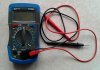
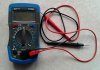
Finally got myself a multimeter. What is the setting to test continuity of wires? Please advise. Thanks.
 

Attachments

  • Multimeter.jpg
    Multimeter.jpg
    161.4 KB · Views: 249
Last edited:

Thanks endecotp. I'll do that.

Got one! Can you now please tell me how to use it? What is the setting to test continuity of wires? Thanks.
 

Attachments

  • Multimeter.jpg
    Multimeter.jpg
    161.4 KB · Views: 222
Last edited:
I suggest you go to YouTube and search for "How to use a multimeter"

I cannot confirm the accuracy of any of the content though.
 
I suggest you go to YouTube and search for "How to use a multimeter"

I cannot confirm the accuracy of any of the content though.
Thanks but all I need is advice for simply testing continuity of wires and especially to make sure that the switched live wire is in the correct connection. I am trying to simplify my task and cut down on reading and watching videos which, BTW, I have already done plenty. Thanks again for your help.
 
Last edited:
Oh dear.
After continuity you'll need to test for voltage. I need to simplify my task and not have to spend my time telling people how to do the simplest thing!!!!.

The meter comes with an instruction book. Look under continuity......RTFM!!! /rant over/

OK. I'll try to help, a little.

I asssume the thing has batteries in it and a display is shown when its switched (see "switching on" in the manual)

With the leads in the sockets per your picture, move the control knob round to the half past 5 position (the symbol that looks like a speaker between the 200 and teh hfe position)
touch the two test leads together, you should get a beep. That shows continuity. That is how you test continuity.

Simples
PS
Before you experiment on your house wiring you need to turn off the voltage and use the multimeter on the voltage range to confirm the power is disconnected.
But then you'll need to test for voltage.......

 
Thanks but all I need is advice for simply testing continuity of wires and especially to make sure that the switched live wire is in the correct connection. I am trying to simplify my task and cut down on reading and watching videos which, BTW, I have already done. Thanks again for your help.
 
Oh dear.
After continuity you'll need to test for voltage. I need to simplify my task and not have to spend my time telling people how to do the simplest thing!!!!.

The meter comes with an instruction book. Look under continuity......RTFM!!! /rant over/

OK. I'll try to help, a little.

I asssume the thing has batteries in it and a display is shown when its switched (see "switching on" in the manual)

With the leads in the sockets per your picture, move the control knob round to the half past 5 position (the symbol that looks like a speaker between the 200 and teh hfe position)
touch the two test leads together, you should get a beep. That shows continuity. That is how you test continuity.

Simples
PS
Before you experiment on your house wiring you need to turn off the voltage and use the multimeter on the voltage range to confirm the power is disconnected.
But then you'll need to test for voltage.......
 
Last edited:
Half past 5 position"...sorry...I don't follow you. And I can't see a symbol looking like a speaker either.

Imagine the control knob is a clock face with 12 at the top and 6 at the bottom. The setting you need is just before - in thr sense of how the hands of a clock turn - the 6 o'clock position. The symbol with a series of curves getting larger to the right id supposed to indicate sound.

Let us know when you've found it.
 

If you need to find a tradesperson to get your job done, please try our local search below, or if you are doing it yourself you can find suppliers local to you.

Select the supplier or trade you require, enter your location to begin your search.


Are you a trade or supplier? You can create your listing free at DIYnot Local

 
Back
Top