• Looking for a smarter way to manage your heating this winter? We’ve been testing the new Aqara Radiator Thermostat W600 to see how quiet, accurate and easy it is to use around the home. Click here read our review.

Systematic procedure for tracing repeated fuse blowing in domestic 5 amp lighting.

Reminds me of a couple of faults I attended years ago, cooker circuit blowing fuses intermittently, householders daughter reported banging under bedroom floor, found a molten mass of cables in a hole in the joist with a wood screw through them, must have been there for years and gradually wore through the insulation
Another was lighting circuit, the three core between the stairs two ways had been melted by a plumbers blowtorch and repaired with tape years before shorted out on central heating pipe
Lastly, cooker had been moved and cable extended with connector block and plastered in to wall, customer had seen blue flashes coming out of the wall.

All of these had been laying dormant for years
 
Our old terraced house had fuse cartridges and iirc was wylex, these were duly upgraded to mcb's by a spark (electrician), don’t think he tried to sell us a rewire
 
Last edited:
After three days (and with much prompting)
the OP still has not advised what wiring has been replaced (with PVC insulated wiring [?])
or
if there is still much of the older Edwardian wiring in situ (VIR - who knows)

We only know :-

As for ceiling roses, they are all plastic, replacements, I would think when the house was split into two flats in 1970s and some rewiring with a WYLEX two way fuse box.
So, there was "some rewiring", in the 1970s -
but where and how much?
(Since such wiring is likely to be OK, it should NOT be the first tested/examined.)

Is the Edwardian wiring in conduit (which wiring may be replaceable - relatively easily)
or
in some other form of "trunking"?

The OP may not be able to answer this himself
but
photos of the Boxes behind switches - and their contents - may help.

Photos have been requested from the OP
but
none have been forthcoming.!

I meant, replacing the fuse box with something less ancient. For example, having a modern RCD would improve your safety while doing this fault-finding.
With which I agree as being necessary - quite apart from fixing this problem.

With an
Edwardian terrace with central hanging wire and bayonet sockets for light bulbs with one wall mounted rocker switch per room.
it is well overdue for "improvement" !
 
I'm immensely grateful to all you guys - I'm going to take some photos of the hallway rose and switch, it being nearest to the fuse box. I should mention there is another similar switch at the other end of the hall
Also regarding the rubber-or-pvc post seventies rewire, the exit wiring from the fuse-box is def not rubber, being a flat whitish pair.
Incidentally, if I go silent now, its not that I have lost interest, I've just got hospital appointment over weekend. Back Monday.
 

Attachments

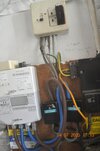
  • fuse-box-01.JPG
    fuse-box-01.JPG
    205 KB · Views: 62
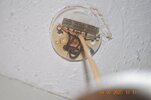
  • Hall-rose-01.JPG
    Hall-rose-01.JPG
    147.9 KB · Views: 73
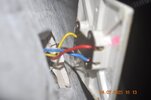
  • Hall-switch-01.JPG
    Hall-switch-01.JPG
    116.5 KB · Views: 63
Okay, those cables are either 1/044" or 1mm/1.5mm pvc, so definitely should not have deteriorated to any extent. Is that your only CU on the premises? I expected to see at least another one for power circuits etc.
 
I'm immensely grateful to all you guys - I'm going to take some photos of the hallway rose and switch, it being nearest to the fuse box. I should mention there is another similar switch at the other end of the hall
Also regarding the rubber-or-pvc post seventies rewire, the exit wiring from the fuse-box is def not rubber, being a flat whitish pair.
Incidentally, if I go silent now, its not that I have lost interest, I've just got hospital appointment over weekend. Back Monday.
Hard to tell exactly, but does the hall rose have thermal damage?
 
I'm going to take some photos of the hallway rose and switch, it being nearest to the fuse box. I should mention there is another similar switch at the other end of the hall

For your information, that is what is known as a '3-plate' ceiling rose (3 terminals + earth). In the photo, left to right, you have the switch wire; live; neutral.

You have the If the rest of the system follows that example, then the L & N will be looped generally from ceiling rose to ceiling rose, but that rose, would appear to be either the last one on the loop, or a sort of spur off the main loop.

Going to the other roses, assuming the same style - you would need to be disconnecting all of the live wires, from the middle terminals in each, and insulating them temporarily, apart from any other removed wires in that middle terminal. Do get back to us, with what you find in the other roses, and photos of each please.

At this point, for speed and simplicity, I would suggest that you purchase what is called, a 'volt stick', and practise using it. It will light up, when ever it's 'nose', is placed close to a live wire, and might save you a lot of diagnostic time, and effort.
 
To see which switces /roomz have power ?

Not exactly!

With all the lives disconnected, at every rose, and insulated, he could put the fuse back in. Assuming it doesn't blow - in which case he will have found his problem....

He could then tape his volt stick on the end of a brush-handle/piece of pipe/stick, go round the ceiling roses, without climbing any tale steps, to find where is first ceiling rose is.

He could then number that rose on his drawing #1, move his steps there, isolate power, and reconnect the lives, then power back up.

Repeat, the process with the volt stick, numbering the drawing, steps, and reconnecting, until the fuse blows.

When the fuse does blow, he might have some lights back on, and working. and have a much better idea of where his fault lies.
 
Last edited:
Not exactly!

With all the lives disconnected, at every rose, and insulated, he could put the fuse back in. Assuming it doesn't blow - in which case he will have found his problem....

He could then tape his volt stick on the end of a brush-handle/piece of pipe/stick, go round the ceiling roses, without climbing any tale steps, to find where is first ceiling rose is.

He could then number that rose on his drawing #1, move his steps there, isolate power, and reconnect the lives, then power back up.

Repeat, the process with the volt stick, numbering the drawing, steps, and reconnecting, until the fuse blows.

When the fuse does blow, he might have some lights back on, and working. and have a much better idea of where his fault lies.
As I keep saying; non contact and led/neon screwdrivers are useful. Like any tool you need to learn how to use them to get the best out of them.
 
Yeah I can see a volt stick being some use. (do they work taped to a wooden pole?), or at the switches.

But first we need more pictures of the roses, to see if they really are looped (as my test method requires), or if there is some hidden junction box.

or With the age (70's) of the wiring, I wouldn't hesitate to call an electrician. With his test equipment he should be able to find the fault much quicker, and shouldn't be condemning the wiring. You can let him give you a quote for a new CU, once he has got your lights back on!

Also, how many rooms are there with lights?
 

If you need to find a tradesperson to get your job done, please try our local search below, or if you are doing it yourself you can find suppliers local to you.

Select the supplier or trade you require, enter your location to begin your search.


Are you a trade or supplier? You can create your listing free at DIYnot Local

 
Back
Top