Thermostat behaving abnormally

Joined
11 Mar 2008
Messages
163
Reaction score
4
Location
Wiltshire
Country
United Kingdom
Hi

When I go to bed I manually set my thermostat to 17.5 so the temperature never falls below and when we wake up it is not too cold.

However, recently in the morning the temperature is actually BELOW what i set.

There is not an 'auto' programme set on there either.

Example:
When waking up the temp is 16.
View attachment 95985
But, I had set it to 17.5, as can be seen when i press the 'i' button.
View attachment 95986

Thanks
 
If the heating is left 'on' permanently, then it should be at the set value when you get up.

If you use a separate timer / programmer and the heating only comes on a short time before you get up then you might not be giving it enough time to reach 17.5

You don't say what make / model of thermostat you have, but some thermostats have a inbuilt algorithm that as the set temperature is approached, switch the heating 'off' and back 'on' for brief periods. This is intended to prevent the set temperature being overshot and save energy. It should reach the setpoint eventually though, so wouldn't apply in the first instance I mention if the heating was permanently on.
 
If the heating is left 'on' permanently, then it should be at the set value when you get up.

If you use a separate timer / programmer and the heating only comes on a short time before you get up then you might not be giving it enough time to reach 17.5

You don't say what make / model of thermostat you have, but some thermostats have a inbuilt algorithm that as the set temperature is approached, switch the heating 'off' and back 'on' for brief periods. This is intended to prevent the set temperature being overshot and save energy. It should reach the setpoint eventually though, so wouldn't apply in the first instance I mention if the heating was permanently on.
Thanks

It is Honeywell CM707:

"If the heating is left 'on' permanently, then it should be at the set value when you get up." - Yep, and this is the issue.... it isn't...

Not sure of any in-built mechanism, but it's not helping me if there is!
 
Don't see anything in those MIs about hysteresis/differential temperatures or if it has TPI control, a very poor manual IMO, must be a better one around.

Found one, for installation.

It seems to state that the minimum switch on hysteresis (proportional band width) is 1.6C, (adjustable 1.6C to 3.0C) which means that the switch on temperature is 15.9C at a SP temp of 17.5C, this may be your "problem", if true then that is a pretty big hysteresis, even mechanical stats can achieve this, my own basic digital (FantiniCosmi) stat differential is settable between 0.3C & 2.0C, I have it set to 0.3C which gives excellent room temperature control with little or no overshoot once up to temperature.
 

Attachments

Last edited:
Anyway suggest first thing to do is go to parameter 13.pb and check the setting, its slightly confusing, its says the default setting is 1.5C yet says the settable range is 1.6C to 3.0C, set it as low as possible, if, by some miracle it can be set right down, suggest setting it to 0.5C.

Depending on what you find here, can look at the Heating Program (user guide), it has 4 daily settable periods and set point temperatures, if used in conjunction with Optimisation ON and controller in Auto, should be able, at least, to have your house temperature at 17.5C at whatever time you awaken and then just live with this apparently wide minimum setting of a ridiculous 1.5C/1.6C.
You may find that in Auto mode that the control is much tighter if it then uses TPI control or similar but I wouldn't hold my breath.
 
Last edited:
Don't see anything in those MIs about hysteresis/differential temperatures or if it has TPI control, a very poor manual IMO, must be a better one around.

Found one, for installation.

It seems to state that the minimum switch on hysteresis (proportional band width) is 1.6C, (adjustable 1.6C to 3.0C) which means that the switch on temperature is 15.9C at a SP temp of 17.5C, this may be your "problem", if true then that is a pretty big hysteresis, even mechanical stats can achieve this, my own basic digital (FantiniCosmi) stat differential is settable between 0.3C & 2.0C, I have it set to 0.3C which gives excellent room temperature control with little or no overshoot once up to temperature.
Thank you
 
I have thermostats and thermometers dotted around the house, and even in the same room I can get a whole range of temperatures. Even when central heating has not been running. This living room now 22ºC wall thermostat, 21ºC one radiator, 20.5ºC other one. Hall 17ºC radiator and 20.5ºC wall thermostat. Dinning room15ºC and wife's bedroom 18ºC central heating not running.

When it does run, the difference is even greater.

What @stem says I found with mother's house, 84067_P.jpgthis old thermostat was the bees knees in its day, with a modulating gas boiler pointless, but that did not stop the heating firm fitting them, and not cheap either.
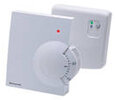
I note the Installation Guide refers to cycles per hour, Optimum start and stop, Proportional Band Width, and Temperature Offset. All these could explain what is going on.
I don't fully understand some of the options
1743889452081.png
and wonder if like mother's thermostat were designed for older boilers. Or oil boilers, many oil boilers don't modulate.

The gas boiler today is designed to extract the latent heat in the flue gases, to do this the return water into the boiler has to be cool enough, so the boiler needs to modulate (turn down) rather than turn on/off. To do this, it needs either a thermostat which turns the boiler up/down not on/off, or use TRVs (thermostatic radiator valves) and by-pass valve.

A typical boiler has an output of around 6 to 36 kW, once below 6 kW, then it cycles on/off. So with the modern boiler, main control is with the TRV, but unless a linked TRV, it has an inherent problem, it can't turn the boiler fully off. So we need a wall thermostat, downstairs as heat raises, in the coldest room, with no outside door, or alternative heating, that will turn off the boiler in warm weather.

In theory, no TRV is fitted in a room with wall thermostat, in practice the ideal room often does not exist, so we need a balance between wall thermostat and TRV setting, and if the wall thermostat is programmable, clearly the TRV also needs to be programmable.

At first glance one asks why have a wall thermostat, linking the TRV to the hub seems a better idea, however I have found one can then find the boiler running just to heat one room, so we often go for a compromise, key rooms have linked TRV heads, but most rooms just programmable but not linked.

I have learnt by my errors, I am an electrical engineer not a heating and ventilation engineer, my house has an oil boiler 20 kW, 15 radiators, two motorised valves, two pumps, 10 electronic TRVs one being linked, and 4 mechanical TRVs, and three wall thermostats, and I would not say it is the perfect system by any stretch of the imagination. It is far better as to when I moved in, but it is a compromise. Mother old house with a gas modulating boiler worked far better than this on/off boiler.

Also, economical is not the same as comfortable, sometimes you have to choose one or the other. And at £40 a pop for a linked TRV head, plus the hub, plus any smart socket adaptors needed to boost the signal, one can end up with a bill the same as a year's supply of oil, so even if my house would run perfect with 14 linked TRV heads, and I am not sure whether it would, it would not be worth the cost, and I seem to remember reading there is a limit of how many thermostats (A TRV is a thermostat) can be linked to one hub.

So you have to decide how far to go.

 
Most of these controllers are much of a much with TPI (Time Proportional & Integral) control for very tight control of the room temp(s) which means constant boiler cycling, this is why there is a cycle rate, 6 cph is recommended for gas fired and 3 cph for oil fired boilers, also minimum firing times, etc., the Honeywell DT90E Stat and the Honeywell Evohome system all use these methods.
@collinsc showed a room temp of 16C with a SP of 17.5C but with a boiler demand symbol, even though the controller was/is on manual then would think that the TPI algorithm (if installed in this controller) is still active as the manual should only override the programmed time settings?.
 
Last edited:
Most of these controllers are much of a much with TPI (Time Proportional & Integral) control for very tight control of the room temp(s) which means constant boiler cycling, this is why there is a cycle rate, 6 cph is recommended for gas fired and 3 cph for oil fired boilers, also minimum firing times, etc., the Honeywell DT90E Stat and the Honeywell Evohome system all use these methods.
@collinsc showed a room temp of 16C with a SP of 17.5C but with a boiler demand symbol, even though the controller was/is on manual then would think that the TPI algorithm (if installed in this controller) is still active as the manual should only override the programmed settings?.
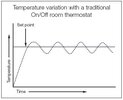
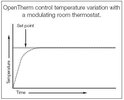
Very concisely put, in Uni it was called a mark/space ratio. And it produces a graph like this Temp_variation_on_off.jpg however with the modulating boiler the TRV does all the work, and is analogue, not digital, seems odd that in this case analogue (up/down) is better than digital (on/off) so we get Temp_variation_OpenTherm.jpg graph.

The problem is some analogue wall thermostats don't integrate with the TRVs. With the likes of OpenTherm we can select a thermostatic control to suit the home, my old open-plan house would work fine with Nest, the house however has things called doors on the rooms, so need linked TRV heads to control multi rooms.

I have wintered in four houses through my life, and each one was different, and also each one I have done something to make them retain heat better, so non are as built. The big change with last house was the swap to so-called energy saving bulbs. As built, in the evening we would turn on the lights, and the inferred would mean even though less active we still felt warm, but once the energy saving bulbs were fitted, in the evening we wanted to turn up the air temperature in the room. So we swapped from a time clock and thermostat to a programmable thermostat.

This changed what was important, no longer was the heating maintaining an air temperature, it brought in a new phrase, recovery time, and items which had worked well for years, now left something to be desired, the old Myson fan assisted radiator was very good, but there was no way to fit a programmable thermostat to it. The standard radiators now needed the old mechanical TRV heads swapping for electronic programmable heads, mainly because of energy saving bulbs. Did they really save energy, did we not want that inferred heat in the home?
 
did we not want that inferred heat in the home

Yes we did, and for the forseeable future I will have that comfort.
Did they really save energy

The energy to provide light was reduced but the energy to provide a comfortable living did a few cases increase by an amount greater than the energy saved in the lighting ciruits
 

If you need to find a tradesperson to get your job done, please try our local search below, or if you are doing it yourself you can find suppliers local to you.

Select the supplier or trade you require, enter your location to begin your search.


Are you a trade or supplier? You can create your listing free at DIYnot Local

 
Back
Top