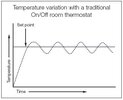
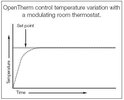
I have thermostats and thermometers dotted around the house, and even in the same room I can get a whole range of temperatures. Even when central heating has not been running. This living room now 22ºC wall thermostat, 21ºC one radiator, 20.5ºC other one. Hall 17ºC radiator and 20.5ºC wall thermostat. Dinning room15ºC and wife's bedroom 18ºC central heating not running.
When it does run, the difference is even greater.
What
@stem says I found with mother's house,
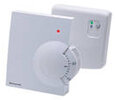
this old thermostat was the bees knees in its day, with a modulating gas boiler pointless, but that did not stop the heating firm fitting them, and not cheap either.
I note the
Installation Guide refers to cycles per hour, Optimum start and stop, Proportional Band Width, and Temperature Offset. All these could explain what is going on.
I don't fully understand some of the options
and wonder if like mother's thermostat were designed for older boilers. Or oil boilers, many oil boilers don't modulate.
The gas boiler today is designed to extract the latent heat in the flue gases, to do this the return water into the boiler has to be cool enough, so the boiler needs to modulate (turn down) rather than turn on/off. To do this, it needs either a thermostat which turns the boiler up/down not on/off, or use TRVs (thermostatic radiator valves) and by-pass valve.
A typical boiler has an output of around 6 to 36 kW, once below 6 kW, then it cycles on/off. So with the modern boiler, main control is with the TRV, but unless a linked TRV, it has an inherent problem, it can't turn the boiler fully off. So we need a wall thermostat, downstairs as heat raises, in the coldest room, with no outside door, or alternative heating, that will turn off the boiler in warm weather.
In theory, no TRV is fitted in a room with wall thermostat, in practice the ideal room often does not exist, so we need a balance between wall thermostat and TRV setting, and if the wall thermostat is programmable, clearly the TRV also needs to be programmable.
At first glance one asks why have a wall thermostat, linking the TRV to the hub seems a better idea, however I have found one can then find the boiler running just to heat one room, so we often go for a compromise, key rooms have linked TRV heads, but most rooms just programmable but not linked.
I have learnt by my errors, I am an electrical engineer not a heating and ventilation engineer, my house has an oil boiler 20 kW, 15 radiators, two motorised valves, two pumps, 10 electronic TRVs one being linked, and 4 mechanical TRVs, and three wall thermostats, and I would not say it is the perfect system by any stretch of the imagination. It is far better as to when I moved in, but it is a compromise. Mother old house with a gas modulating boiler worked far better than this on/off boiler.
Also, economical is not the same as comfortable, sometimes you have to choose one or the other. And at £40 a pop for a linked TRV head, plus the hub, plus any smart socket adaptors needed to boost the signal, one can end up with a bill the same as a year's supply of oil, so even if my house would run perfect with 14 linked TRV heads, and I am not sure whether it would, it would not be worth the cost, and I seem to remember reading there is a limit of how many thermostats (A TRV is a thermostat) can be linked to one hub.
So you have to decide how far to go.