• Looking for a smarter way to manage your heating this winter? We’ve been testing the new Aqara Radiator Thermostat W600 to see how quiet, accurate and easy it is to use around the home. Click here read our review.

Twin socket extension boat

Joined
22 Jul 2007
Messages
633
Reaction score
4
Location
Cheshire
Country
United Kingdom
For some reason the manufacturer decided to place the power sockets inside of existing cupboards. This is inconvenient and we want to relocate position to outside of cupboards. To this end I have just purchased a couple of C-Line sockets and a double face frame.

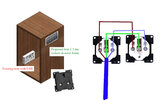
The attached image shows the original twin switched plus USB socket and the proposed new install to outside cabinet. At this time I am unsure if we should keep the interior twin with USB charging (just for charging purposes only) and just take a plug and lead from one outlet to the new site or remove completely and replace with a junction box and cable from there to the new site.

In either case is the proposed wiring shown on the right hand side acceptable/good practice?

Thanks in advance for your opinion/suggestions

EDIT 07/11/2025: I just altered this as the first sentence incorrectly stated 'shore power sockets' when it should have read as power sockets (twin 13amp switched). My apologies for the misleading wording, I was thinking about another issue at the same time relating to an isolated and one of Schuko socket.
 

Attachments
  • Twin sockets.jpg
    Twin sockets.jpg
    164.4 KB · Views: 55
Last edited:
I can'see any reason not to keep the exsisting one, but I would fit trunking running around the inside of the cabinet rather than just clipping it.
 
DO ensure you use flexible cable(s) and NOT twin + earth for this boat/caravan mains wiring.

You will, of course, also need a suitable double back box to contain the exposed terminals on the rear of the C-lines. Or two single back boxes when there'd be a need for some outer sheath on any exposed bit between the two.

+1 for leaving existing in situ.
 
There is no point in two sockets like that, each supply needs its own RCD protection. And if two sockets, what else has been missed, a TN-C-S supply is not permitted. And one has to be careful with galvanic protection. It can get rid of your anode in days if not correct.

Hull material is important, aluminium is a big problem. Steel not quite so bad, but likely needs some earth diodes to stop erosion.

This is rather a specialist subject, may be better on a narrow boat forum.
 
DO ensure you use flexible cable(s) and NOT twin + earth for this boat/caravan mains wiring.

You will, of course, also need a suitable double back box to contain the exposed terminals on the rear of the C-lines. Or two single back boxes when there'd be a need for some outer sheath on any exposed bit between the two.

+1 for leaving existing in situ.
Thanks definitely planned on flexible cable in trunking. Back boxes are supplied these are round seperate for each socket. Will look to see if there is a suitable double back box or may even resort to design and print one!
 
You're looking at section 709 of BS7671, I only have the 2008 edition, 709.553.1.8 Socket-outlets shall comply with BS EN 60309-1 above 63 A and BS EN 60309-2 up to 63 A.

I don't think a 13 amp socket complies with BS EN 60309-2, you're looking at these
1762363265294.png
I think.
 
There is no point in two sockets like that, each supply needs its own RCD protection. And if two sockets, what else has been missed, a TN-C-S supply is not permitted. And one has to be careful with galvanic protection. It can get rid of your anode in days if not correct.

Hull material is important, aluminium is a big problem. Steel not quite so bad, but likely needs some earth diodes to stop erosion.

This is rather a specialist subject, may be better on a narrow boat forum.
AFAIK the RCD protection is present on the shorepower connection unit which should trip for any socket on the 240v side. There is of course the 12 volt circuit which kicks in for the dual voltage fridge when shorepower disconnected.
A galvanic isolator I believe is standard and of course anodes fitted to stern gear. Hull material is actually grp as this is a sports boat of Norwegian origin. I believe the original sockets would have been Schuko (I think that is the correct name!) which have been changed at some time to our UK standards
 
You're looking at section 709 of BS7671, I only have the 2008 edition, 709.553.1.8 Socket-outlets shall comply with BS EN 60309-1 above 63 A and BS EN 60309-2 up to 63 A.

I don't think a 13 amp socket complies with BS EN 60309-2, you're looking at these View attachment 398331 I think.
Not that type as that is what I would class as a shore power lead, i.e. from the marina outlet to the boat to supply 240 volt. My shore power lead like this
Screenshot 2025-11-05 172643.png
 
Schuko not permitted in UK as reversible line and neutral.
I really appreciate the information posted.

My post about Schuko probably a little misleading, sorry. The original sockets in the boat would, I believe have been Schuko. At some time a previous owner upgraded them to UK standards including twin switched USB sockets.

I do however have another area where there are the original twin Schuko sockets. I intended to use the free socket to plug in an extension to the engine room which will be fitted with a Powertxt switch to operate twin tube heaters for the up and coming cold months
To that end I purchased this:
https://cpc.farnell.com/pro-elec/ec...6730&s_kwcid=AL!5616!3!491034915811!!!network
The assumption being that as these are sold in the UK from reputable(?) suppliers that they would be legal!

I can see that there could be issues due to potential wrongful reversal of live and neutral. I believe that this (attached) is the correct wiring for both socket and plug.

So now my dilema. Should I continue with the neater solution of the purchased Schuko into the original twin socket Schuko install ? Or take the less favourable route (to me at least) and see if I can fit an adapter to take a standard UK plug, which makes for an unwieldy install ?
 

Attachments

  • Schuko.jpg
    Schuko.jpg
    100.1 KB · Views: 15
The point is that the Schuko plugs can be inserted upside down thus reversing the polarity.

This doesn't matter where a suitably rated circuit over-current protective device is in the Line conductor.

The trouble is with the U.K. Ring Circuit which require a fuse in the plug [edit] to be in the line conductor because the appliance flex is too small for the circuit OPD.
 
Last edited:
So if I am understanding correctly it looks like it may be a better/safer way to go with something like this to convert the Schuko F sockets to a UK standard fused plug? :
 

If you need to find a tradesperson to get your job done, please try our local search below, or if you are doing it yourself you can find suppliers local to you.

Select the supplier or trade you require, enter your location to begin your search.


Are you a trade or supplier? You can create your listing free at DIYnot Local

 
Back
Top